


A form of Parkinson’s disease once considered rare is far more common in Pacific communities than previously recognised. Researchers estimate more than 400 Pasifika people in New Zealand could be living with a genetic form of the condition linked to a variant in the PINK1 gene.
The PINK1 clue in Parkinson’s disease
Follow Our Changing World on Apple, Spotify, iHeartRadio or wherever you listen to your podcasts
The condition, known as PINK1 Parkinson’s disease, is being researched in Aotearoa and the Pacific after studies revealed unusually high rates of the variant, particularly in Samoan and Tongan populations.
Unlike most forms of Parkinson’s disease, where the underlying cause remains unclear, researchers know exactly what drives PINK1 Parkinson’s disease, creating new opportunities for more targeted treatments.
A pattern emerges
The discovery began more than 15 years ago in Auckland neurology clinics, where doctors started seeing an unusual number of young Pasifika patients with Parkinson’s disease.
Neurologist Dr Richard Roxburgh told RNZ’s Our Changing World he recalls noticing a growing number of young Pasifika patients with Parkinson’s disease, some diagnosed in their 30s and 40s and one at just 11 years old.
“What was striking was that there were a number of people who are quite young and they were from Pacific families.”
PINK1 Parkinson’s team in Tonga, March 2026. Left to right: Tame Vailahi, Dr Richard Roxburgh, Dr Christina Buchanan, and Reverend Moimoi Kaufononga.
Supplied
Genetic testing provided the first clue. Two unrelated patients – one Samoan and one Tongan – were found to carry two copies of the same rare PINK1 variant, known as PINK1 L347P.
Researchers followed up with a pilot study involving eight Pasifika people with Parkinson’s disease. All five participants diagnosed before age 50 carried two copies of the variant, while none of the older participants did, providing strong evidence that the genetic change was responsible for their disease.
Building awareness and breaking down stigma
As researchers uncovered the genetic basis of the disease, they encountered another challenge: many Pasifika families were not seeking diagnosis, treatment or support.
Community advocate Aloese Lefono and Parkinson’s New Zealand established a dedicated Pacific Parkinson’s Support Group in South Auckland after noticing few Pacific people were attending mainstream meetings.
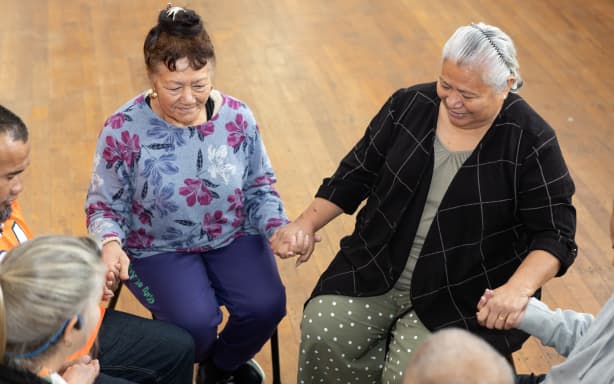
Parkinson’s Pacific Support Group
Narelle Pierce, Shore Photography
“Some of the Pacific Island people thought it was a curse,” says Lefono.
She said that Pasifika can be shy when it comes to sharing about their illness, but it helps if the sessions are a place where Pasifika feel comfortable.
“They love coming together, speaking their own language, sharing their own experiences with the disease,” Lefono says.
Researchers now attend the meetings regularly and say the relationships built with families have helped shape the direction of the work.
Why scientists are excited
Unlike most Parkinson’s disease, where the precise cause often remains unknown, scientists know exactly which molecular pathway is disrupted in PINK1 Parkinson’s disease.
“Because we know the cause, this opens the possibility of treatments,” Roxburgh says.
Researchers are now using donated skin samples from patients to create stem cells and laboratory-grown brain cells carrying the variant. These models allow scientists to study the disease and test potential therapies. The work is also generating growing interest in finding treatments that target the underlying causes of the disease rather than simply managing symptoms.

Parkinson’s Pacific Support Group
Narelle Pierce, Shore Photography
While any targeted treatment would still need to go through clinical testing, Buchanan believes it is not far away.
“What everyone always quotes is five to 10 years. I truly believe that it is probably within the five years.”
A genetic clue uncovered in Pacific families could one day help shape treatments for Parkinson’s patients around the world.
“If we can work out ways of treating this,” Roxburgh says, “it is possible that we’ll be able to treat common Parkinson’s disease using similar lines of treatment.”
Far from rare
PINK1-linked Parkinson’s disease has traditionally been described as a rare inherited condition, but a recent international meta-analysis has further challenged the idea that PINK1 Parkinson’s disease is rare. Researchers estimated that about one in 1300 people of West Polynesian ancestry are affected, a frequency higher than the threshold usually used to define a rare genetic disease.
Research genetic counsellor Christina Buchanan says the result was unexpected.
“In Samoa, we tested over 1200 people. One in 16 carried a single gene change in PINK1.”
Because the condition is inherited in a recessive pattern, people typically need to inherit two copies of the variant, one from each parent, to develop the disease.
“So 1 in 16 is a huge carrier number,” Buchanan says. “If you’ve got two people that are carriers, each baby they have has a one in four chance of PINK1 Parkinson’s.”
Together, the findings suggest PINK1 Parkinson’s disease may be affecting more Pacific families than previously recognised.
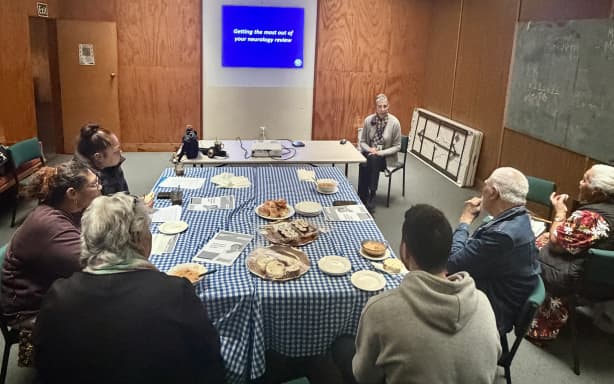
Parkinson’s Pacific Support Group
RNZ / Ayana Piper-Healion
Sign up to the Our Changing World monthly newsletter for episode backstories, science analysis and more.
