


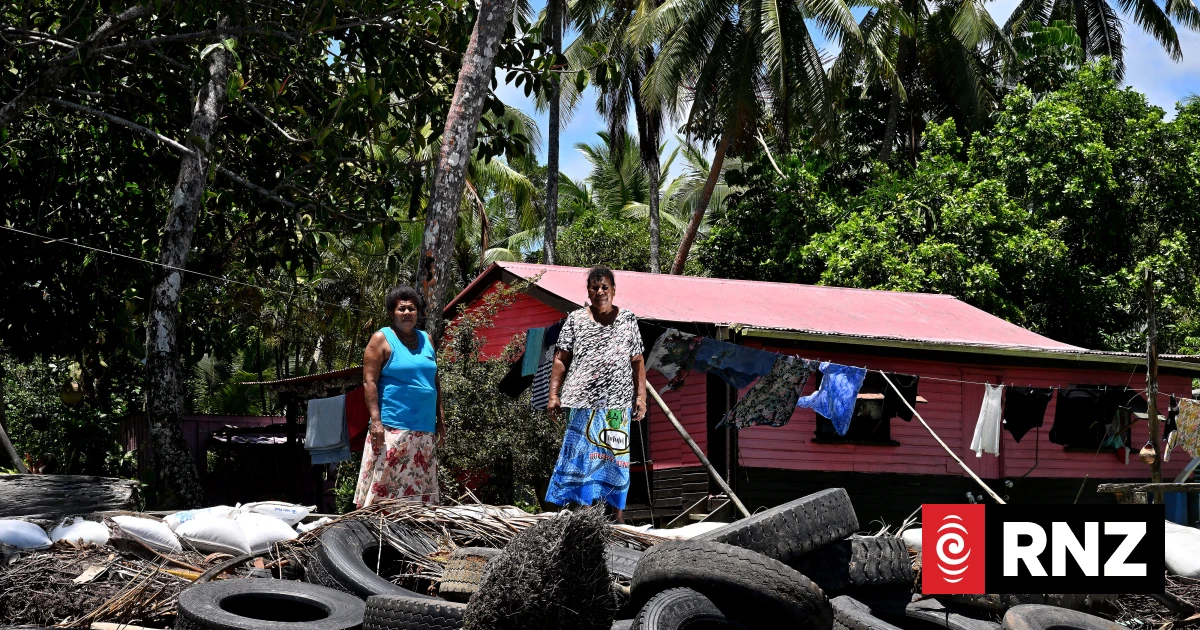
A New Zealand government-backed regional climate mobility programme has been launched to help ensure Pacific people remain at the centre of decisions about their homes and futures in the face of climate change.
The NZ$17.9 million Pacific Climate Mobility Partnerships Programme (PCMP) has been established to help Pacific Islands strengthen regional cooperation and implement practical, people-centred responses to climate mobility challenges.
Climate mobility can be described as the movement of people, whether through migration, displacement or planned relocation, in response to the impacts of climate change.
Fiji’s permanent secretary for environment and climate change Dr Sivendra Michael said the initiative, which would support a dozen islands, was an important step as Pacific peoples confront the impacts of the climate crisis.
He said the region was on the frontlines of increasing climate-related hazards, sea-level rise, environmental degradation, and displacement. These impacts were placing a growing pressure on livelihoods, wellbeing and human security across island communities.
The launch of the regional initiative in Suva brought together stakeholders from the International Organisation for Migration (IOM), the Pacific Islands Forum Secretariat (PIFS), the United Nations Human Rights Office (OHCHR), the Platform on Disaster Displacement (PDD), the Pacific Community (SPC), and the Secretariat of the Pacific Regional Environment Programme (SPREP).
IOM chief of mission and sub-regional coordinator Solomon Kantha stressed that no single government, organisation or community could address climate mobility alone.
“Our strength lies in the breadth of this partnership and in our shared commitment to Pacific-led, rights-based and people-centred action,” he said.
He said the programme was designed to advance Pacific-led solutions that were culturally appropriate, gender-responsive, and disability-inclusive, and ensure communities most affected by climate change are at the centre of decision-making and action.
The programme marks the third phase of regional support for climate mobility in the Pacific and builds on the achievements of the Pacific Climate Change Migration and Human Security Programme.
It will support climate mobility priorities in Fiji, Niue, Palau, Papua New Guinea, the Marshall Islands, Solomon Islands, Tonga, Tuvalu, and Vanuatu, while contributing to broader regional efforts under the Pacific Regional Framework on Climate Mobility (PRFCM) 2025-2030 and its accompanying implementation plan.
The Pacific Islands Forum leaders endorsed the Pacific Regional Framework on Climate Mobility (PRFCM) in 2023 to serve as a guide for governments and communities, ensuring that any movement related to climate change is grounded in leadership and collaboration, human rights, protecting cultural identity and dignity and continuing statehood, nationality and associated rights.
The PRFCM outlines ‘Planned Relocation’ as one of the five core areas for priority action, including staying in place, safe migration, displacement from extreme weather, and the long-term impacts of sea-level rise.
The climate change crisis, disasters, and other natural calamities present a profound challenge to communities across the Pacific Islands.
As sea levels rise and extreme weather events intensify, many communities are reaching the limits of adaptation and are confronted not only with the prospect of leaving their ancestral lands, but also with the deep disruption, loss, and trauma that accompany such movement.
That includes low-lying islands in Tuvalu and Kiribati, two of the worst affected so far. Other islands in Vanuatu, the Solomon Islands and Tonga are also experiencing slow washouts as sea level rise continues.
