

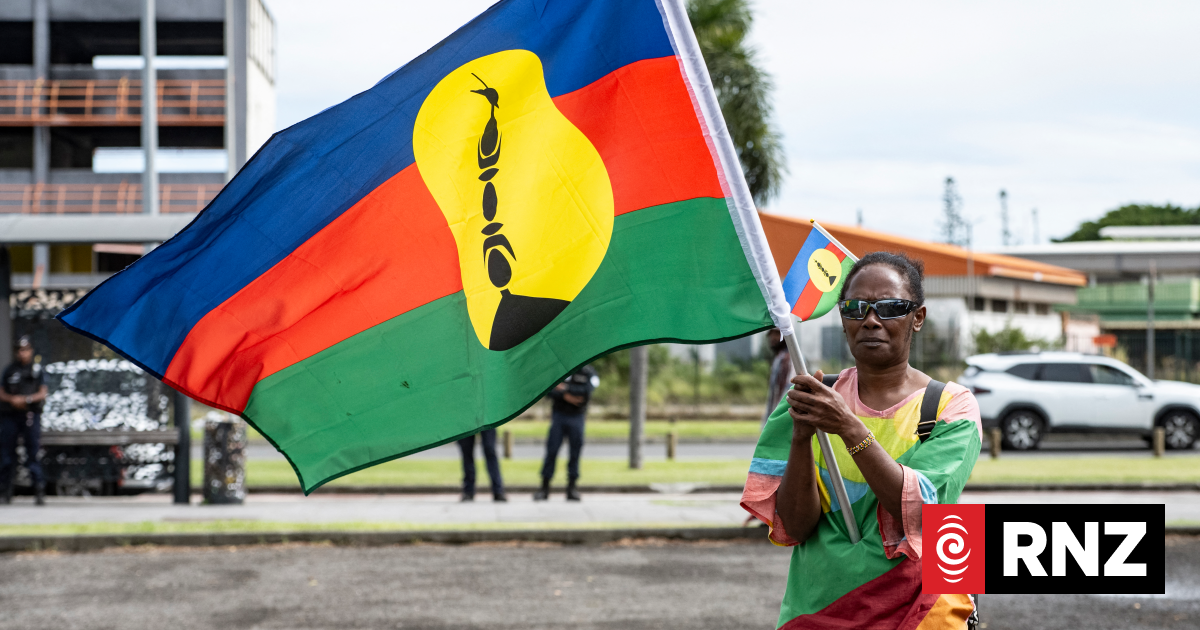
A pro-independence activist waves a flag during a demonstration to mark the second anniversary of the spring 2024 riots in Noumea. 13 May 2026
Photo: AFP / Delphine Mayeur
New Caledonia’s political parties are now in marching order to contest the upcoming local provincial elections scheduled to be held in just over a fortnight.
The French High Commission has published an initial list of 24 political groupings are running for a seat in New Caledonia’s three provincial assemblies (North, South and the outer Loyalty Islands).
The list is subject to final verification before the upcoming polls on 28 June.
In New Caledonia’s Southern province, there are 40 seats to be filled.
After the provincial level poll, 32 will be entitled to sit at New Caledonia’s Congress.

The trickle-down effect of New Caledonia’s provincial elections.
Photo: Congrès de la Nouvelle-Calédonie
The Southern province’s candidates, which is traditionally a pro-France stronghold, will include a “Strong and United” list headed by incumbent Provincial president and pro-France leader, Sonia Backès.
The list includes leaders from several of the main components of the pro-France camp: Backès’s Les Loyalistes, Virginie Ruffenach’s Le Rassemblement-LR and New Caledonia’s MP in the French National Assembly, Nicolas Metzdorf’s Génération NC.
It also includes current local government minister for economy Christopher Gygès, as well as pro-France mayors of Greater Nouméa cities of Dumbéa and Mont-Dore (Cynthia Jan and Nina Julié).
On the pro-independence side, one of its main components, the FLNKS (Kanak and Socialist National Liberation Front) is presenting a “Kanaky for Everyone” (Kanaky Pour Tous or KPT) list headed by a young politician, Johanito Wamytan.
The list also includes Union Calédonienne secretary general Dominique Fochi.
Other pro-independence parties are the Labour Party, the Rassemblement Démocratique Océanien or the Mouvement des Océaniens Indépendantistes.
In the pro-independence movement, but separate from the FLNKS, another list “Unis pour le Pays” (United for the Country) is headed by Louis Mapou, a former New Caledonian government president.
The list is presented by the “UNI” (Union Nationale pour l’ Indépendance) political group, which mainly consists of pro-independence PALIKA and UPM (Union Progressiste en Mélanésie).
Both PALIKA and UPM broke away from the FLNKS group in August 2024, citing diverging views regarding New Caledonia’s independence process.
But in the Southern Province, as well as in the two others, this year’s provincial elections are marked by a perceived strong emergence from parties which identify themselves neither in the main pro-France nor pro-independence blocks.
Some of those non-radical groups prefer to describe themselves as belonging to a “non-partisan” or civil society” movement.
Wallisian-based Éveil Océanien, which first emerged at the previous provincial elections in 2019, is presenting a list conducted by its leader Milakulo Tukumuli.
He is leading a list dubbed “Un autre monde est possible!” (Another world is possible).
His second co-list is the New Caledonia’s Congress president Veylma Falaeo.
Several parties and lists are running for the first time: one of those is called “Une province pour tous, un pays solidaire, un avenir partagé” (A province for everyone, a country in solidarity, a shared future).
It is headed by former journalist and media personality Walles Kotra, with the support of incumbent Senator for New Caledonia, Georges Naturel and incumbent environment minister Jérémie Katidjo-Monnier.
A former leading figure of Calédonie Ensemble party, pro-France Philippe Dunoyer is now heading another list called “Nous, Réunis !” (Us, united).
Some of the common themes to most of these “middle” parties are the notions of pragmatism, away from the polarising arguments, a priority for the restoration of the ailing local post-riots economy and the provide pragmatic assistance to a population still reeling from the social and economic devastation caused by the violent riots that shook New Caledonia in May 2024.
In the Northern Province, its incumbent president and veteran pro-independence politician Paul Néaoutyine has decided to run for another term at the helm of the local assembly, which he has been holding since 1999.
He is the front man of the “UNI” list.
In the same contest, he is running against the FLNKS-Union Calédonienne group headed by Houaïlou city Mayor Pascal Sawa also including FLNKS figures such as Pierre Chanel Tutugoro and territorial government minister Gilbert Tyuienon.
A pro-France list is also headed by Vanessa Wacapo.
Other “middle” lists are based around the theme of “country-building” and controlling public spending while reducing red tape.
New Caledonia’s Congress consists of 54 members:
- Northern Province (22 assembly seats; 15 Congress seats)
- Southern Province (40 assembly seats; 32 Congress seats)
- Loyalty Islands Province (14 assembly seats; 7 Congress seats)
The provincial elections are held at a single round, under a general rule of proportional representation.
The makeup of the proportionally representative Congress will be known after the 28 June provincial elections.
From the new Congress, a “collegial” government for New Caledonia and its president will then emerge.
