


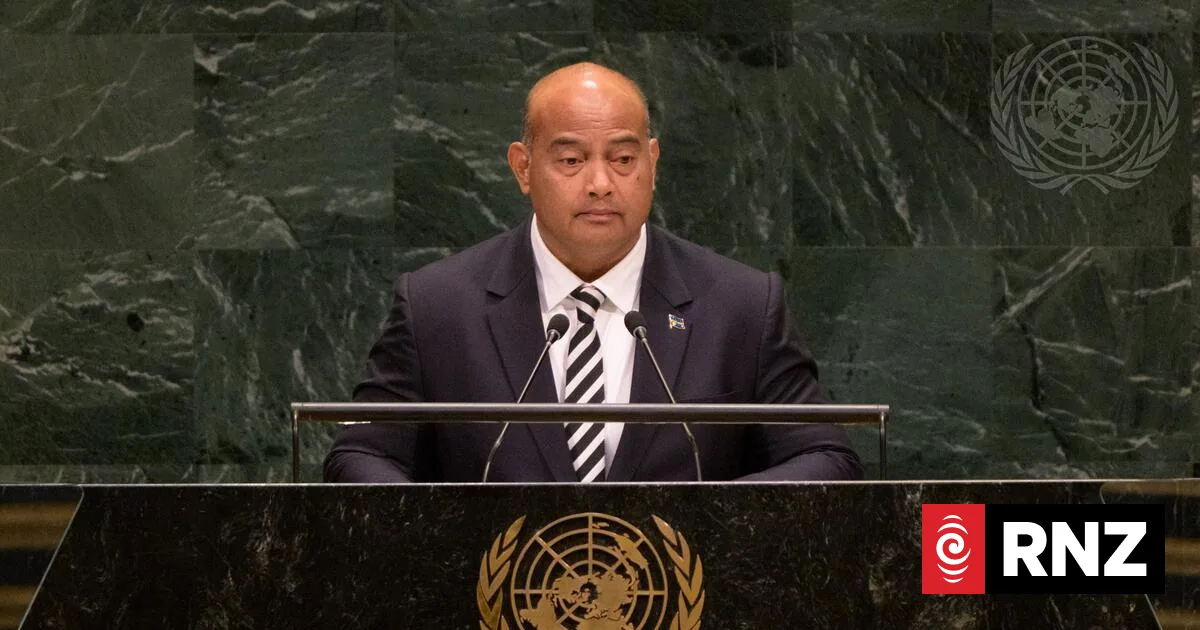
David Adeang, president of Naoero (formerly Nauru), used a United Nations gathering of world leaders to announce his country’s voluntary withdrawal from the International Criminal Court (ICC) and criticise the International Seabed Authority (ISA) for delays on agreeing on rules for deep sea mining.
Adeang was the first Pacific Islands Forum leader to address the 81st session of the UN General Assembly New York.
His message focused on formally introducing Naoero’s name restoration, sovereignty and a demand for smaller island nations to be treated as equals.
He described the International Criminal Court as one of the multilateral institutions that was “of increasing irrelevance” to Naoero.
“Before I depart New York, Naoero will be depositing our instruments of withdrawal with the Rome Statute repository,” he said.
Adeang’s ICC announcement followed a call from United States President Donald Trump to UN member states gathered earlier on Tuesday (Wednesday NZ time).
He also criticised the ISA for being slow to adopt rules for mining the deep seabed, saying the Authority did not have the mandate to “determine whether deep seabed mining is … a correct course of action”.
Naoero remains one of the strongest proponents of deep seabed mining, alongside the Cook Islands, Kiribati and Tonga, among Pacific Island countries.
The president of the world’s smallest independent republic said Naoero has spent 15 years supporting exploration activities on the deep seabed.
He said Nauru Ocean Resources Inc has also contributed more than one-third of the Clarion-Clipperton Zone data held in the ISA DeepData system.
However, he said the ISA has delayed completion of a mining code despite prolonged negotiations.
“At every stage, we have called for the Mining Code to be finished. And when progress stalled … [we] invoked the two-year rule. We were told we were rushing. That was five years ago, and the rules remain unwritten,” he said.
“A multilateral system that cannot deliver for a State like mine does not deliver at all. That holds here, in this assembly and in any institution we build.
“Naoero, therefore, calls upon the Authority to let the waiting end.”
On economy, Adeang also pointed out that Naoero would be considered a high-income country under the Organisation for Economic Cooperation and Development (OECD) system in January 2027.
However, he said that “real progress … should not be punished”.
“Because 58 percent of our revenue comes from bilateral arrangements that are not ours to renew. Eighty-seven percent of the food our people eat is purchased and imported. We have one runway. One port. One road that connects everything we have.
“None of that appears in how we are assessed.”
He said Naoero strongly supports the Multidimensional Vulnerability Index and the United Nations’ efforts to pilot the tool.
“Its full implementation is essential to ensuring that countries like ours are fairly assessed and adequately supported. It recognises that vulnerability is complex, and it must be seen, measured, and acted upon,” he said.
He concluded his speech by stressing Naoero’s diplomatic stance of being “a friend to all and an enemy to none”.
He said the country’s partnerships were “not all of one kind”.
“Some are born of kinship. Some of shared interests. Some have been built through decades of cooperation. And some are grounded in the conviction that when a wrong persists, it must be named and addressed,” Adeang said.
“Each relationship matters. None is a substitute for another. And none comes at the expense of another.”
