


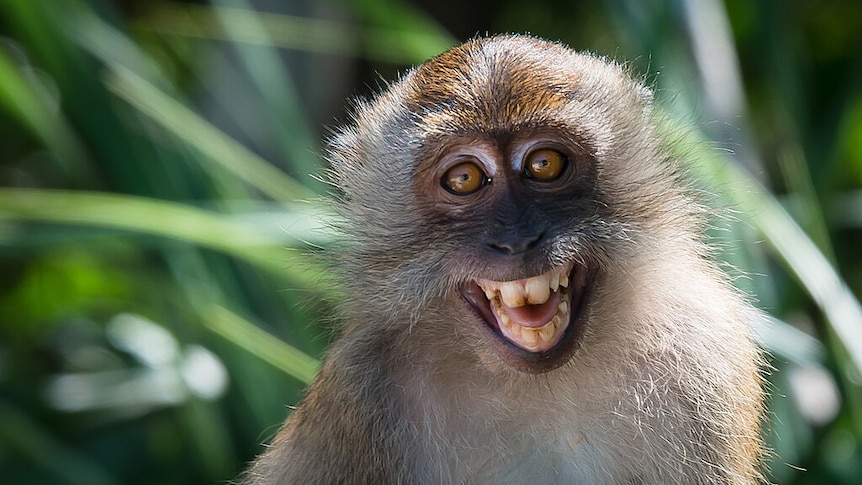
A lone monkey, about the size of a toddler, leaps from branch to branch above the wreckage of a World War II plane.
It looks harmless, but it is one of about 5,000 long-tailed macaque monkeys overrunning Angaur, a remote island just 4 square kilometres at the southern tip of Palau.
“It’s probably a deposed old monkey,” says Marvin Ngirutang, the island’s former governor and our tour guide for the day.
“They live by themselves for the rest of their lives.”
Mr Ngirutang ensures we stick to the road and well-worn paths.
“It’s full of unexploded ordnances,” he warns.
The northern part of Angaur is littered with bombs from the 1944 Battle of Angaur in World War II, a bloody campaign between US and Japanese forces.
It has kept people out, but created a haven for the monkeys.
With no natural predators, their numbers have exploded since their introduction more than a century ago.
Now, US military land clearing is pushing them south, where they are threatening the island’s agriculture and food security.
Faith Swords, one of the 114 people left on the island, has lived with the monkeys all her life, but over the past few years, she has been invaded.
“Right now, they’re pests,” Ms Swords says.
“You grow your taro, then you go the next day and it’s all gone because the monkeys have destroyed it.”
“It breaks culture, because right now the younger people don’t know how to fix taro because it’s all gone.”
Residents now have to import their food — even coconuts — and as they continue to leave the island, the monkey population climbs.
How did the monkeys get here?
It began in 1899, when Germany colonised Palau and began mining phosphate in the north of Angaur.
Monkeys were introduced from Indonesia and used like canaries in coal mines to detect toxic gas.
When World War I broke out, Japan took control of Angaur and continued the phosphate mining and turned the island into a militarised zone — so did the displacement.
The US military has maintained a military presence since World War II.
US military plans
Today, an airport runway dissects the island. And now the US is building a missile detection radar facility — called Tactical Mobile Over-the-Horizon Radar — as part of its strategic footprint in the Pacific.
Under the Compact of Free Association Agreement (COFA), Palau grants the US exclusive military access to its land, airspace and sea.
In return, the US provides defence, economic aid and access to US services.
But the radar project has come at a cost.
“Before, it was just jungle just off the runway. And there were monkeys all over the place,” Governor Natus Misech says.
“But when they cleared the land, all the monkeys had to go elsewhere — and more so into the community, into town.”
Palau’s President Surangel Whipps Jr says dealing with the monkeys is a challenge.
“These monkeys have survived World War II, when the island was completely bombed and nothing was left. They’ve survived typhoons,” he says.
“They’re resilient and they continue to multiply.”
Efforts to control the population have failed, from trapping to feeding them birth control — even bounties.
“I know that when I say something like that, people will say, ‘That’s so inhumane,'” Mr Whipps says.
“But they truly are invasive.
“[They’re] detrimental to crops, everything from betel nut, which the people of Angaur sell as a cash crop, to farm products, tapioca or papaya.”
Out-of-the-box solutions
Jackson Henry, a real estate broker, Angaur chief and Palau’s former ambassador to Taiwan, sees an opportunity — tourism.
“We’re the only island in Micronesia that has monkeys.
“When the tourists come, they buy fruits and they feed the monkeys,” he says.
“That way, they stay away from the village.
“We don’t want to kill any monkeys. They’re good animals.”
Loading…
Mr Misech, who has seen bounty programs fail, also has ideas.
“I’m hoping that the military of the United States will come up with some kind of program to use the monkeys in some experimental project or something instead of eliminating them.”
A call for accountability
Mr Whipps says he has raised the issue with US admirals.
“I said, ‘Your radar site has displaced these monkeys, so now they’ve become a pest in the rest of the village, so you need to help us with the situation.'”
He has also appealed to the former colonial powers.
“The response from Japan, the US and even from Germany is that this happened a long time ago, so they don’t want to take any more responsibility,” Mr Whipps says.
“It was Germans who brought them here. It wasn’t the people of Angaur.”
Germany recently returned ancestral remains from its museums, acknowledging its colonial past.
When contacted, a German government spokesperson outlined how Germany was confronting its colonial legacy, including intensifying its engagement with Pacific Island states, notably through opening the German embassy in Fiji.
There was no mention of the monkeys.
The US embassy in Palau said it was consulting with its admirals — three months later and there is still no response.
Mr Misech wants more autonomy and says the Palauan Congress has blocked several proposals from Angaur to address the crisis.
“We’re practically beggars in our own paradise,” he said.
Asked if there was a chance the island would be left to the monkeys and military, he stands firm.
“That’s not going to happen for as long as I live. I will never give my land,” Mr Misech says.
“I will never leave it to monkeys and military.”
