


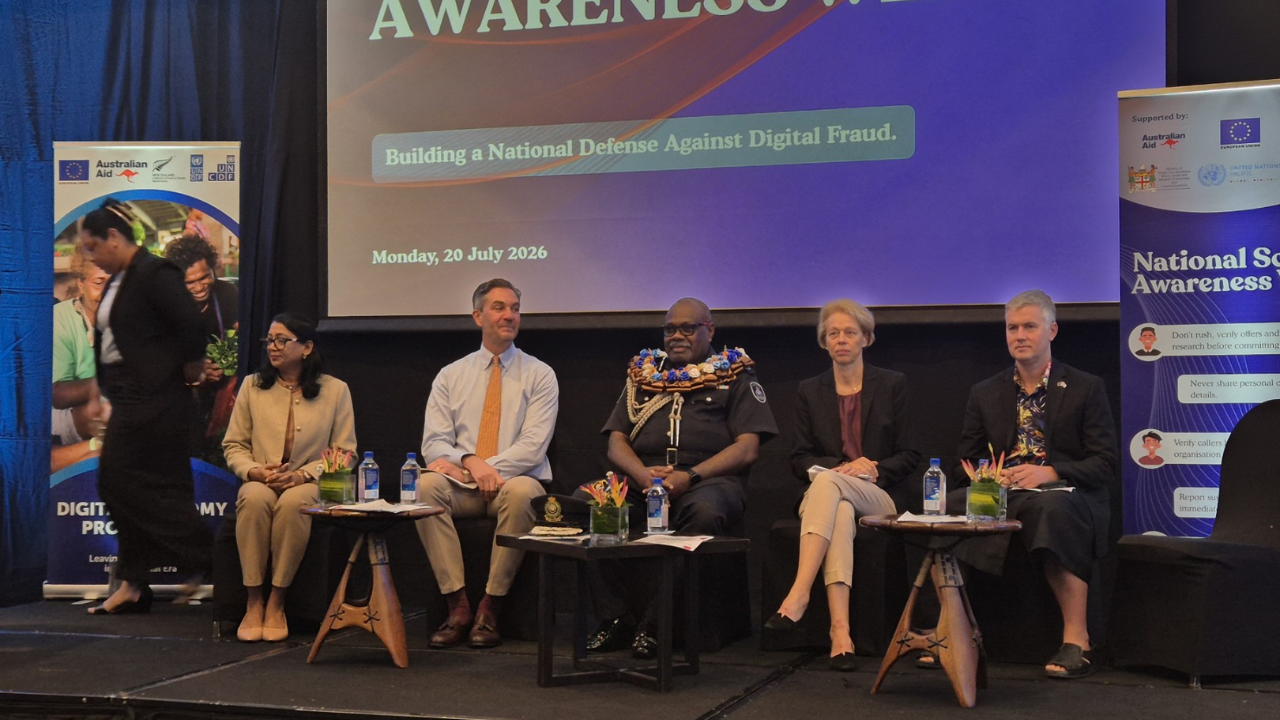
[Pic by Praneeta Prakash
More than $1.3 million has been lost to scam-related offences reported across Fiji since 2017, with the majority of cases still under investigation.
Police Commissioner Rusiate Tudravu revealed this during the launch of the third annual national scams awareness week.
Commissioner Tudravu says 1,672 scam cases have been reported at 21 police stations nationwide over the past seven years.
He says of those cases, 338 have reached the prosecution stage, while 1,334 remain under active investigation.
The Commissioner says the Western Division recorded the highest number of scam reports, followed by the Southern, Central, Eastern and Northern Divisions.
He adds that pending investigations in the Western Division alone involve more than $500,000.
Tudravu says despite the large number of reports, only 11 cases have resulted in convictions over the past seven years, with offenders receiving prison terms, fines or being ordered to compensate victims.
Two cases were acquitted after victims failed to appear in court despite being summoned.
The Police Chief says the Fiji Police Force has strengthened its response by establishing a dedicated Scams Section, comprising specialist investigators with digital and forensic expertise to target cyber-enabled criminal syndicates.
He warns that scammers continue to evolve, exploiting human behaviour rather than weaknesses in technology.
“The reason these criminals succeed is not because our laws are weak or because our banks are failing. Scammers exploit human psychology. They weaponise hope, urgency and vulnerability.”
The Commissioner highlighted a growing scam involving fake social media pages impersonating commercial banks and advertising low-interest loans.
He says victims are directed to fraudulent websites where they unknowingly provide personal information before receiving a one-time password .
He adds that posing as bank representatives, scammers then convince victims to disclose the code, allowing them to empty bank accounts within seconds.
Tudravu stresses that no legitimate bank would ever ask customers to share their OTPs, passwords or PINs.
