

Feature – A Tongan youth leader believes discrepancies in New Zealand’s education system should not prevent Pasifika youths from succeeding in their careers.
Louise Amelia Murphy, 44, from Brooklyn in Wellington, said the academic achievement of Pasifika children, especially those who come to Aotearoa at a young age, remains an area of concern.
She said that it is critical for families to ensure they set the right direction for their children early on.
“Set the right pathway and get educated,” Murphy said.
She believes the primary challenges for Pasifika children in the local education system in Aotearoa center around culture and language.
With English being the second language for many Pasifika children, it makes the challenge tougher, she said, adding that family and community support are key to overcoming those difficulties.
She said Pacific learners speak a variety of languages at home, with the most common non-English language being Samoan, Tongan and Fijian.
Official records here in Aotearoa reports that there is a disparity in Pasifika education achievement, with declining proficiency in maths, reading and science.
According to the ‘PISA 2022: Pacific Learners Summary’, Pacific learners performed at a wide range of proficiency levels in mathematics, reading and science, with an increase in the numbers of those performing below the baseline level of proficiency.
The 2022 mean mathematics, reading and science scores for Pacific learners have decreased since PISA 2018, it said.
The report said that the sense of belonging declined since 2018 and feeling lonely, award or an outsider at school has increased.
“I think there are disparities in education where achievement for Pasifika learners is low, and a key thing as well in the in pathway is that it is important for our children to ensure they are doing the right subjects so that they can get university entrance if that is the pathway they want to take,” Murphy said.
“Particularly in accounting, you need to have core subjects [like] English, Maths, and Science. I encourage families, together with their children, to know what pathways are, to know what the subjects are, that they need to be focusing on to meet the pathways that they are aiming for and [to] seek help where they can.
“There are different community organisations and churches who run programmes that are culturally responsive, that suit the needs of our children. Sometimes, for some children, they might be academically capable, but if they cannot see themselves in the learning, then they might be disengaged. Understanding the child’s needs and how they can be supported on the pathway is important.”
Loise with her parents.
Supplied
Murphy, who is of Tongan and Pākehā descent, has navigated her own challenges and wants to share her journey so that Pasifika people can learn from her experience.
Her mum Kolo is from Vava’u and her dad Brian is from Lower Hutt in Wellington.
Her dad was a bank officer with the Bank of New Zealand, and that had some influence in her decision to pick accounting as her career pathway.
Get education
Murphy is a firm believer in the power of education, but stresses that it must go hand-in-hand with practical work experience.
“Because the two work strongly together, so sometimes it can be hard to get the experience if you are not given job opportunities and things like that.”
She said part of her success has been working in my community, and volunteering.
“I think it didn’t feel right that I felt like God gave me certain gifts and skills and knowledge to share, so it was important for me to share that with my community and with my people.
“Education is important, work experience is important, and if you cannot get the jobs that you want, look for volunteering opportunities and other opportunities elsewhere.
“I think the biggest thing also is having a growth mindset, thinking outside just one pathway. There are lots of different pathways to be successful, thinking about goals and strategies that you might have for your own future, which sometimes is hard in our cultures, because sometimes our culture they’re beautiful, but sometimes different parts of the culture creates barriers for us as well.”
She said Pasifika youths should keep building and growing, backing themselves and believe in themselves.
She encouraged Pasifika people, particularly women who are underrepresented in such spaces, to build self-confidence and back themselves.
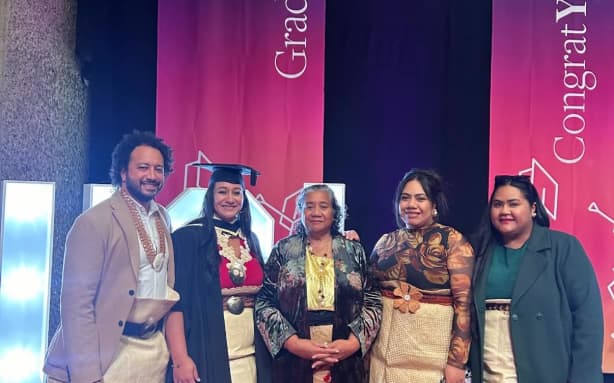
Louise (second from left) with her family at her graduation.
Supplied
Demand
Murphy said there is a growing demand for Pasifika accountants and finance professionals in New Zealand.
“We have a lot more Pacific businesses,” she said. “There’s demand for organisations and entities in general who want people with a Pacific lens, people with expertise who come with their cultural knowledge, identity, lens, and the way that they contribute to organisations and finance, but also from a strategic level.”
Murphy added that personalities are also important and people need to be open-minded, develop their people skills and be able to learn on the go.
“For me personally, I have probably got into where I am due to competency and skills, but also relational skills.
“And this is where it is important to have those relationships, to be able to build relationships, to maintain them, and to be able to support businesses and teams across a business on all levels.
“So, in finance roles, you are dealing with everyone from all levels. So you might be dealing with senior leadership, or you might be dealing with team members across the business. It is very important and a lot of hiring managers look for that as well.
“They ae not just looking for skills and competencies, they are looking for how you can fit into a team and how you can contribute in those ways as well, particularly with these business partnering.”
Opportunities
Murphy shared that Pacific youths should find out what opportunities are available to support further developing their skills and knowledge base.
For instance, she said there are so many opportunities available to Māori and Pasifika youths in the financial sector.
“I did ask Chartered Accountants Australia and New Zealand for some information, and they provided some really great insight, saying that there is great opportunities for Pacific, but also for Māori, because of the different organisations in New Zealand that require expertise again with those lenses of Pacific and Māori, and our worldviews that we bring to different roles and organisations.
“And one thing they commented on was that accounting, the profession, doesn’t really reflect yet the modern New Zealand, and they’re wanting to change that.
“My understanding is that New Zealand is a diverse country, but people in the profession do not yet represent the diversity that we have in New Zealand, and so Chartered Accountants Auatralia New Zealand are really trying to create more opportunities for communities and for people to get into the profession, so that they can support New Zealand’s future.
“I know that Chartered Accountants Autralia and New Zealand are now offering scholarships as well, so I would encourage people studying in that field or wanting to go down that pathway to look at those options and find out what they offer in their scholarships.”
She said there are many other community organisations, charitable trusts that support through ways of scholarships as well. I really encourage families and learners to look at what scholarships are out there, or there might be grants as well.
“There is great opportunities out there for people who are interested in business in general as well as accounting. I just really encourage people if they have an interest in that space to give it a go. People might think they need to be extra intelligent or extra smart, but I think if people apply themselves and work hard, you know, they can do anything that they put their mind to.”
Murhpy said while AI is fast becoming the in thing now, replacing the human element will be hard and that is an area youths should work on.
“I would just encourage all our young people to really back themselves, believe in themselves, and no matter what their background, their upbringing, just really encourage them to take the opportunities that are there.
“There are so many opportunities that come before us, and if they are there, just grab them and take them.”
Early days
Murphy said growing up as a ‘Tongan palangi’ was a big challenge but she was lucky to have the cultural grounding through her mum, which helped her in ger growth.
She attends the Tokaikolo Tongan church here in Wellington with her mum, which is also a big part of their family life.
“I think I was very fortunate to grow up in a good community, and my links have really been maintained because my mother was very strong in ensuring we knew our roots and we were connected with our family in Tonga,” she shared.
“We grew up in a Tongan church, so all of that really helped me stay connected to my Tongan culture, my Tongan roots. I am m very grateful for that.
At the time, you do not realise it or appreciate it but what I have realised now that I am older is that it gives you different perspectives. I have perspectives from two different worlds, as well as my community that I grew up in as well. Probably some of the challenges with that is that because you live in two worlds, sometimes you are not you, sometimes you are not quite brown enough.
“Sometimes you are not quite plangi enough and navigating that space could be challenging at times. But I think I am just very grateful for a loving family, loving parents who are very supportive, always wanted the best for me. I was fortunate in that sense.”
Education came via Brooklyn Primary School and Wellington Girls College, before she entered Victoria University of Wellington, where she did a Bachelor of Commerce and Administration.
She majored in accounting and marketing, graduated with her degree, and ended up in a couple of finance jobs, before she moved to the United Kingdom to further her studies.
“I was travelling the world, living life, and I got a management accounting job that then helped me decide that accounting was the definite pathway for me,” she revealed.
“I started getting work experience and then I started studying under the the Association of Chartered Certified Accountants in the UK, so that was where I continued my accounting studies, and I decided to do a masters.
“I have a Masters of Science through the University of London, which is in professional accountancy. So that’s been my education pathway.”
Murphy is currently the general manager (business and finance) and chief financial officer at the New Zealand Council for Education Research (NZCER) in Wellington.
She has called on Pasifika families to support their children and help them positively, instead of focusing on their weaknesses and faults all the time.
