


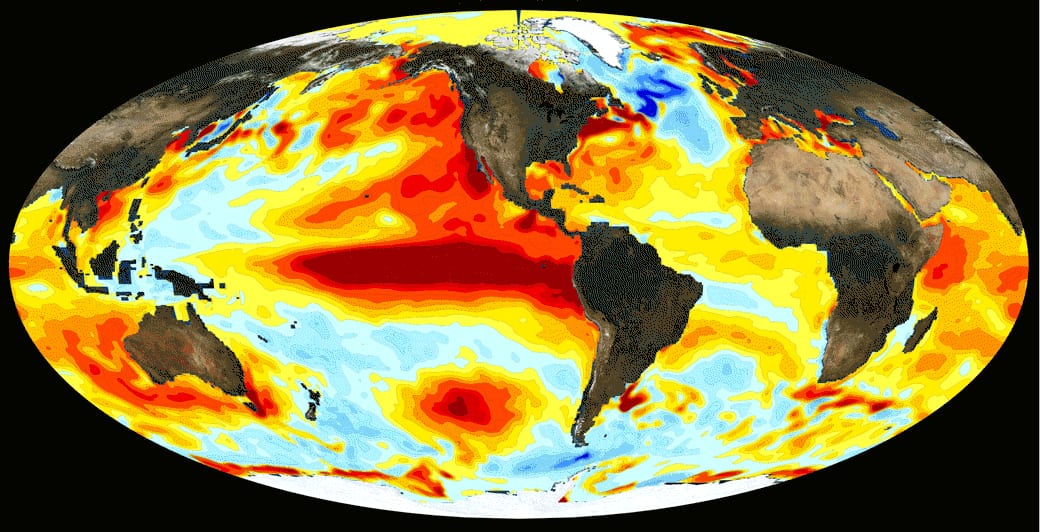
For the first time since COVID, the Pacific Islands Forum has activated its emergency response mechanism. The immediate trigger was not climate, but a regional fuel and transport cost shock linked to the war in Iran, which has pushed Tuvalu and the Republic of the Marshall Islands to declare states of emergency and led Fijian ministers to accept a 20% pay cut to offset, at least symbolically, rising fuel costs. Forecasters now warn that a developing El Niño, with a roughly 63% chance of reaching “very strong” intensity by later this year — leading some to call it a “Super El Niño” — will compound that pressure through the rest of 2026 into early 2027.
A genuinely catastrophic El Niño would force action regardless of the region’s architecture. A moderate one, arriving on top of an emergency mechanism already switched on for an unrelated shock, is a far rarer thing: a live opportunity to see whether the institutions built since the last major El Niño can actually do what they were designed to do, before the stakes are higher.
Over the past few years, the Pacific has built a genuinely new layer of regional climate architecture: the Pacific Resilience Facility, the partnership mechanism governing how external actors engage with the region, and most recently India’s deepening Blue Pacific climate-security partnership. Each has, in its own way, asked whether the region’s institutions can move from declaration to delivery. El Niño’s arrival on top of an already-activated emergency mechanism gives that question something concrete to be tested against.
The most useful comparison is the 2023-24 El Niño, the last major event before this one. In its wake, a number of financing and coordination tools were built or strengthened specifically to pre-position resources ahead of forecast climate shocks, rather than waiting to respond after the fact. Globally, anticipatory action reached 9.6 million people in 2025, activated 146 times across 54 countries, with almost US$120 million released to support these actions. For this specific El Niño, FAO and WFP have launched their first-ever Joint Anticipatory Action Appeal, seeking US$202 million to help nearly 8.8 million people prepare, with systems already in place for about 1.2 million people and additional financing needed to reach the remaining 7.6 million across 22 priority countries.
What does anticipatory action actually look like in practice? In Somalia, WFP and the Somali government activated a flood anticipatory action plan in 2024 that provided cash assistance up to eight days before floods arrived. It reached almost 80,000 people. In the Philippines, WFP distributed emergency cash to 42,000 families ahead of Cyclone Fung-wong making landfall in November 2025. In Zimbabwe, drought-tolerant seed varieties and small-scale well repairs are pre-deployed ahead of forecast dry seasons to protect crop yield before losses occur. These are not responses to disasters already unfolding — they are interventions triggered by forecasts, before the worse impacts hit.
The open question is whether that maturity is reflected in the Pacific Islands Forum’s own institutions, or whether it remains concentrated in donor-run programs that sit alongside, rather than inside, the region’s own emergency architecture. Critics of the Partners in the Blue Pacific initiative have argued that much of the region’s recent institution-building has produced commitment without deployable capacity: frameworks, dialogues and partnerships that look substantial on paper but have not yet been tested under the pressure of an actual, simultaneous, region-wide shock.
This El Niño offers a way to find out, without needing to wait for a worse one. Three things are worth watching in the coming months. The first is whether the Pacific Resilience Facility, whose establishing treaty only entered into force on 6 May 2026 after Australia and Fiji’s joint ratification, can move finance to member states ahead of the worst impacts, rather than after. Total pledges have reached US$172 million of the facility’s US$500 million initial target, and its first call for proposals is not due until the Pacific Islands Forum Leaders’ Meeting in Palau in late August 2026. The second is whether PIF’s emergency response mechanism, already activated for the fuel and transport shock, can absorb a second, climate-driven layer of pressure without requiring an entirely separate activation process. The third is whether external partners — Australia, India and others increasingly engaged through the Blue Pacific framework — channel support through these regional mechanisms, or default to the bilateral, donor-led pathways that have characterised most Pacific disaster response to date.
It is currently impossible to say how strong this El Niño might get, with forecasters cautioning that real certainty about this event’s peak strength will not arrive until at least October 2026. The time between now and then should not be wasted. The Pacific Resilience Facility’s first call for proposals is not due until August. The region’s emergency mechanism is already running, for a different shock, with months still to go before this one peaks. Whether that adds up to readiness, or two systems running in parallel without ever actually meeting, is something this El Niño will show before the next one arrives.
