


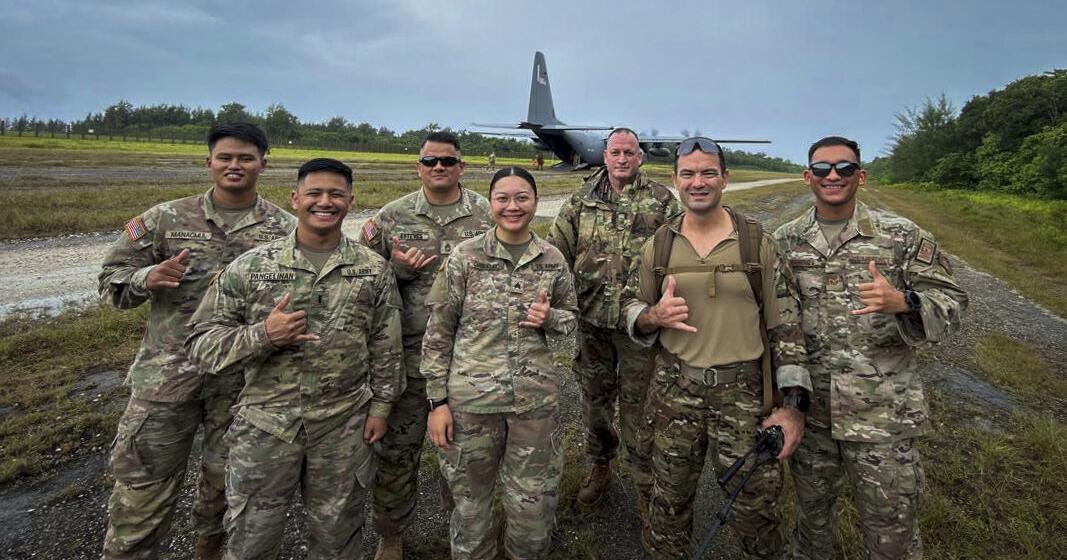
Guam and Washington National Guard troops flew a C-130 onto a remote, World War II-era airstrip on Angaur Island in Palau last month, testing whether the runway could serve as a backup option if the main airport in Koror ever became unavailable.
The landing capped Exercise Alupang Agile Combat Employment, or Alupang ACE, a joint mission carried out under the umbrella of Valiant Shield 2026, the biennial, multinational military exercise that ran from June 22 to July 1 across Guam, the Northern Mariana Islands, Japan and the waters around the Mariana Islands Range Complex.
For the Guam Guard, the drill was more than a training milestone. It showed how the U.S. military could keep operating in the Pacific if a major base such as Andersen were ever put out of action.
Capt. Duane Sablan, the Guam Guard’s State Partnership Program coordinator, served as the lead planner for Guam’s side of the mission and explained how the collaboration came about.
“When we learned that the Washington National Guard was looking for opportunities to operate in the (Pacific Command) area of responsibility, it was a natural fit to bring everyone together,” Sablan said in a recent release from the Guam National Guard.
“One of the greatest strengths of the State Partnership Program is the idea of ‘Partner with One, Partner with All,’ which combines the unique capabilities of other state National Guards to help meet our partners’ needs,” he added.
Guam and Palau formalized their partnership in April 2024, an arrangement Sablan described as mutually beneficial for both sides in readiness, capacity building and disaster response cooperation. He said the idea for Alupang ACE traces back to a Guam-born Guardsman with Palauan roots serving with the Washington National Guard, who proposed the joint drill not long after the partnership began.
The partnership’s first event followed that October, when Guam Guard soldiers and airmen spent four days assessing emergency action plans and communications equipment alongside Palauan agencies, including the National Emergency Management Office, the Division of Maritime Law Enforcement, and the Bureau of Public Safety.
At a welcoming meeting for that visit, Palau President Surangel Whipps Jr. said the arrangement “creates numerous opportunities for our people to help each other in that Pacific Way, caring for one another while ensuring our shared values of freedom and democracy remain strong.”
The plan for Alupang ACE called for troops from Guam and Washington National Guards to fly into Palau and stand up a mission sustainment site, complete with an expeditionary communications suite and a medical aid station, demonstrating the kind of support the U.S. could offer during a disaster or other emergency.
The drill also supported the Air Force’s Agile Combat Employment (ACE) concept, which calls for spreading aircraft, personnel and support functions across multiple smaller sites rather than concentrating them at a handful of major bases.
Angaur’s airstrip is not new to this kind of use. U.S. military engineers rebuilt and expanded the World War II-era runway in 2020 through the Angaur Airfield Joint Improvement Project, a partnership between U.S. Army Pacific, the Air Force and Palau, and a C-130 tested the rebuilt strip that September. Alupang ACE marked one of the more recent efforts to keep that capability active.
Reaching Angaur still took preparation well before last month’s C-130 touched down. Airmen with the 36th Contingency Response Squadron, based at Andersen Air Force Base, spent time on the ground readying the airstrip, which Sablan said takes some getting used to.
“You can see from the photos there that it’s not your typical runway,” Sablan said during an interview with The Guam Daily Post. “It takes some assessment and some prep to be able to make a safe landing.”
The C-130 was sourced by the Washington Guard, flying from Dyess Air Force Base in Texas before staging at Andersen for Valiant Shield. In Palau, the crew landed on Angaur to revalidate the strip before continuing to Koror, where the team set up the sustainment site.
Mark Scott, a Guam Guard spokesman, said Alupang ACE had been in the works for a couple of years but ran into funding hurdles until organizers found a way to attach it to the larger Valiant Shield exercise, which already had aircraft staged on Guam.
“We don’t do these things for the dividends or the return,” Scott told the Post, pointing instead to the long-term value of building relationships within a small, geographically isolated network of Pacific partners.
Sablan said the results surpassed what organizers had hoped for on a first try.
“For an inaugural proof-of-concept exercise, Alupang ACE exceeded our expectations,” Sablan said. “My biggest takeaway is that no challenge is too great when you have committed partners working toward a common goal.”
Sablan said organizers hope to repeat the exercise annually and eventually add more capabilities to what Guam and Washington can offer Palau. He noted the Guam Guard has no aircraft of its own and depends on partnerships with other state Guards to fill gaps such as airlift.
Asked whether the Guam Guard might someday reciprocate by supporting missions elsewhere, from the West Coast to Alaska or Hawaii, Sablan said no specific missions are in the works right now, though Guam would step up if needed.
“We will definitely always be there,” Sablan said, adding that the Guam Guard would answer in kind if another state’s Guard ever needed its help.
Alupang ACE was one piece of a much larger Valiant Shield 2026, now in its 11th iteration since the exercise began in 2006. This year’s drill also included a live-fire sinking of the decommissioned amphibious transport dock USS Juneau roughly 200 nautical miles off Guam and a long-range anti-ship missile strike from an Air Force B-2 bomber and involved thousands of U.S. and allied troops training across sea, air, land, space and cyberspace.
Announcing the broader exercise last month, Navy Adm. Steve Koehler, commander of U.S. Pacific Fleet, said the goal is to keep the U.S. and its allies able to “continue to seamlessly innovate and operate together, project combat power together, and prevail over any challenge together.”
For Guam, the exercise on Angaur could prove significant well beyond the island itself. It helps give Palau and the wider region a second working airstrip, and it highlights the Guam Guard’s growing role in Pacific force posture.
