


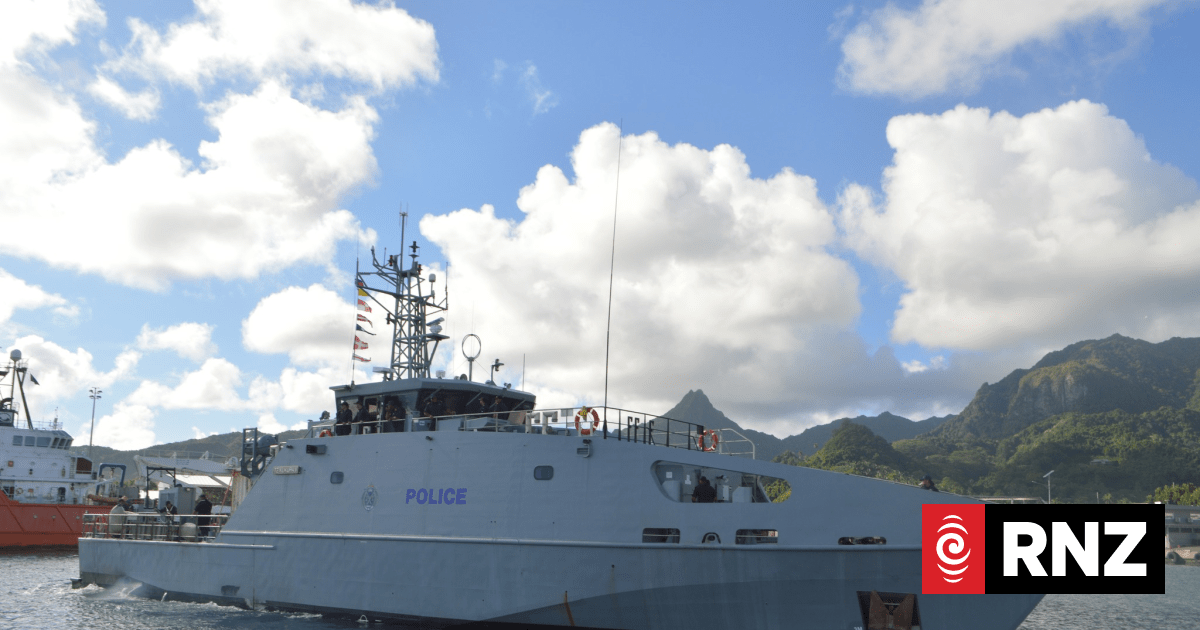
Cook Islands’ police patrol boat Te Kukupa II. (file photo)
Photo: Cook Islands Police Service Facebook
Penrhyn Island in the Cook Islands used its last 100 litres of diesel last week and has borrowed diesel from the police patrol boat, as fuel prices continue to go up in the region.
The island is also restricting power use.
They have borrowed 5000 litres of diesel from police patrol boat Te Kukupa II, which executive officer Puna Vano said should last until their next shipment of fuel arrives at the end of the month.
“Unfortunately, fuel delivery will come on the barge, which the ETD [estimated time of departure] from Raro[tonga] for the Northern Group is on June 18,” he told Cook Islands News.
“We are anticipating they will arrive here around the 25 or 26 of June, if things go well and there is no further delay.”
Power use on the island is restricted to between 6am and 10pm.
Penryhn has been relying on diesel-generated electricity after its solar farms’ batteries reached the end of their lifespan; a New Zealand-funded battery replacement project is underway.
Fuel prices in the region, meanwhile, are going up again in June.
In Samoa, kerosene is going up almost one tālā – 96.9 sene to 5.02 tālā.
Petrol is going up to 3.99 tālā for June, and diesel to 5.31.
The latest statement, signed by Samoa’s finance minister, said the price increases in May and this month now reflect the ongoing impact of the Middle East conflict on refined product prices.
Further supply is scheduled to arrive this week and in early July.
“As the USA/Iran conflict enters its 14th week, both crude and refined product prices remain volatile,” the statement said.
“Reports that the US and Iran were close to reaching a deal to reopen the Strait of Hormuz have not materialised, and worldwide crude oil supply remains constrained.”
Niue’s fuel prices have also increased as of 1 June, with petrol going up from NZ$3.80 to $4 per litre, while diesel increases from $4 to $4.20.
The government of Niue said fuel supply remains stable, with no rationing in place, and that essential services continue without disruption.
People are urged to use fuel wisely, reduce unnecessary travel, and conserve energy where possible.
Over in Fiji, the country’s Competition and Consumer Commission (FCCC) said it is aware of an image circulating on social media that claims to show FCCC-approved fuel and LPG prices for this month.
“FCCC confirms that this image is false, was not issued by the Commission, and does not reflect the approved fuel and LPG prices that take effect from 1 June 2026,” it said.
The actual price increases in Fiji include motor spirit going up 80, 81 or 84 cents depending on location.
In Viti Levu, motor spirit will be FJ$3.93 (within three kilometres of a public road) and $3.98 beyond that; and diesel will be $4.58 and $4.63 respectively.
In Vanua Levu and Ovalau, motor spirit will be $3.97 (within three kilometres of a public road) and $4 elsewhere, and diesel $4.62 and $4.65.
The FCCC acknowledged the concerns of consumers and businesses regarding the continued rise in fuel prices.
“The June 2026 adjustment reflects unprecedented volatility in international fuel markets over the past two months,” it said.
“In setting the new prices, FCCC took deliberate steps to protect vulnerable consumers and those most exposed to these increases. The products that vulnerable households, outer-island communities and maritime users depend on most were cushioned the most.”
The Asian Development Bank has said it is prepared to spend hundreds of millions to support Pacific countries through the fuel crisis.
In Aotearoa New Zealand, fuel stocks have dipped slightly, latest data shows, while the first shipment of diesel to be stored at the refurbished Marsden Point tanks is on its way.
