


Overview:
Palau lawmakers are reviving a push to establish cattle and goat farms in a bid to strengthen food security amid rising import costs and shipping delays. But the proposal is drawing scrutiny for its lack of scientific evidence, unanswered questions about feasibility, and concerns that past efforts offer caution—not confidence.
Delegates back cattle and goat farms, while critics point to lack of research, past failures, and questions over sustainability
By: Eoghan Olkeriil Ngirudelsang
NGERULMUD, Palau (April 30, 2026)– Last week, delegates passed a resolution urging President Whipps and the Agriculture, Fisheries, and Environment Ministry (MAFE) “to establish a cattle and livestock farm, primarily cows and goats.”
Citing shipment delays and rising food costs, House Joint Resolution No. 12-12-3S aims to bolster Palau’s food security. Within the committee report, delegates claim that “cattle raising was successful during the Japanese Administration and further believe that it can be more successful and sustainable now with modern technology, learned knowledge, vast experience, and best practices, techniques, and methods we have obtained.”
The committee report also reports that following consultation with MAFE, the ministry recommended launching a pilot project for capacity building, local data collection, and expertise development to sustain the livestock sector. MAFE estimates start-up costs for a 30-cow cattle farm at $300,000–$450,000, and $47,000 for a smaller goat pilot farm.
Similar ideas have surfaced before. During the Toribiong administration’s Green Revolution initiative, pig semen from Taiwan was brought to Palau to boost the pig population, alongside 120 live goats. Furthermore, in 2008, Japan’s Tomoe Dairy Processing Co. President Toshio Nagata donated 22 cattle to the Ngiwal Livestock Association.
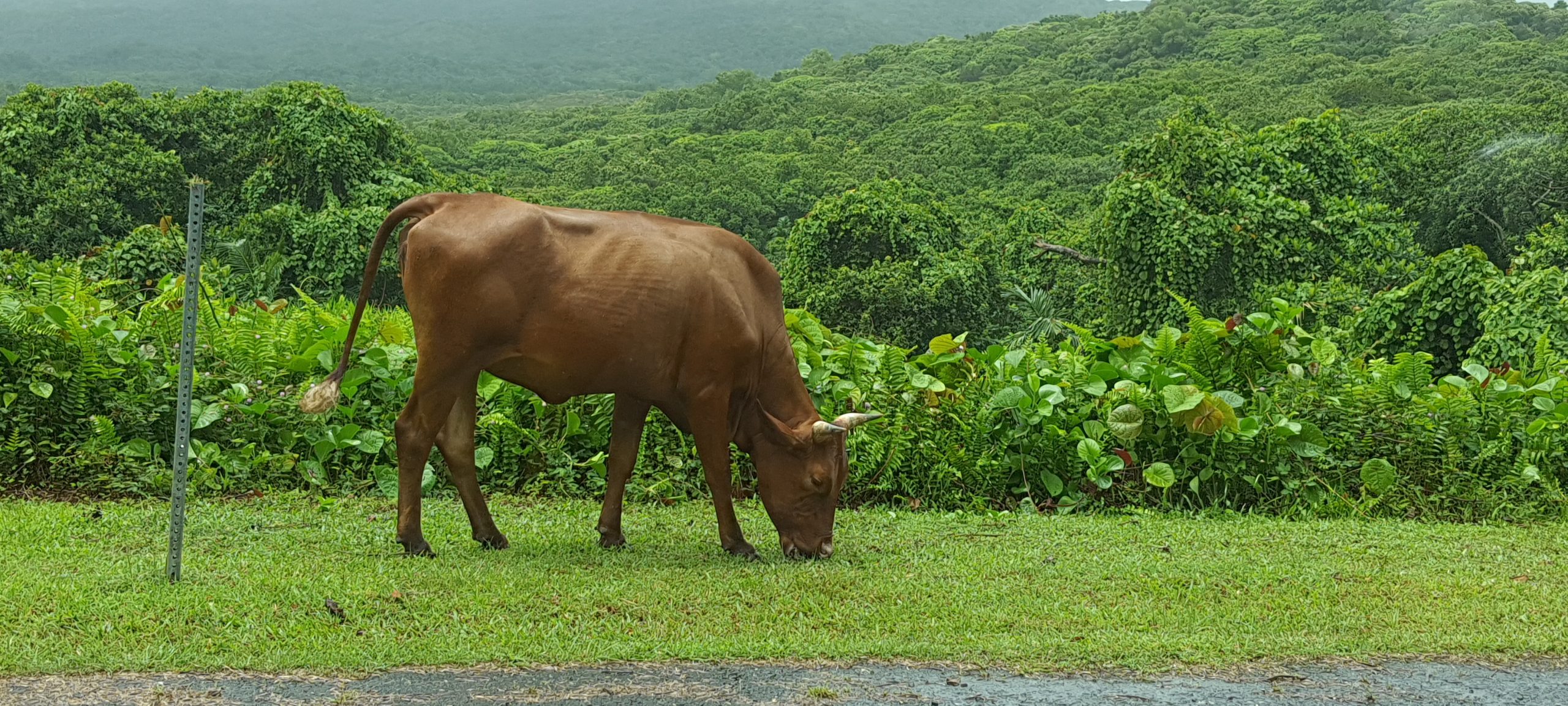
Yet Palau’s livestock industry remains virtually nonexistent, limited to small-scale operations at the Taiwan Technical Mission in Nekken and to minimal local raising primarily for customary events.
While the initiative was raised to address food security issues, the three-page committee report lacks scientific backing. It offers no evidence for historical claims of successful Japanese-era cattle farms or for significant beef production at the time. No data were provided on studies assessing whether Palau has enough feed—grown locally or land for feed cultivation to support such livestock. Nor is there proof that local beef or mutton would be cheaper than imports, undermining food security claims.
A female youth from Ngiwal commented that “such efforts may not be fitting to Palau, those are not part of our traditional diet. We are a small country with very few people, so instead of trying to produce and raise all kinds of food out there, let’s focus on developing our fish and crab farms, as they have a higher success rate. Such food can make up a majority of our diet, while we eat imported beef sparingly. In Ngiwal, we no longer see the cows. I do not think anyone would want to eat those cows; instead, they would feel really sorry for the animals. The cows seemed not to have enough to eat. I think there are only about 3 cows left that are so underfed you can even see their rib bones.”
Peleliu Delegate Nace Soalablai introduced the resolution, joined by others.
This resolution aligns with another House food security bill that tightens clam-harvesting rules. That measure would let states set their own regulations—such as larger harvest sizes than national minimums, seasonal closures, or permit fees—to protect species.
Palau’s Marine Protection Act of 1994 safeguards clam species: Otkang (true giant clam), Ribkungel (fluted giant clam), Oruer (crocus clam), two Melibes species (elongated clam and Noah’s giant clam), Kism (smooth giant clam), Duadeb (bear claw giant clam), and Duadou (China giant clam). The law sets legal harvest sizes and bans exports.
Delegate Marino noted that despite import bans, local consumption—including by tourists at restaurants—continues depleting stocks. “Originally, we did not consider the impact of the local market within Palau,” he said. “When tourists increased, especially those from mainland China, clam harvesting and selling increased significantly, especially to local hotels and restaurants – the conservation measures of the law did not incorporate impacts from the local market.” However, no study or data show how much is in the wild, how much is harvested, or how much is consumed in restaurants to support the assumption that stocks are depleting.
The bill would empower states to impose stricter rules and require the MAFE’s Bureau of Fisheries to allocate resources for restocking clams in protected sites nationwide.
