


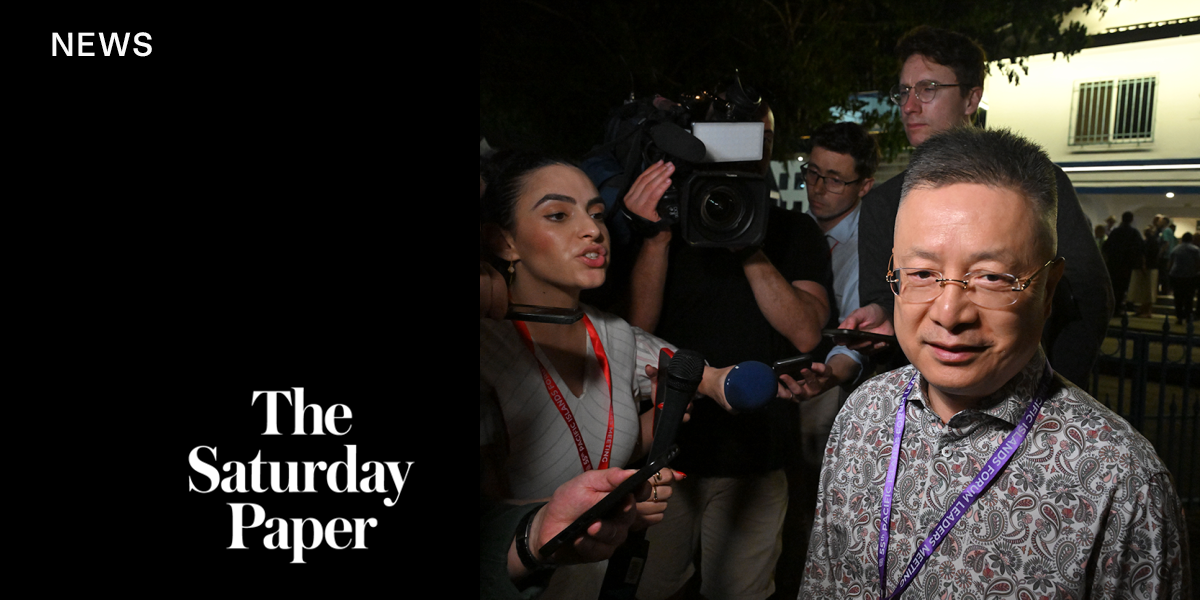
Last weekend, an article in The Economist declared “Australia builds a Pacific alliance system to keep China out”. The strapline read “Chinese influence among Pacific island states is in retreat”. In conversations with journalists in the lead-up to this week’s Pacific Islands Forum Leaders Meeting in Palau, I would often be asked, “Is Australia winning?”
My answer paraphrased what Chinese Premier Zhou Enlai probably never said to Henry Kissinger about what he made of the French Revolution: “Too soon to tell.”
After the shock of 2022, when Penny Wong described the freshly inked but never publicly released China–Solomon Islands security pact as “the worst foreign policy blunder in the Pacific that Australia has seen since the end of World War II”, Australia signed security agreements with Tuvalu in 2023, Naoero (then Nauru) in 2024, Papua New Guinea in 2025, and Vanuatu and Fiji, both in 2026.
The Papua New Guinea treaty was particularly notable, as it built on an existing bilateral security agreement and was driven almost entirely by the Pacific side. Of all the agreements, this one rankled most in Beijing. A Chinese diplomat asked me if PNG still “wanted to be friends”.
The recent agreement with Fiji similarly raises relations to the status of an alliance, a big shift for a nation that under the government of Frank Bainimarama (2007-22) was China’s biggest champion in the region.
Yet the omens that not everything was falling Australia’s way were evident a month ago in Suva, the capital of Fiji, during the Pacific Islands Forum Foreign Ministers Meeting. A month before the meeting, a Chinese nuclear submarine in the South China Sea fired a ballistic missile that flew over the Philippines, and the Exclusive Economic Zones of the Federated States of Micronesia, Naoero and Kiribati, before landing in international waters close to the maritime boundaries of Taiwan-allied Tuvalu.
The resolution – to condemn the test – failed to pass after a day of debate. Naoero and Kiribati – two nations that had recently resumed their diplomatic allegiance to China – held out for a resolution that condemned missile testing without specifically naming China. It was not a controversial position, with Pacific Islands Forum secretary-general Baron Waqa telling Nic Maclellan of Islands Business, “We all want to make a strong statement to everyone, not just China.”
The case for broad condemnation was clear – while China has fired three missiles in the Pacific since 1980, the United States has done 256 “glory trips” of missiles on Kwajalein Atoll in Marshall Islands, the most recent on May 20 this year.
No agreement was reached.
The geopolitical theatrics continued in the week before the forum, with Kiribati introducing legislation to amend their constitution to “Taiwan-proof” the country against any future government wishing to flip from Beijing to Taipei. While Kiribati had flipped relations three times – bested only by Naoero, on four – the legislation and the justification provided for it by President Taneti Maamau was eccentric, even by Kiribati standards.
After a successful leaders’ meeting last year in Solomon Islands, there was a broad hope the China–Taiwan issue would not overshadow this year’s leaders’ meeting, and it remains possible that the forum can produce a strong communiqué.
After a convoluted metaphor about the “parents of the boy” (presumably Kiribati) “selecting a remarkable girl” (presumably China), article 4 of the explanatory memorandum attached to the amendment reads: “For the government of Kiribati (GoK) to establish its diplomatic relations with any country which is not an Independent State Member of the United Nations and a Permanent Observer in the United Nations and so forth is so embarrassing and very much like bringing our BSHK’s reputation down.” BSHK stands for Beloved Sunny Home Kiribati, a term that appears to have been coined for the amendment. “And so forth” seems to cover the many Pacific nations, including Cook Islands, French Polynesia and Niue, that do not have full United Nations member status.
After those theatrics, it was no surprise when Kiribati sent a senior bureaucrat, the head of their foreign service and recently returned ambassador to China, David Teaabo, to Koror, Palau’s largest city and commercial centre, for the Pacific Islands Forum Leaders Meeting. Kiribati has a history of drama, becoming the first and only Pacific nation to voluntarily withdraw from PIF in 2022.
Yet after a successful leaders’ meeting last year in Solomon Islands, there was a broad hope the China–Taiwan issue would not overshadow this year’s leaders’ meeting, and it remains possible that the forum can produce a strong communiqué. This year’s host of the forum, Palau’s president Surangel Whipps Jr, when interviewed by Taiwanese media, was almost wistful about the lack of “noise” at last year’s PIF, when dialogue partners China, the US and Japan, along with development partner Taiwan, all stayed home.
Missing from this year’s PIF are Fiji’s Sitiveni Rabuka, Vanuatu’s Jotham Napat, and Samoa’s La‘auli Leuatea Schmidt, who is unwell. A leadership spill in Solomon Islands, just a few months into Matthew Wale’s tenure as prime minister, meant he had to turn around shortly after arriving in Koror. The absence of five of the forum’s 18 leaders is not a good look. New Zealand minister of Foreign Affairs Winston Peters described their collective absence as “highly suspicious”, without naming any suspect.
The prime suspect is, of course, China. President Whipps made this clear after he called for a “united front” against China’s missile test, musing, “I guess from China’s standpoint they want to let us know that any one of your islands, we can take out.” In an article on Monday, China’s nationalist tabloid the Global Times railed against Whipps Jr’s “misguided strategic choices”. The words “united front” – a term China uses for a party-led agency charged with coercing and co-opting its opponents – evidently hit a nerve.
Whipps Jr is the perfect panto villain for China, maintaining close relations with Palau’s former colonial power, Japan, and the US, which he has encouraged to build military facilities, including an over-the-horizon-radar transmitter. Now well into his second consecutive term as president, he is fond of Reaganite slogans such as “peace through strength” and regularly gives interviews to far-right media outlets. Many observers were surprised by his thumping victory in the 2024 election, although his strong pro-US stance reflects a population raised on the Voice of America, with large diasporas in California and Oregon.
While China will have a long march to win over Palau – and it certainly has a few Palauan MPs in its corner – it’s not clear a focus on signing security pacts and “winning” is useful. Every time Australia signs a new agreement with a Pacific nation, their major trading partner asks, “Well, what about me? How about a security pact? A policing presence? Close your Taiwanese trade office? Or perhaps give Palau a miss – you do believe in the one-China principle, don’t you?”
The main target of China’s ire is Taiwan, which it views as a renegade province. Qian Bo – China’s abrasive special envoy to the Pacific, who is fond of telling Pacific leaders that Australia and New Zealand don’t have “real economies” – said of Taiwan’s presence at the forum, “There will always be consequences”, before adding, “It’s not a threat.”
One of the most immediate consequences looked to be the withdrawal of Solomon Islands prime minister Matthew Wale, who found out a no-confidence motion had been brought against him after his plane landed in Palau. Having formed government with the bare 26 MPs required, Wale’s Government for Reform, Empowerment, Accountability and Transformation (GREAT) coalition party was always vulnerable to the same move that brought it to power. However, the timing of the move, led by Home Affairs Minister Manasseh Maelanga, was suspicious. While Solomon Islands politics could produce almost any outcome, the potential switch from a leader who was advocating for a regional security arrangement, to ardent Xi Jinping fan Manasseh Sogavare will make recent cork-popping in Barton look a touch foolish.
For all the machinations, other than showing up, sticking to its commitments and being supportive, there’s not much Australia’s representatives can do. Perhaps this is what the Pacific family looks like at its annual party. If Australia is going to play the overbearing parent, it shouldn’t be surprised when drunk uncles and weird cousins want to pull focus to themselves. With the pre-COP meeting in Fiji and Tuvalu looming in October, the long list of no-shows is disappointing but largely outside of Australia’s control.
In a reflection on “The Forum That Wouldn’t Die”, veteran New Zealand journalist Michael Field argued that during the PIF’s five decades as a “much maligned institution” the real action went on behind the scenes, long before and after the circus left town. “Its best work has always been quiet and technical: fisheries, environmental protection, and the slow, practical improvements that matter in villages and on atolls.”
