


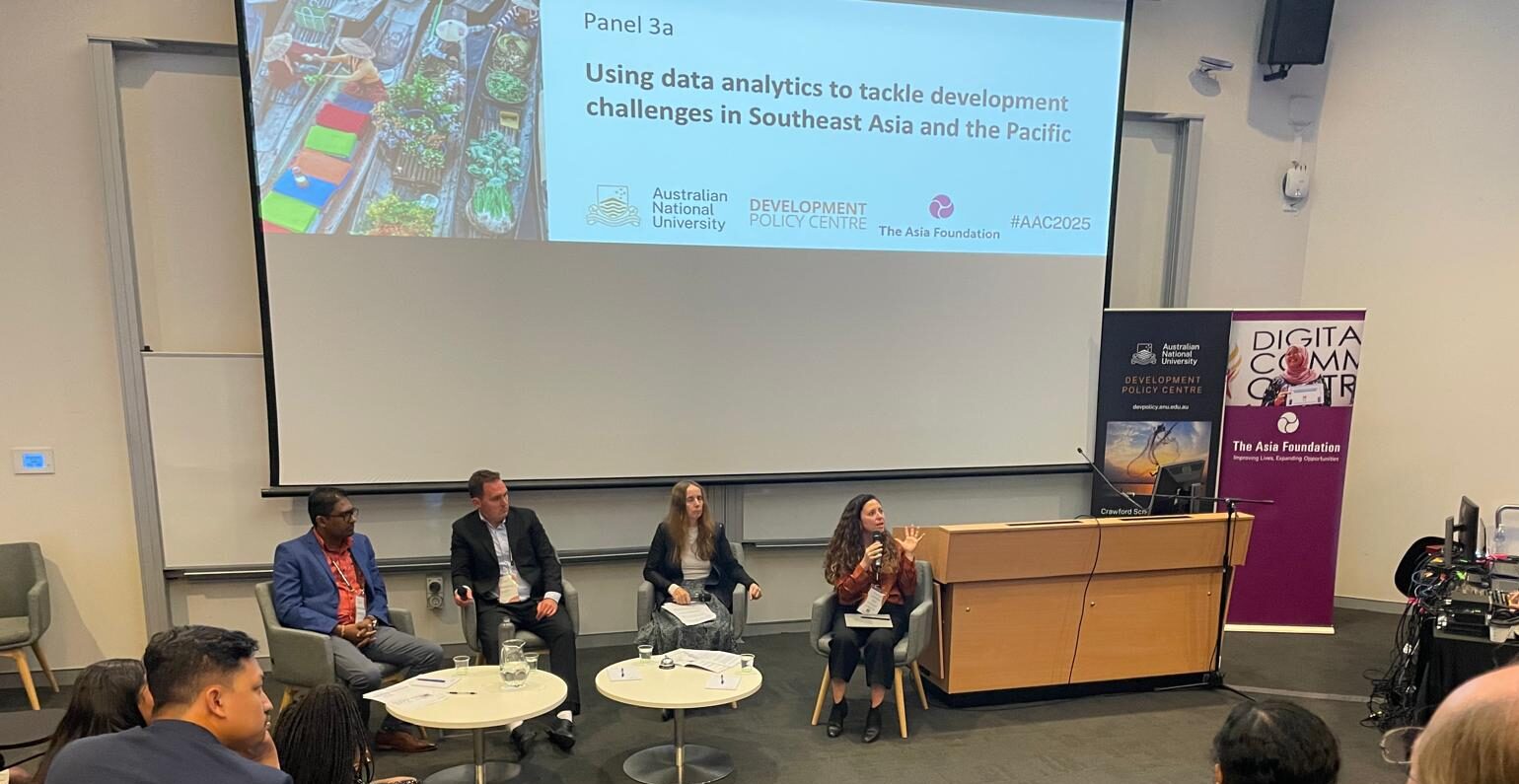
Development policy depends on data. But collecting data is only the first step. Its real value comes from careful analysis that shows where problems are most severe, who is being left behind and which policy responses are most likely to work. On 4 December 2025, a panel at the Australasian AID Conference demonstrated how data analytics can provide policymakers across Southeast Asia and the Pacific with much-needed evidence. Chaired by Professor Beth Webster, Director of the Melbourne Institute of Applied Economic and Social Research at the University of Melbourne, the session brought together three researchers from the Institute working on Timor-Leste, Papua New Guinea and Fiji. Across these contexts, the common message was that better analysis helps move development policy beyond broad averages and towards more targeted action.
Webster framed the session as a natural companion to the conference’s keynote on the science of scale. Quantitative and qualitative evidence, she argued, are deeply complementary. Qualitative work excels at defining problems and developing theory. Quantitative work can tell us whether a problem affects 1% or 99% of people, whether it is growing or shrinking, and whether the programs designed to address it are actually working. The three presentations that followed illustrated exactly how.
Diana Contreras Suárez illustrated this through research on child stunting in Timor-Leste, where about half of children under five are stunted. Stunting matters not only because it reflects deprivation in early childhood, but because it has long-term consequences for cognitive development, education and later-life earnings.
Rather than treating stunting as a single average outcome, Contreras Suárez used machine learning and advanced econometric analysis with a rich dataset collected in partnership with The Asia Foundation to examine whether its drivers differ depending on the severity of the stunting. Her analysis suggests that maternal underweight is especially important among children who are severely stunted, while household food insecurity is a strong risk factor across the distribution. Micronutrient supplementation appears particularly protective for children facing the worst outcomes. The policy implication is clear: a one-size-fits-all response is unlikely to be enough. Better analysis can help distinguish between problems that require broad-based action and those that require more targeted interventions.
Christopher Hoy showed how data analytics can also test whether policies are benefiting the people they are meant to help. His research in Papua New Guinea examined who benefited from recently introduced tax exemptions on basic food items. These exemptions are often justified as a way to reduce the cost of living for poorer households. But whether they actually do so is an empirical question, not something that should simply be assumed.
Using detailed survey and administrative data, as well as web scraping and AI tools, Hoy’s work follows the chain from tax policy to prices to household outcomes. Ultimately, this data analysis showed that a policy that appears pro-poor in theory is extremely regressive in practice.
Kushneel Prakash, a postdoctoral fellow at the Melbourne Institute, approached the question from another angle by asking what development data should measure in the first place. His research in Fiji goes beyond standard economic indicators to examine broader dimensions of wellbeing, including trust, social cohesion, cultural identity and uncertainty. In a region where concepts such as vanua — the Fijian understanding of the relationship between people, land and identity — sit at the core of community life, GDP per capita can obscure as much as it reveals.
Prakash’s work shows that better analysis is not only about extracting more information from existing data but thinking more carefully about what should be measured. If development policy is intended to improve lives, then the evidence base should reflect the social and cultural dimensions of wellbeing that matter to communities themselves. Development programs that inadvertently erode the social fabric can undermine the very resilience that communities depend on.
Taken together, the three presentations made a common point: the most useful policy insights often lie beneath the averages. In Timor-Leste, better analysis helps identify which children are most at risk and which interventions are likely to matter most. In Papua New Guinea, it helps test whether a common tax policy is actually reaching poorer households. In Fiji, it broadens the evidence base by incorporating dimensions of wellbeing that standard economic measures often miss.
As Webster noted in her introduction, the Melbourne Institute has built an active research group focused on Southeast Asia and the Pacific over the past decade — the Disadvantage and Wellbeing in the Asia-Pacific team led by Professor Lisa Cameron. The panel suggested this kind of sustained, regionally focused quantitative research capacity is exactly what is needed to complement the growing emphasis on evidence-based development policy in Australia and the region.
The message for policymakers, donors and researchers is practical: invest in collecting good data but invest equally in analysing it well. In a region as diverse as Southeast Asia and the Pacific, that kind of careful analysis is critical if development policy is to be both effective and responsive to local realities.
You can watch a recording of this panel and other 2025 Australasian AID Conference sessions on the Devpolicy YouTube channel.
