


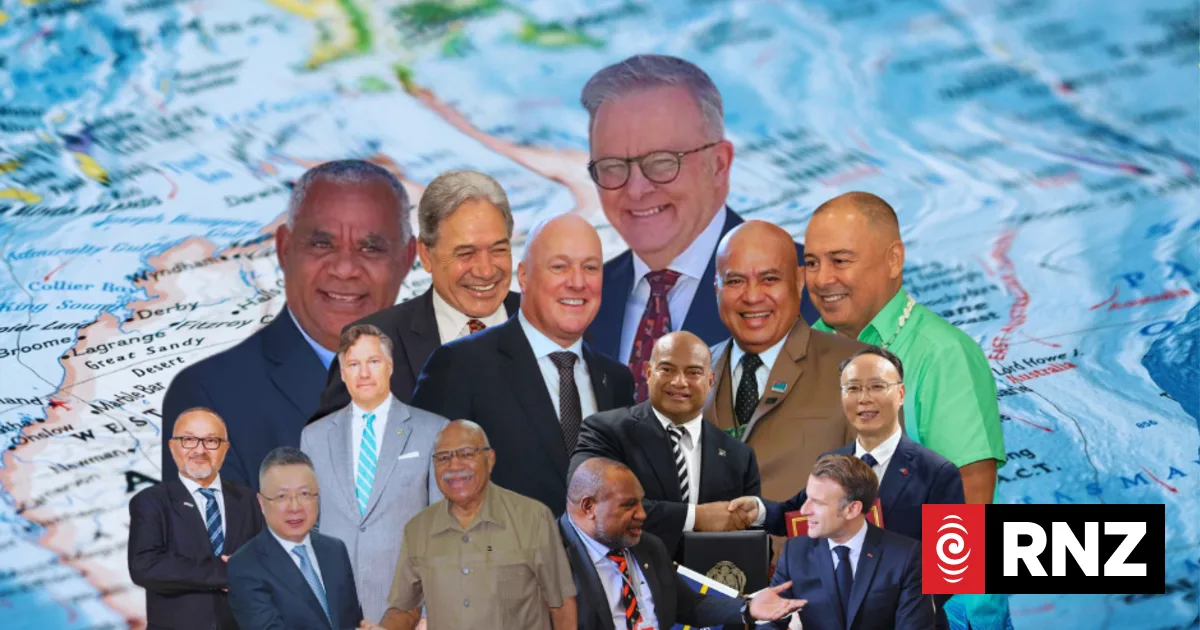
A Pacific geopolitical expert there is a risk that Pacific Islands’ priorities and security concerns are being sidelined by increased geopolitical competition and tensions in the region.
Are there too many security alliances in the Pacific?
Pacific Waves
This comes amid a growing number of security alliances being formed between Australia and Pacific countries, as well as new regional security organisations, and as China increases its footprint in the region.
Anna Powles, an associate professor at the Centre for Defence and Security Studies at Massey University, told RNZ Pacific that the already crowded regional architecture is becoming more complex, and that there is a need for clarity to ensure it is genuinely Pacific-led.
(The transcript has been edited for brevity and clarity.)
Johnny Blades: On this growing number of security or defence alliances that we are seeing in the Pacific lately, is there any precedent for this in modern times, in other regions of the world?
Anna Powles: Well, it certainly speaks to the sense of urgency on the part of, of particularly Canberra and and of course New Zealand as well, and it is a reflection of the current security environment and concerns about the trajectory of security in the region.
And where it is an interesting comparison, where we have seen the similarly, if we think about those European countries who were not NATO members and have subsequently become NATO members, such as Sweden, as a consequence of Russia’s invasion of Ukraine, and that impetus and the flurry of action and sense of urgency that we have seen in Europe is an interesting comparison when we consider what we are seeing now here in the Pacific.
JB: What do you see as being the risks for Pacific Island countries from these alliances?
AP: The risks are twofold. Firstly, the concern that this flurry of action, this geopolitical contestation, that we have seen really since around 2014, where we started to see it escalate – and then obviously from 2022 onwards, following the signing of the security agreement between Solomon Islands and China – the activity became that much more intensified, and the risks always are that those priorities that have been identified by Pacific Island countries themselves and laid out in declarations such as the Boe Declaration that was signed in 2018, that those concerns, those security priorities such as transnational crime, environmental security, climate change as the existential threat to Pacific peoples, to the region itself, that those issues are going to be crowded out as a consequence of geopolitical interests in the region.
We see this a great deal by the fact that even though there is discussion, there is references to Pacific Islands Forum centrality, which is similar to taking taking a spin from ASEAN centrality. There is rhetoric and the strategic narrative that the Pacific Islands Forum is at the centre of the regional architecture. But what we are seeing through this hub and spokes type model, at which Australia is very much at the centre of these regional, both bilateral and regional security and defence arrangements.
We are seeing the regional security architecture itself becoming increasingly broadened, and there are certainly concerns about what this means for the region itself, for what it means for a genuinely Pacific-led regional security architecture. The Pacific Elders group have raised these concerns themselves only a week or so ago publicly that Pacific priorities are being diluted, that Pacific priorities and strategic narratives, such as the Blue Ocean of Peace are being diluted and potentially undermined by this intensified strategic competition taking place in the region.
JB: Looking at the the Ocean of Peace Centre, at least as it stemmed from the Ocean of Peace Alliance signed by Fiji and Australia a few weeks ago, how do you expect the centre to operationalise the Ocean of Peace Declaration that was earlier made by Pacific Forum countries?
AP: I think we are waiting to see that. Certainly, if Fiji put their hand up to to lead to host the Ocean of Peace Centre in Fiji, and it is as far as we understand, it will be as you say operationalising the Ocean of Peace Declaration, which was signed by foreign leaders at the last leaders summit in 2025. So presumably, it will seek to lead Pacific conversations on the issues that the Ocean of Peace have have identified as being critical, particularly around managing and navigating crises in the region.
There is very little information in the public domain as yet about what the mandate of the Ocean of Peace Centre will be, but we understand that it will, as you say, operationalise the Ocean of Peace Declaration.
JB: RNZ Pacific has heard some comments of concern from civil society about where the centre may be heading, or where the security alliances are heading. But your thoughts on Marco De Jong’s comment about maybe regional civil society had asked for a peace centre, but maybe they got a military base instead. Is that a bit unrealistic, do you think?
AP: I think civil society are rightly concerned about the hijacking of peace building mechanisms in the region, and obviously the Pacific civil society, have been at the forefront of leading on issues such as nuclear non-proliferation, climate change, oceans governance, and so on. Their voices in this conversation is incredibly important.
Dr Anna Powles
Supplied
There is there is and concern that there has been this co-opting of language in the region. We thought firstly when we started talking about the Blue Pacific and the Strategy for the Blue Pacific Continent, we saw the co-opting of that term Blue Pacific. And now we are also seeing this co-opting of that the Ocean of Peace language as well for strategic narrative purposes.
How that will play out again, it is less clear. Presumably, as Fiji has has put their hand up to to host the Ocean of Peace Centre, and the Ocean of Peace, of course, is very much Prime Minister Rabuka’s legacy project. Hopefully, that will mean that it does maintain that regional ownership.
But specific civil society across the region have been deeply concerned that even the Ocean of Peace Declaration has not gone far enough with respect to really anchoring peace building and emphasising peace over security. Those concerns and those perspectives need to be very much part of this conversation as well.
JB: I know you have been tracking the regional security pacts and agreements that have been forged, and and also the regional security-related structures that have been established in recent times. Are they all becoming a bit complicated? Are there too many security arrangements?
AP: Well, certainly, what we are seeing increasingly is a sort of lattice work security architecture, or this highly networked security architecture in the Pacific. But it does feel that there is potentially some overlap, and as a consequence critical gaps as well. If the Pacific Islands Forum (PIF) is at the heart of the regional security architecture, then it needs to be very clear that the Pacific Islands Forum itself has both the mandate and oversight of these various different regional security institutions or arrangements, and so on.
The review of the regional architecture is seeking of clarify and streamline and better align the existing, already crowded and increasingly contested architecture, and these additional security arrangements overlay the existing murkiness that we do see in the region.
So it becomes very congested, but it also becomes congested in a number of critical ways, which is who decides on the rules for the region. For example, who makes the rules, who is the trusted partner, who is the trusted security partner, who upholds the rules, and who provides oversight?
All of those types of questions we need greater clarity on, and this is certainly something that, again, where civil society have been asking these questions loudly and frequently. We need to be finding those answers before the regional security architecture is inadvertently weakened as a consequence of this effort to strengthen it.
JB: Do you think there is a risk of developments in this space nudging the Pacific towards militarisation in a way that Pacific Islanders say they they deeply oppose?
AP: There is certainly a risk. Firstly, these agreements are certainly security agreements such as the Pukpuk Treaty, Veitacini Treaty between Australia and Fiji, the recent agreement that New Zealand just signed with Papua New Guinea, also with Cook Islands as well, amongst others, Nakamal (Vanuatu), Falepili (Tuvalu), and so forth from Australia.
Ans New Zealand’s perspective, these agreements form a broader effort, which is very much about strategic denial and very much about securing the region through these binding Pacific Island countries to Australia, to New Zealand, and to a shared sense of collective security, and importantly, a shared sense of a collective threat landscape as well.
Now, obviously, Pacific countries will differ in how they view that threat landscape, and this is where it starts to get really tricky with these agreements, because there are certain demands, potentially. If you look at, for example, the agreement between Papua New Guinea and the United States, which gives the United States access to six different sites in Papua New Guinea, these could potentially bind Pacific countries to the United States, to Australia, to New Zealand in the case of any type of conflict in, for example, the Taiwan Straits.
So there are inherent risks here. Of course, Pacific countries have agency when they sign these agreements, but we also know that there is a degree of asymmetry when when it comes to power relationships as well. So there is that danger, yes.
JB: In the current dynamic geopolitics, we have seen PNG’s government announce that it will close Taiwan’s representative office in Port Moresby. That seems like a big development, would you agree? And what does that mean – a clear concession to China?
AP: Without a doubt. If you consider the fact that whittling down Taiwan’s allies in the Pacific has been a central objective of Chinese engagement in the Pacific for several decades since the cheque book diplomacy years of the 1980s, 1990s, and it has been very successful in doing so.
I mean, within one week, we saw both Solomon Islands and and Kiribati switching diplomatic recognition, followed by Nauru. And now, there are only three Pacific countries who remain allied to, or recognise, Taiwan. So this is a very geopolitical move by by Papua New Guinea as well, and doing so is sending a very strong signal to China.
In fact, that is actually reflected in the comments made by Papua New Guinea when they announced that decision that the Chinese ambassador was informed of the decision, so it does send a very strong signal. But it also needs to be understood in terms of Papua New Guinea hedging and balancing its relationships between China and and and with Australia as well. So, it is not simply a case of alignment by any stretch of imagination. It is more a a strategy of hedging and balancing core relationships.
JB: The Taiwanese Trade Office is a feature in numerous Pacific countries where they otherwise do not formally recognise Taiwan diplomatically.
AP: Yes, exactly. These tensions have arisen before, in Fiji for instance, not so long ago as well. I think what people are concerned about is certainly the manner in which this was conducted. It was quite undiplomatic, and Taiwan is a valued economic partner of Papua New Guinea.
Taiwan imports something like a third of Papua New Guinea’s LNG (liquefied natural gas) – so by no means an insignificant economic partner. The way that this was conducted, it was really very unfortunate [and] sends a very strong message in the lead up to the PIF leaders’ meeting in Palau.
Palau, of course, recognises Taiwan. It certainly sends an uncomfortable message.
