


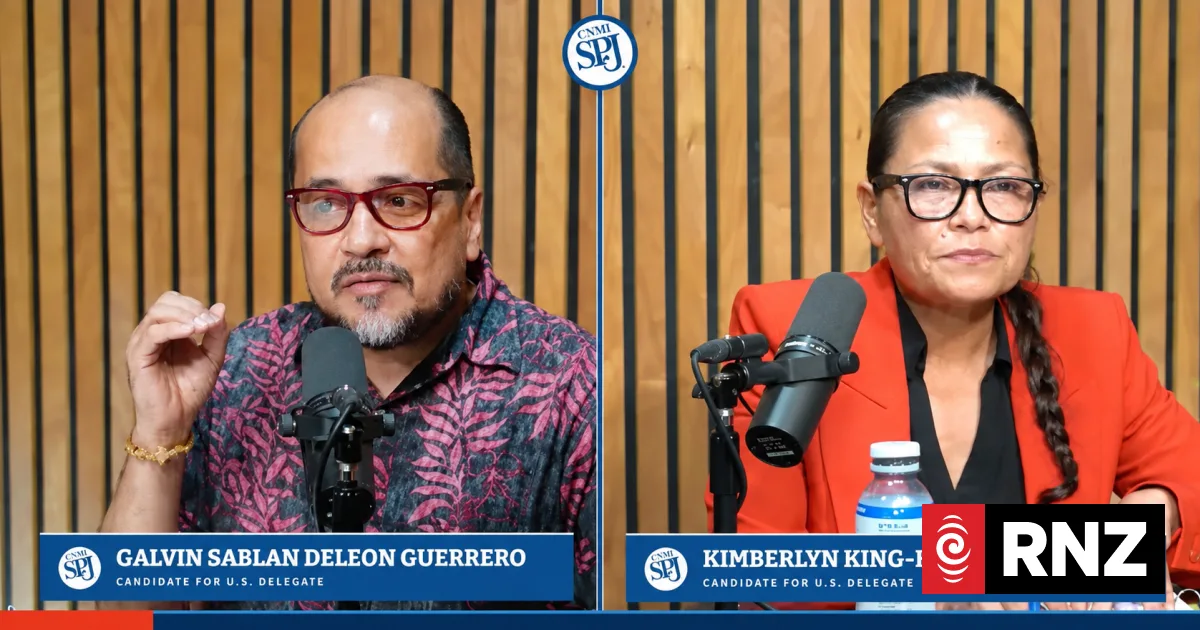
The two candidates running for the Commonwealth of the Northern Mariana Islands (CNMI) seat in the US Congress clashed over whether the territory is getting enough economic benefit from the growing American military presence in the territory.
Challenger Galvin Deleon Guerrero described the current arrangement as a “raw deal” for the CNMI, saying military expansion should result in more jobs for local residents, contracts for local companies and investment in public infrastructure.
While incumbent delegate Kimberlyn King-Hinds said relations between the CNMI and the US military have improved and argued that continued engagement can produce greater benefits for the territory.
“I would say the relationship right now has improved significantly where we are now not fighting against each other, but are looking for areas where we can collaborate,” she said.
The candidates made the comments during a Congressional Debate hosted by CNMI Society of Professional Journalists on 29 August.
Deleon Guerrero said military-related infrastructure development has too often operated as a closed system benefiting the military rather than the wider community.
“We cannot have national security unless we have economic security,” he said, arguing that military investment should support jobs, businesses and infrastructure in the CNMI.
He also questioned why more CNMI workers and businesses were not benefiting directly from the build-up.
“Why aren’t our local people being hired? Why aren’t our local businesses getting contracts? Why is our local infrastructure not being developed?” he said.
King-Hinds said there had already been efforts to connect local businesses and workers to military opportunities, pointing to industry days, job fairs, employer outreach and programmes linking small businesses to federal contracts.
The candidates also differed over how the CNMI should respond to possible deep sea mining in waters surrounding the islands.
Deleon Guerrero said he wanted the US Congress to expand CNMI jurisdiction beyond its current territorial waters and argued that the Commonwealth should have a greater say over activities across its surrounding exclusive economic zone.
“When it comes to deep sea mining, commercial fishing or anything involving our oceans, we need to have more jurisdiction over those waters,” he said.
King-Hinds said recovering jurisdiction may not be politically achievable in the near term and argued instead for legislation placing environmental and economic safeguards on any mining activity.
She said her proposal would prevent the federal government from waiving royalties and other payments, require companies to post bonds for environmental restoration and require consultation with the CNMI government.
“We can shape it to benefit our community and put guardrails to protect our environment,” King-Hinds said.
Deleon Guerrero rejected what he characterised as simply accepting the existing arrangement, saying greater CNMI control should remain the goal.
He said the islands should be in a position to make decisions over deep-sea mining rather than merely being consulted or offered a share of any economic proceeds.
