


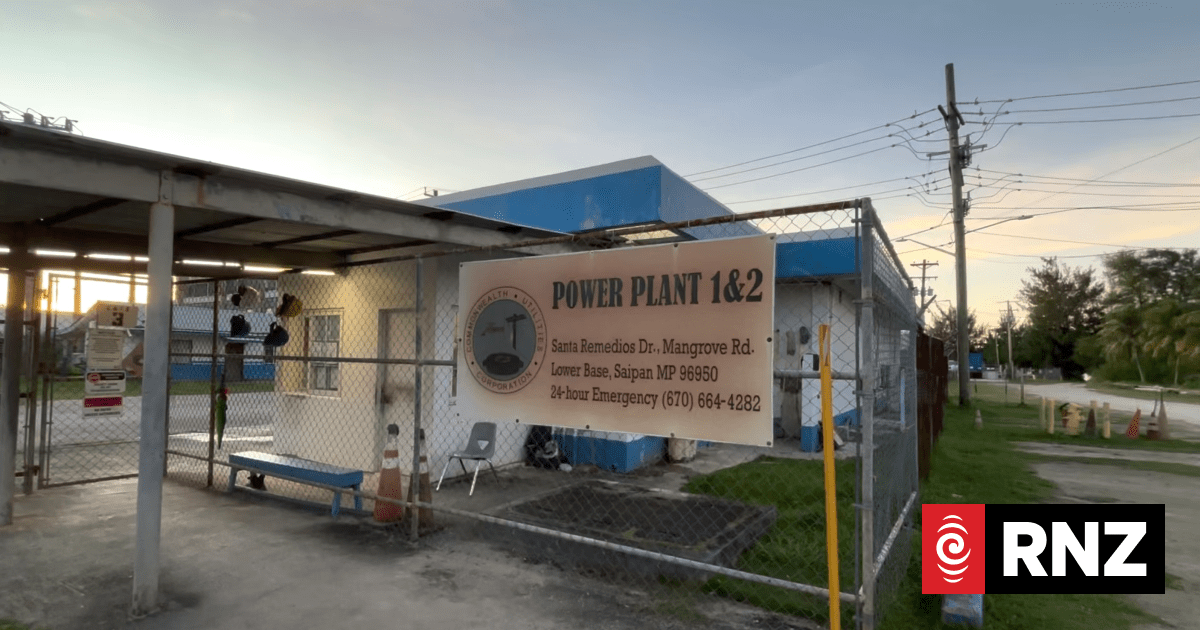
The Commonwealth Public Utilities Commission voted 3-1 last week to raise the FAC from 24.5 cents per kilowatt/hour to 44.489 cents per kilowatt/hour effective 15 May.
Photo: RNZ Pacific / Mark Rabago
Businesses in the Northern Mariana Islands (CNMI) are bracing for higher operating costs after regulators approved a sharp increase in the public utility provider’s fuel surcharge.
The Saipan Chamber of Commerce is warning the near-doubling of the Commonwealth Utilities Corporation’s (CUC) Fuel Adjustment Charge (FAC) could ripple through the economy and force some businesses to scale back operations.
The Commonwealth Public Utilities Commission voted 3-1 last week to raise the FAC from 24.5 cents per kilowatt/hour to 44.489 cents per kilowatt/hour effective 15 May, nearly doubling the surcharge tied to global fuel prices.
The CUC has also warned the FAC could climb higher if fuel costs continue to rise amid instability in the Middle East.
Saipan Chamber of Commerce president Joshua Wise said businesses across the CNMI are already feeling pressure from rising operational expenses.
“We are concerned that a two-fold rise in the FAC will place additional financial pressure on businesses across multiple sectors,” Wise said.
“Increased utility expenses and higher shipping and transportation costs tied to fuel increases will inevitably raise the cost of doing business.”
Wise said the impact would extend beyond monthly utility bills and could affect services, staffing and overall business sustainability.
“In response, some businesses may be forced to scale back certain products or services, or in unfortunate cases, consider downsizing or closure,” he said.
The increase comes as businesses and residents continue recovering from Super Typhoon Sinlaku, which caused widespread damage across Saipan, Tinian and Rota.
Wise urged collaboration between the private sector and policymakers to help cushion the economic blow.
“At the same time, this underscores the need for continued dialogue and collaboration between the business community, policymakers, and utility stakeholders to help mitigate impacts on the CNMI economy,” he said.
But while businesses worried about affordability, Senator Celina Babauta raised concerns over whether the FAC increase violates the governor’s emergency price freeze order issued ahead of Typhoon Sinlaku.
“The decision by the CPUC to allow an increase to the Fuel Adjustment Charge during a declared price freeze raises serious legal and ethical concerns,” Babauta said.
“Calling it an ‘adjustment’ instead of a ‘rate increase’ does not change the reality that consumers are still paying more out of pocket.”
Babauta argued that CUC should not be exempt from emergency protections because electricity and water are essential services affecting every household and business in the Commonwealth.
The CNMI cannot continue down the path of becoming an island where laws are treated as optional, she said.
“The rule of law must apply equally to everyone, including government corporations and regulatory agencies.”
She also criticised the timing of the increase as residents continue recovering from the typhoon.
“At a time when families are still recovering financially, emotionally and physical from the storm, many without stable income, reliable utilities, or relief from rising living costs, increasing the FAC is not just tone deaf – it is unacceptable,” Babauta said.
CUC said the increase reflects a sharp rise in ultra-low sulfur diesel prices in April, with fuel costs reportedly doubling compared to March.
