


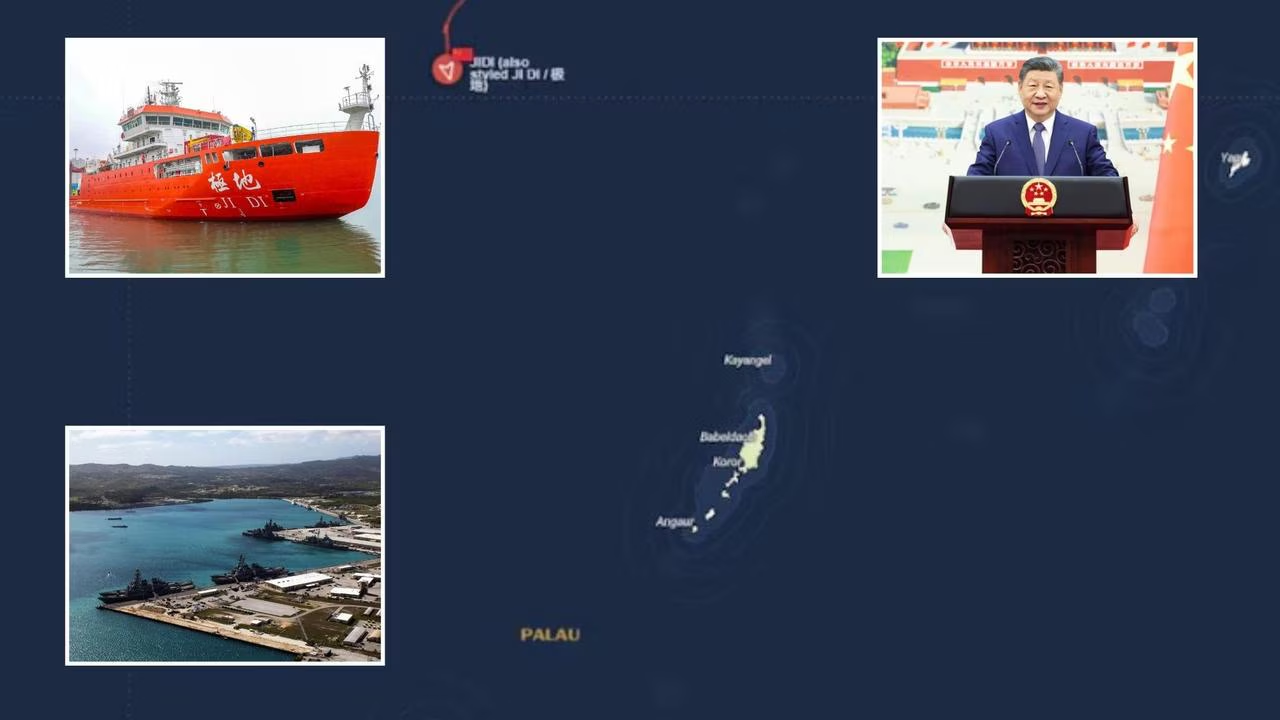
An incursion by a Chinese research vessel into a tiny Pacific Island nation’s waters has led to accusations that Beijing is carrying out a mass surveillance program.
Palau’s President, Surangel Whipps Jr, said China’s research vessels enter the country’s Exclusive Economic Zone (EEZ) uninvited and “do whatever they want.”
“What are they looking for, and what is the ultimate intention?” he said, according to the ABC.
The national broadcaster reported at the end of May that China’s 89-metre icebreaker, Ji Di, ventured 74 km into Palau’s waters and was moving slowly through the island nation’s maritime zone.
The Ji Di was officially launched in 2024 as a new generation of polar scientific research vessels designed and constructed by China, according to the China Classification Society.
It’s said to have a full-rotary electric propulsion system, a bow designed to break through 1 metre of ice and enough storage to supply a crew of 60 for 80 days.
At the time, the Ji DI was billed as a way to bolster China’s research of polar oceans and advance the country’s research “towards serialisation and diversification” of those icy regions.
It’s the presence of this icebreaker in the warm waters of the North Pacific that has got heads turning.
“It’s not the first research vessel we’ve seen operating in the region, doing similar patterns and working around the region,” Leland Bettis, director of the Pacific Centre for Island Security (PCIS), told news.com.au.
“These are legitimate research vessels, but the question is, how much does this feed back to the People’s Liberation Army’s research related to submarine and anti-submarine warfare? We obviously don’t know that, but the type of work these research vessels do directly feeds into all the things submarine and anti-submarine warfare people are looking for.”
He said this includes scanning the topography of the seabed to see how sonar signals bounce, testing sediment composition, water temperature and salinity.
Security experts fear research vessels are being used to collect intelligence that may help Beijing in a future conflict over Taiwan.
Mr Bettis said last year a Chinese research vessel was spotted carrying out “lawnmower pattern” manoeuvres just south of the Bashi Channel, which is widely considered a major choke point for China located between Taiwan and the Philippines.
Similar incursions into Palau’s waters were reported in 2018, 2024 and 2025.
In 2023, Palau claimed a Chinese ship allegedly operated near the country’s fibre optic cable.
President Whipps said the most recent incursion happened in July, days after a Chinese submarine launched a ballistic missile into the Pacific widely believed to have been retaliation over Australia’s freshly-signed defence pact with Pacific Island nations.
The incursion has not been independently verified.
“They’re surveying over the top of our fibre optic cable, and they have gear in the water, so for us it’s a security concern,” Mr Whipps said.
Mr Bettis believes the May incursion was Beijing giving Palau the middle finger because of its recognition of Taiwan.
“It’s fear mongering but it’s also Beijing demonstrating their ability to do what they want to do without acknowledging Palau,” he said.
He also said over the past six months, at least 10per cent of vessels tracked by the PCIS were Chinese research ships.
“Under international law, they have the right of passage but there is clearly a lot of activity.”
‘A lawnowner pattern’
According to the PCIS, 16 Chinese research vessels have made their way into the north Pacific this year.
In 2024, the Centre for Strategic and International Studies (CSIS) found 80 per cent of the 64 Chinese vessels they investigated were acting suspiciously or had links with organisations believed to be advancing Beijing’s geopolitical agenda.
The think tank also found China has built the world’s largest fleet of civilian research vessels and was heavily concentrating surveys in the South China Sea and western Pacific Ocean.
A 2025 study by Frontiers in Political Science did little to quell concerns that China was using its giant research fleet to spy in the Pacific.
It said, unlike other countries, China “doesn’t distinguish between ships operating for naval survey, scientific research, or commercial purposes”.
Mr Bettis told ABC news there were clues in the vessels’ patterns and pointed to Ji Di’s May expedition near Guam.
The think tank director said the ship’s movement suggested it was mapping the ocean floor along a corridor likely to be used by US submarines.
“It’s doing a lawnmower pattern, which is typical of oceanographic survey work,” he said.
“The fact it’s doing the lawn-mowing positioning directly off of Guam where US submarines are based underscores the potential for some of the dual-use capabilities.”
Guam is home to a US base and multiple US subs. It would likely be a staging area if the US intervened in a conflict between China and Taiwan.
It comes as the Lowy Institute, a foreign policy think tank, said Beijing was developing its army to invade Taiwan and to deter or defeat a US intervention.
Former Royal Navy Officer turned naval defence analyst Jennifer Parker said China’s state-owned survey vessels have been increasingly operating across the western Pacific and Indian Ocean collecting data on the seabed.
She said mapping the seabed had many civilian benefits, but it also had key military benefits.
“Some of the locations China’s vessels have been surveying are strategically important because of the location, including around Palau, but also some areas to the north of Papua New Guinea,” she told news.com.au.
“Understanding what the seabed looks like is important for both operating submarines and detecting submarines. Of course it has many other uses. But some of the strategic locations where China has been surveying are areas where submarine operations would be likely and useful.”
She said China’s “civilian military fusion” meant research vessels could support military as well as civilian needs.
“China has also conducted surveys in a number of countries’ Exclusive Economic Zones, which, under the UN Convention on the Law of the Sea, requires advance permission. However, China often ignores this requirement.”
The Chinese Embassy has been contacted for comment.
