


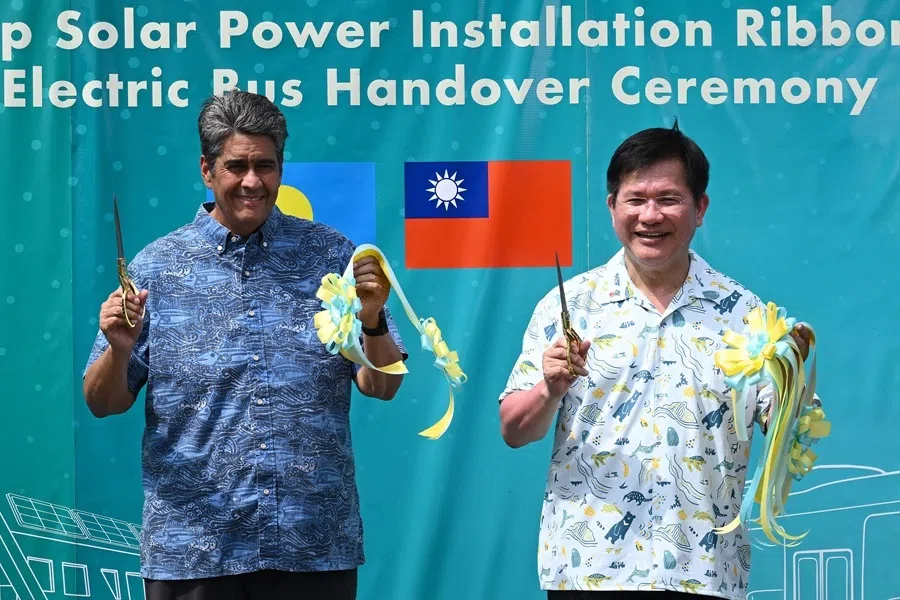
Palau’s decision to invite Taiwan to the 2026 Pacific Islands Forum Leaders Meeting after its exclusion last year shows the limits of China’s influence over the Pacific island countries (PICs). Taipei further ruffled Beijing’s feathers by sending its foreign minister, a higher representation compared to previous years.
However, while isolating Taiwan remains important, it is no longer the primary consideration in China’s engagement with the PICs. With its global ambitions, expanding military capabilities and new-found confidence in standing up to the US on trade and other matters, including tougher sanctions on Iran, Beijing seeks to erode America’s power projection from the second island chain (which it regards as a Cold War legacy) and expand its own reach and influence.
Beijing’s engagement with the PICS used to be overwhelmingly motivated by the need to isolate Taiwan diplomatically. This goal remains important, as three of the 14 PICs — the Marshall Islands, Palau and Tuvalu — still recognise Taiwan rather than China. Beijing has also offered additional economic incentives to encourage the PICs with which it has diplomatic ties to further narrow Taiwan’s diplomatic space. A recent example was Papua New Guinea Foreign Minister Justin Tkatchenko’s announcement in July 2026 of the closure of the Taipei Economic and Cultural Office in Port Moresby even though Papua New Guinea already recognises China and adheres to a ”one China” policy.
Not surprisingly, Beijing has lauded the move while Taipei has protested the unilateral decision and insisted it would keep the office running. If the closure is followed through, it could set a precedent that Beijing would also expect countries that recognise China to close Taipei’s representative offices in those countries.
Under President Xi Jinping, China has accorded greater attention to strengthening ties with the PICs. In 2014, Xi made a state visit to Fiji, becoming the first Chinese president to set foot in a PIC. Fiji was also the first PIC to establish formal ties with China. Xi toured the region a second time when he visited Papua New Guinea and attended the APEC Economic Leaders’ Meeting in Port Moresby in 2018. While meeting the representatives of the eight PICs (i.e. the Cook Islands, Fiji, Niue, Papua New Guinea, the Federated States of Micronesia, Samoa, Tonga and Vanuatu) in 2018, he announced the elevation of ties with these countries to a comprehensive strategic partnership, a notch higher than the strategic partnership enunciated during his 2014 visit.

China succeeded in getting Papua New Guinea, the largest and most populous PIC, to join the Belt and Road Initiative (BRI) in June 2018. The seven other PICs mentioned above followed suit later that year. Three more PICs — Solomon Islands, Kiribati and Nauru — endorsed the BRI in 2019, 2020 and 2024 respectively, after switching diplomatic recognition from Taiwan to China. To date, all 11 PICs have agreed to work with China to build a community with a shared future for mankind.
Beijing has further institutionalised and built a more comprehensive relationship with the PICs. Cognisant of the limits of the Pacific Islands Forum (where it is just one among 21 dialogue partners that includes the five founding dialogue partners of Canada, France, Japan, the UK and the US), China co-organised the first China-Pacific Island Economic Development and Cooperation Forum with Fiji in 2006, focusing on promoting trade, investment and aid projects.
Since 2019, this forum has been displaced by a broader and more strategic-oriented platform, the China-Pacific Island Countries Foreign Ministers’ Meeting that oversees cooperation in more areas including climate response (of paramount concern to the PICs due to rising sea levels), disaster management, Free Trade Area negotiations, agriculture and fishery, police and law enforcement, human resource training, medical exchange, and culture and tourism.
While such wide-ranging cooperation has the objective of ensuring that these countries continue to recognise China (Kiribati, for one, has switched sides a few times), and even persuading the remaining three PICs to establish formal ties with China, they are also designed to serve Beijing’s longer term objectives of projecting its influence and power.
China’s efforts to strengthen ties with the PICs particularly in police and law enforcement cooperation has come under close scrutiny. One concern is that Beijing could wield disproportionate influence in helping to set up a key institution for maintaining order and control. Over time, Beijing could progress into other areas like maritime and coast guard patrols, surveillance and intelligence gathering facilities, and even military basing rights, although it has so far squashed such talks.

In March 2022, a draft of a China-Solomon Islands security agreement was leaked that apparently contained a clause where the Solomon Islands could, based on its own needs, request China to dispatch law enforcement and security personnel — including police, armed police, and military personnel — to the Solomon Islands to assist in maintaining social order and protecting people’s lives and property. A further clause stated that the Chinese side may, based on its own needs and with the consent of the Solomon Islands, arrange for naval vessels to visit, conduct logistical replenishment, and make stopovers or transits in the Solomon Islands.
Beijing subsequently acknowledged in April 2022 that it had signed a framework agreement on security cooperation with the Solomon Islands that affirmed some of the above provisions. In particular, the two countries agreed to collaborate in areas such as maintaining social order, protecting people’s lives and property, providing humanitarian assistance, and responding to natural disasters. While such assistance would enable the recipient country to maintain internal order and stability, it also provides Beijing with a means to protect Chinese nationals and businesses in times of unrest.

So far, China has provided police training, supplied equipment and even introduced its social governance model (known as the Fengqiao experience that aims to resolve issues at the community level before they snowball) to the Solomon Islands. Other PICs that have received related assistance include Fiji (police training and equipment, and even Chinese officers embedded in Fiji’s police force previously), Kiribati (police training), Papua New Guinea (police equipment), Samoa (police academy building), and Vanuatu (police training and equipment).
Beijing remains unfazed by its failure to sign a region-wide Pacific Islands deal in 2022 covering policing, security and data communications cooperation. At the sidelines of the third China-Pacific Island Foreign Ministers Meeting in Xiamen in May 2025, the representatives from the PICs toured one of China’s largest maritime patrol vessels, Haixun 06, to observe drills such as maritime search and rescue, ship firefighting, and oil spill emergency response.
On that occasion, China’s Vice-Minister of Transport Wang Gang announced China’s readiness to work with the PICs to enhance regional shipping safety, protect the marine environment, safeguard seafarers’ rights, and ensure stable global logistics and supply chains. Beijing is also prepared to conduct high-seas boarding of fishing vessels, with Chinese and Taiwanese vessels accounting for the vast majority of infringements around the Pacific Islands. Clearly, Beijing wants to enter areas where the US, Australia and New Zealand are already active with the PICs.
The US-China Economic and Security Review Commission has separately highlighted that China’s objectives regarding the PICs are aimed at blunting US military power in the Indo-Pacific, projecting its own power beyond the second island chain (where most of the PICs are situated), and deterring US intervention in the event of a Taiwan contingency.
If Beijing were to secure military basing rights or even a logistics base in one or more PICs, such as the Solomon Islands and/or Papua New Guinea, it would complicate America’s ability to project power from the Federated States of Micronesia, the Marshall Islands and Palau. In 2023, America signed updated Compacts of Free Association (COFA) with these three countries that grant Washington unbridled authority to operate military facilities, control strategic Pacific transit corridors (extending from Hawaii via the above three PICs to Guam and the Philippines) and deny foreign military access across the land, waters and airspace of these countries.

Over the years, China has regularised and even expanded its security presence in the Pacific through naval forays and ballistic missile tests. The People’s Liberation Army Navy (PLAN) hospital ship, Peace Ark, made early attempts to win hearts and minds through free medical missions in 2014, 2018, and 2023. PLAN training ships, frigates and destroyers have also visited the region.
More recently, Beijing appears to be flexing more of its hard power beyond the second island chain. It launched a land-based nuclear-capable intercontinental ballistic missile that landed near French Polynesia in 2024, marking its first intercontinental ballistic missile (ICBM) test in international waters in 44 years. This year, it fired a submarine-based intercontinental ballistic missile into waters between Nauru and Tonga, demonstrating its second-strike nuclear capability. It could next test an air-launched, nuclear-capable ballistic missile to showcase the third critical pillar of its nuclear triad.
In 2025, the PLAN conducted live firing exercises in the Tasman Sea (between Australia and New Zealand) and then circumnavigated Australia for the first time. That same year, the Liaoning and its escort vessels breached the US-Japan military blockade, marked by the second island chain, and operated for the first time in the waters beyond it. Beijing is clearly trying to mount a credible challenge in an area that used to be dominated by the US and other Western allies.
Despite the inroads it has made in the Pacific, China has to grapple with a number of challenges, including the inclination of the PICs to prioritise development and avoid being too caught up in geopolitical rivalry. Papua New Guinea’s refrain of being friends to all and enemies to none captures this sentiment well, and underscores the desire of the PICs to glean maximum benefits by working with multiple partners. In the Solomon Islands, Matthew Cooper Wale, who became prime minister earlier this year, has indicated that a review of the 2022 controversial security agreement with China is in the works.
Furthermore, the US and other Western countries have strong ties with the PICs, and they show no signs of letting up. Apart from the US updating COFA in 2023, Australia signed a defence agreement with Fiji (in July 2026) and a security and economic treaty with Vanuatu (in June 2026), following a defence pact with Papua New Guinea (in October 2025). Canberra also remains the Pacific’s largest development partner by a considerable margin.
Notwithstanding the above, Beijing is likely to persist, even redouble its efforts, to engage the PICs to expand its power and presence. This endeavour serves the added purpose of making America think twice about interfering in a Taiwan contingency.
Related: China’s Pacific push isn’t a clean sweep | America’s Pacific retreat: China’s advance?
