


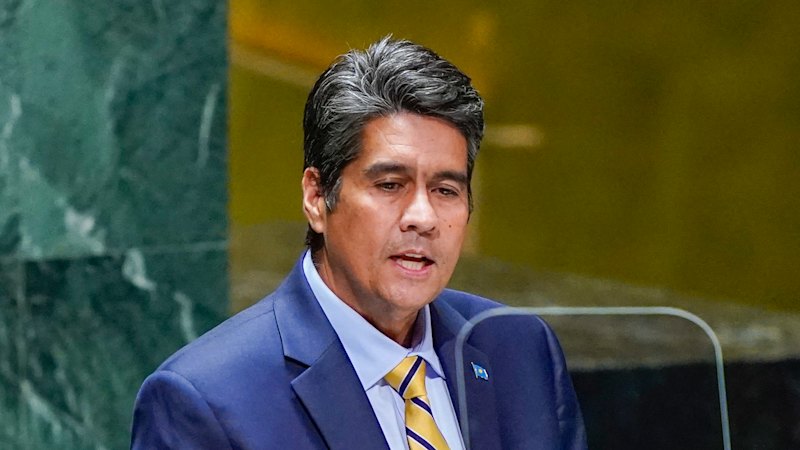
The incoming chair of the Pacific Islands Forum has urged leaders to unite against their region being used as a testing ground for nuclear-capable weapons, warning China’s recent ballistic missile launch sent a menacing message.
Prime Minister Anthony Albanese said in July the forum was drafting a “very strong” joint statement condemning China’s test-firing of an intercontinental ballistic missile fitted with a dummy warhead, but division within the grouping has prevented a forceful statement from being issued.
Palau’s President Surangel Whipps Jr, who will host the Pacific Islands Forum at the end of this month, said he was hoping to achieve a “united front” against China’s missile test, which came with only a few hours’ notice to select countries.
“This is something that we should be united in our voice about,” he told this masthead.
“It’s important for us in the Pacific, especially being so close to China, that any activity that happens in the Pacific should be transparent, and we should all know about missiles flying overhead over our area. I think we have a right as countries to be notified.”
Whipps said the test had raised “concern and unnecessary anxiety” within the region and delivered a disturbing warning to small Pacific nations. Palau is a group of hundreds of islands in the Western Pacific, but has a population of less than 20,000.
“I guess from China’s standpoint they want to let us know that, any one of your islands, we can take out,” he said.
Whipps questioned why China test-fired the nuclear-capable missile near Tuvalu and the Solomon Islands rather than the vast open ocean between China and the United States.
“We understand it’s international waters, but [these missiles] are flying right over us, and not only that, they’re landing in the heart of the Pacific,” he said.
Pacific foreign ministers called for “transparency and reassurance” on missile testing in the region in a statement issued last week that did not directly criticise China.
Pacific Islands Forum Secretary General Baron Waqa told reporters following the foreign ministers’ meeting in Fiji that there are “mixed feelings on how the statement should be formatted, whether just to make an outright statement particularly on that single incident, but there are other ideas that it should be a general statement covering any tests in the Pacific”.
Nauru and Kiribati have been singled out for blocking a stronger statement because of fear of angering China, but Waqa denied they were the roadblocks.
“They just honestly placed their position so that others can consider and see how best they can all contribute,” he said.
Kiribati switched diplomatic recognition from Taiwan to China in 2019, and Nauru followed in 2024.
Beijing defended the test as a “routine” part of its military training, insisting it complied with international law and was “not targeted at any specific country or target”.
But a slew of regional leaders criticised the test, with Solomon Islands Prime Minister Matthew Wale declaring it was “not the act of a friend”.
Whipps, who has led Palau since 2021, said he was open to Wale’s idea of a Pacific-wide security pact, while noting it would have to comply with his nation’s longstanding arrangements with the US.
“Anything to promote peace and stability in the region I think is important.”
Whipps said he would put climate change at the top of the agenda at the PIF leaders forum, including securing more funding for the Pacific Resilience Facility, a fund created to help vulnerable nations cope with higher temperatures and rising sea levels.
Funding for critical infrastructure like ports and sustainable fishing would also be key priorities for the meeting, he said.
“If we provide 50 per cent of the skipjack tuna that’s caught in the world, we want as much of that tuna processed in the Pacific, so the value stays in the Pacific,” he said.
Whipps said he remained hopeful some world leaders could be convinced to travel to the Pacific for meetings ahead of November’s COP31 climate change conference in Turkey despite little signs of enthusiasm so far.
Australian and Pacific Island officials are scrambling to avoid a diplomatic embarrassment caused by non-Pacific leaders declining to show up at the pre-COP events in Fiji and Tuvalu, scheduled as part of a compromise deal between Turkey and Australia, who were competing to host the main event.
“I haven’t given up hope. I think we need to continue to work on getting as many leaders there as possible,” Whipps said.
If world leaders cannot travel, then relevant ministers should be invited to represent their nations, he said.
“Having the highest level representation is important, and we have to get leaders, ministers, as many as we can get. That should be the goal, and we’re working with Australia to encourage them to come.”
Cut through the noise of federal politics with news, views and expert analysis. Subscribers can sign up to our weekly Inside Politics newsletter.

