


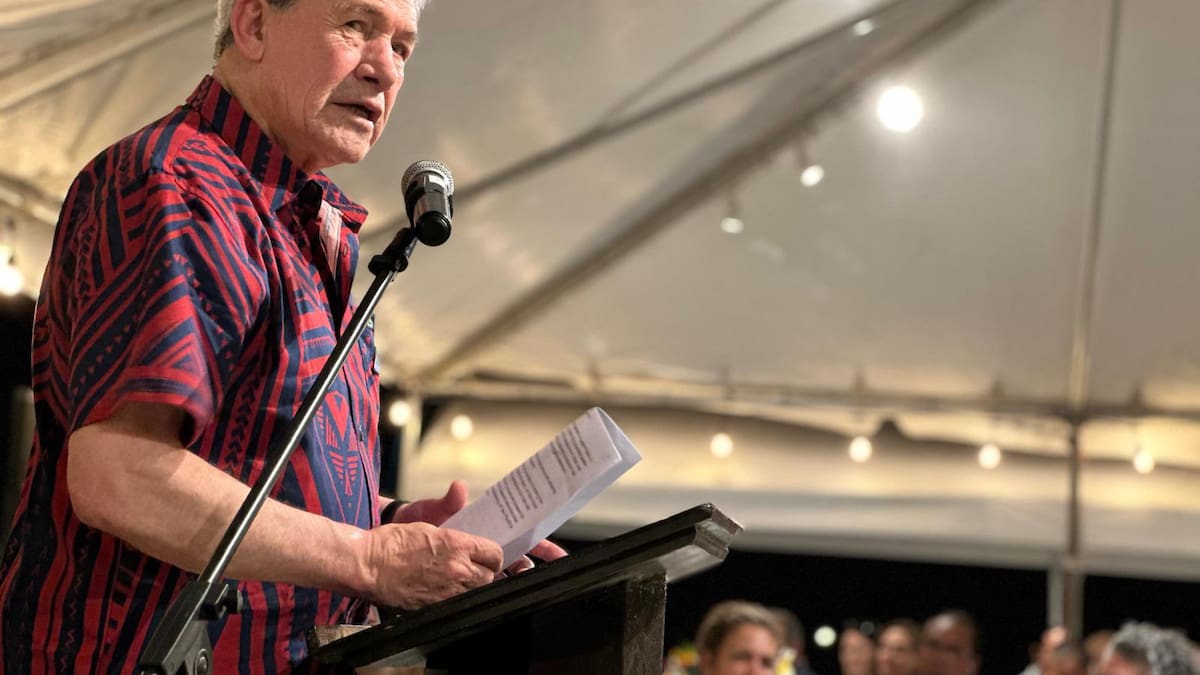
Foreign Affairs Minister Winston Peters has said the collective absence was “highly suspicious” — but hasn’t made any accusations.
University of Waikato international law professor Alexander Gillespie told The Front Page that the absences could be a coincidence, or something to be very concerned about.
“Because when you have a major event, and it happens once a year, and 18 countries come together to discuss issues of utmost importance, and five of the leaders can’t turn up, it’s not great.
“For the reasons they’re not coming, you’d have to ask them, and it’s either a coincidence in timing or there’s something significant going on, and there’s a boycott occurring.
“This is bad for the meeting at the moment, and it’s got significance for next year when New Zealand hosts, because New Zealand will need to know why these countries aren’t turning up so we can fix that problem in advance,” he said.
The forum has existed in various forms since the 1970s and has always had its disagreements, but the current landscape is testing its cohesion harder than ever before.
“But when they can’t speak together on the most pressing items of the time, then yes, it’s losing its punch.
“It loses its impact, and people don’t respect it to the same degree. You expect our leader to go, and [Christopher] Luxon is going, and the Australian Prime Minister to go, and that also is occurring. But if other leaders can’t make it, it’s a sign of disrespect as well. It’s not good.
“There’s been a lot of debate over the decades, and you can think about debates over succession and over who’s gonna be the leader of the group. There have been strong debates over climate change as well in the past, and whether countries like Australia or New Zealand have been doing enough to carry their weight.
“But what you’re seeing right now is a multiple number of crises at the same time, and they’re increasing in temperature, which means the need to speak together with a common voice is greater than ever. Yet that’s dwindling right now,” he said.
The meeting comes after foreign ministers could not agree on a joint statement on China’s ballistic missile test in July.
The test saw a nuclear-capable ballistic missile fired into the Pacific, coming down close to Tuvalu.
Peters called it “most concerning, most unhelpful and most unacceptable”.
Meanwhile, China’s Pacific envoy says there will be consequences for Taiwan being allowed to send representatives to the forum.
It comes while the United States, New Zealand, and the Cook Islands team up to co-fund a major upgrade to the port in Penrhyn. The deep lagoon is of interest because it will enable the port to host large ships, including military ones.
In a joint statement with Peters, US Deputy Secretary of State Christopher Landau hinted that the agreement related to US interest in Pacific critical minerals.
Listen to the full episode to hear more about:
- Taiwan’s representation
- Diversifying partners in the Pacific
- Australia-Fiji security ties
- Climate change adaptation.
The Front Page is a daily news podcast from the New Zealand Herald, available to listen to every weekday from 5pm. The podcast is presented by Chelsea Daniels, an Auckland-based journalist with a background in world news and crime/justice reporting who joined NZME in 2016.
You can follow the podcast at iHeartRadio, Apple Podcasts, Spotify or wherever you get your podcasts.
