


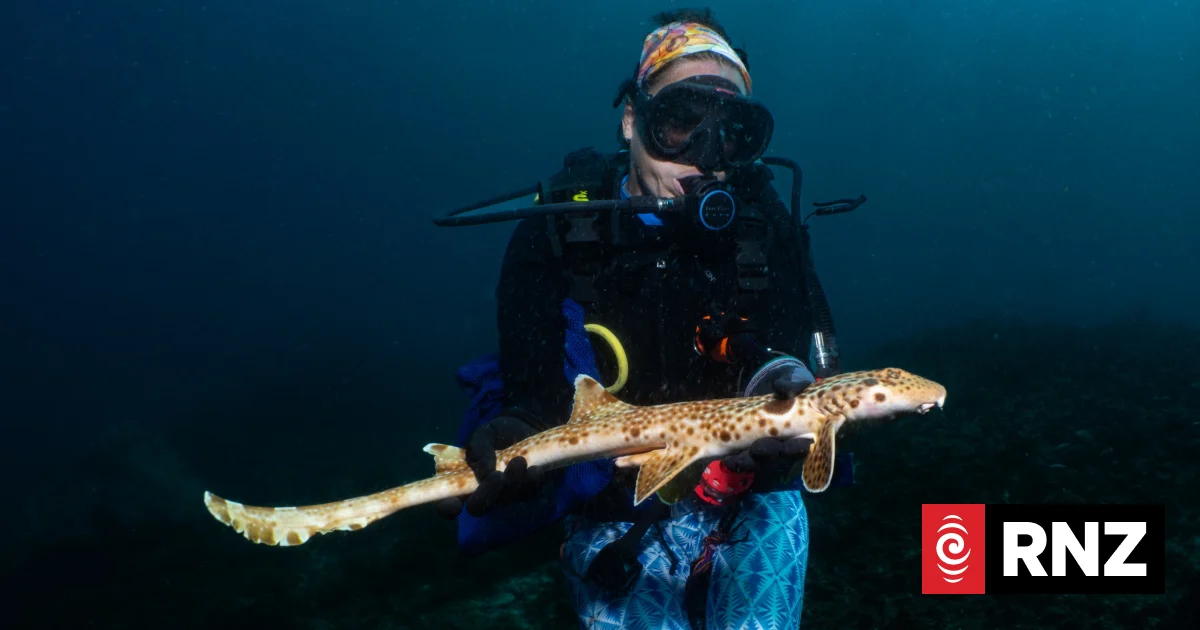
A research team diving in Papua New Guinea has discovered a new, highly vulnerable species of shark that walks on its fins.
The fish is a type of epaulette shark, a group of small sharks native to New Guinea and Australia, famous for their ability to waddle between rock pools at low tide.
Research team discovers new shark species in PNG
Pacific Waves
Locals in PNG have long been aware of the legendary nocturnal fish, which they have nicknamed Kadedekedewa, which means a “lazy shark” or “dog shark”.
Dr Christine Dudgeon is a member of the team at Queensland’s University of the Sunshine Coast that made the exciting discovery.
The senior research fellow was doing a night dive in Milne Bay, in remote, shallow water off the south-eastern tip of New Guinea Island, when she saw what she thought was one of the nine known species of walking sharks in the genus Hemiscyllium.
She was part of an expedition documenting the distribution of the animal when she noticed a metre-long shark swimming in shallow seagrass, on the top of a coral mount.
Dr Dudgeon shone her torch in front of the shark – causing it to freeze, then caught it by hand, with a slick manoeuvre.
“I was able to swim down and grab it behind the head, they don’t have big teeth but they can bite, so you want to avoid the mouth, and they’re quite long and wriggly. So what we do is flip them [on their side] and tuck the long tail under your armpit, almost like a football,” she said.
The new species of walking shark discovered in Papua New Guinea.
Supplied / Christine Dudgeon
Once she reached the support boat and the team examined it under light, they realised its body markings were unusual.
“The body patterns are quite varied amongst the different species. The one that we were searching for has a really distinctive leopard print pattern, that’s the Milne Bay or Micheal’s walking shark. This new species had little white dashes and little brown speckles all over it, and that is just very unique to this species.
However, it was too early to claim it was a species unknown to science, Dr Dudgeon said.
“There’s only 500 odd species of shark across the world, so we don’t discover them as quickly as we do other species, like boney fish.
“On that evening, we only had one sample and that’s not enough to be able to say that it is anything new,” she said.
Over the next two nights, they found eleven more sharks with identical markings and were convinced it was indeed a new species.
Dr Dudgeon said that while walking sharks do swim, they often use their four fins to walk on the sand.
“When the tide goes out they’re able to walk on their fins. They have two pectoral and two pelvic fins that they basically use like little feet to propel themselves along the bottom,” she said.
“It means that they can stay in very shallow tidal pools, and come out of the water a little bit to hop into other pools and they do this at night time when they are not as vulnerable to being predated by sea birds.”
While “cute” and harmless to humans, with a personality she described as “puppy-dog”, their strong jaws allow them to suck prey out of the sand.
“This gives them an advantage as a predator on the reef, they can then access food. They like to eat things in the sand, so snails and crabs and worms.”
So, do they really walk on land?
“They don’t really come out of the water properly, it is just that if a tide pool is separated from the next one that they want to get to, they can,” she said.
“Studies on the species found on the Great Barrier Reef (northern Australia) have shown that they can withstand very low oxygen environments for hours.”
Extensive genetic analysis later confirmed the team’s hunch and the shark became the tenth known species in the genus. It was named Hemiscyllium dudgeonae in honour of Dr Dudgeon.
Walking sharks are endemic to shallow waters off Australia and New Guinea.
“They’re found in the Gulf of Papua, Milne Bay up around the northern part of New Guinea and into eastern Indonesia. So into Rajah Ampat and across to the Halmahera islands, so they are very restricted to this part of the world,” she said.
While some of the genus are at risk of extinction, the conservation status of the new species, found only in PNG, is unknown.
However, Dr Dudgeon said its restricted distribution and mounting pressure from local fishing and reef destruction places it at risk.
“This is a little shark that lays an egg, lets say on a coral reef and the baby hatches out as a miniature version of the adult,” she said.
“It lives basically on the bottom and is attached to the place where it was born. The grownups tend to stay in the same area too, so they don’t disperse very far.”
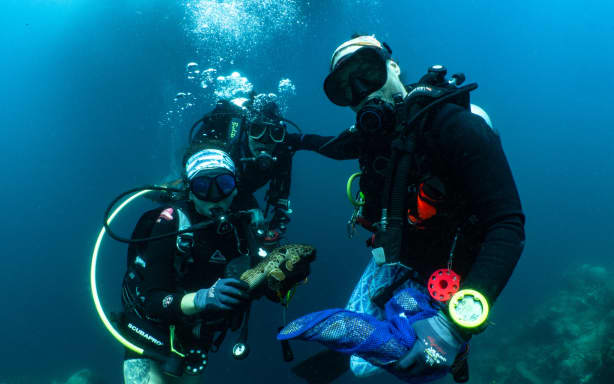
Christine Dudgeon and her colleagues with the new species of walking shark discovered in Papua New Guinea.
Supplied / Christine Dudgeon
More research was needed to determine exactly how the new species came about. But she added that walking sharks do not migrate and reproduce between species, due to barriers like very deep water and fresh water outflow.
Local communities in PNG are keen to protect their sea country and have set up marine protected areas for the fish, Dudgeon said.
“With the Milne Bay species, because it’s endemic to PNG, we have found that the people are very excited about that. They look at it a bit differently, as something that can be valued, not just as a food item, but as a cool species of pride.”
She said the research team included a local fisheries officer who has helped raise the profile of the latest species.
It is hoped that a marine-protected area will be set up to support its habitat.
