


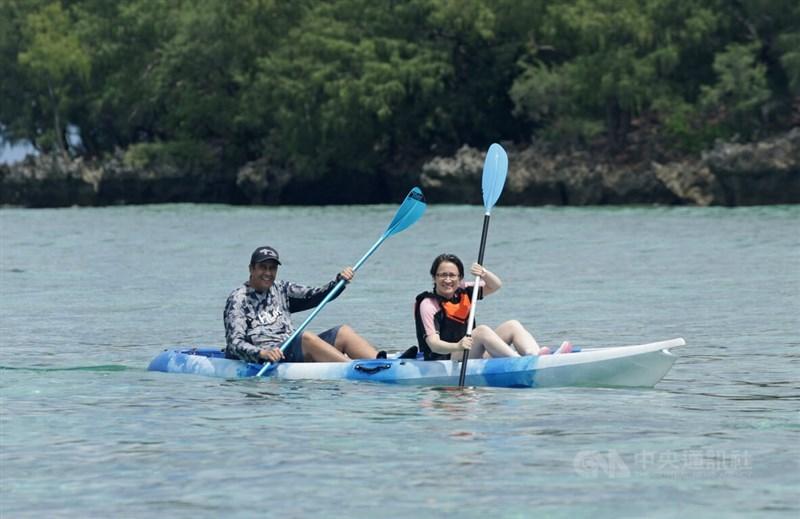
China has been “weaponizing” tourism in Palau by restricting travel by Chinese tourists, Vice President Hsiao Bi-khim (蕭美琴) said today, and she urged Taiwanese to visit the tropical island nation.
“Palau has in recent years been affected by China weaponizing tourism as a means of coercion,” Hsiao said while speaking with reporters on the last day of her visit to the diplomatic ally.
Photo: CNA
The number of Chinese tourists to Palau has often fluctuated dramatically according to controls placed by Beijing, she said.
Palau’s own tourism statistics bear that out, hitting a high of 91,095 visitors from China in 2015, up from 21,661 in 2014, before plunging to 28,368 in 2019 and 21,286 last year.
Hsiao recommended that Taiwanese tourists visit Palau, where they can engage in snorkeling, hiking, boating and cycling, and experience the country’s maritime culture.
China has in recent years banned state-run package tours to Palau and issued periodic travel alerts for the island country, significantly decreasing the number of visitors in an effort to pressure Palau to switch diplomatic allegiance from Taipei to Beijing.
Former president Tsai Ing-wen (蔡英文) in March 2021 set a goal to increase the annual number of tourists to Palau to 100,000 as she tried to help it survive the ravages of the COVID-19 pandemic on its tourism sector.
However, that goal never materialized, and the number of seats sold by Taiwan’s state-run China Airlines per flight to the island country averaged about 10 percent of capacity in November that year, forcing the airline to cancel all direct flights that month.
China Airlines resumed direct flights to Palau in December 2021, and it now operates four flights a week to Koror that in the first four months of this year had a load factor of about 77 percent.
Taiwanese visitor numbers have never rebounded from their peak from 2011 to 2014, when they averaged 33,126 visitors a year, according to Palau inbound tourism statistics.
They rose to 13,367 last year, up about 18 percent from the previous year, but were still far from the peak of 40,605 Taiwanese visitors in 2012, Palau’s figures show.
In her comments today, Hsiao also highlighted the public infrastructure projects aided by Taiwan dotting Babeldaob and Peleliu she had seen on her trip.
She praised the work of Taiwan’s Shin Kong Wu Ho Su Memorial Hospital in assisting with healthcare services at the Belau National Hospital.
Such projects are a testament to the frequent exchanges between the two countries, Hsiao said.
Hsiao is scheduled to wrap up her five-day visit to the Pacific ally and return to Taiwan tonight.
