


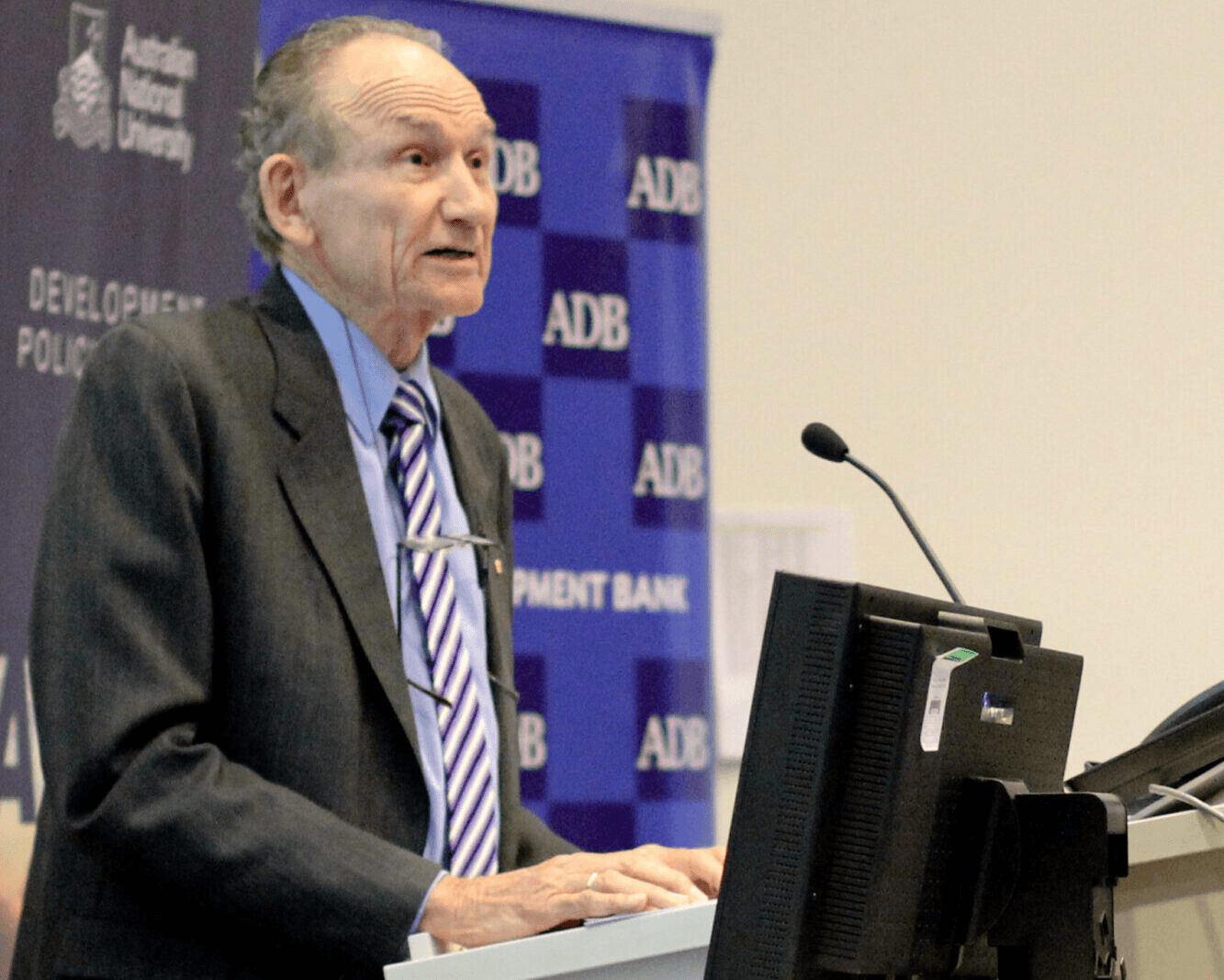
Emeritus Professor Ronald (Ron) Charles Duncan AO was my former boss and mentor, and over time became a close family friend. With Ron, Premila and I always said we got “two friends for the price of one”, because Rita was just as much a part of our lives. A few years ago, while driving through the highlands of Fiji, Premila even made me stop the car to pick wild red-fleshed guavas especially for the Duncans — a small gesture that captured the affection she has for them both.
Ron’s career was distinguished, wide-ranging and deeply influential. After completing his PhD at the Australian National University in 1972, he undertook post-doctoral research at the Commonwealth Scientific and Industrial Research Organisation (CSIRO) before moving to the University of Minnesota and Harvard University. In 1974, he joined the Industry Assistance Commission, rising to the position of First Assistant Secretary by 1979. He later moved to the World Bank, where he became Chief of the International Trade Division — a role in which he shaped global thinking on trade, development and policy.
In 1994, Professor Helen Hughes — the inaugural Executive Director of the National Centre for Development Studies and herself a distinguished Australian and former World Bank colleague — announced her retirement. I have little doubt that Helen, a former professor and close family friend who was an excellent judge of talent, enticed Ron back to the ANU to succeed her. He returned that year and led with characteristic clarity, integrity and intellectual generosity.
Across his career, Ron received numerous honours: the Centenary Medal for Services to Australian Society through Economics (2003), Distinguished Fellow of the Australian Agricultural and Resource Economics Society (2006), Officer of the Order of Australia (2014) and the Socialist Republic of Vietnam Medal for Contributions to Education and Public Policy (2016). Yet, to my recollection, what Ron valued most were not the medals but the many graduate students and colleagues he mentored over decades — people whose careers and lives he quietly shaped.
I owe much of my own career to Ron’s guidance. Although I had moved to what is now the ANU School of Economics for my PhD, my first major collaboration with Ron was on the landmark “Duncan Report”, commissioned by Prime Minister John Howard in 1996. The report examined how Australia could deepen economic ties with the members of the Pacific Islands Forum (PIF). Among its many recommendations were proposals for greater trade and labour market integration between Australia, New Zealand and the Pacific island nations. When PM Howard presented the report at the PIF Leaders’ Meeting in Majuro, The Australian noted that some recommendations — particularly those on labour mobility — were unlikely to appeal to the Government. With hindsight, the Duncan Report foreshadowed modern regional frameworks including the Pacific Agreement on Closer Economic Relations (PACER), the Seasonal Worker Program (SWP) and the Pacific Australia Labour Mobility (PALM) scheme. Ron was ahead of his time.
Ron was again called on by the Howard Government in 2005, this time to lead a three-person “core group” to review and make recommendations for the Australian aid program. The resulting report provided the basis for the 2006 White Paper on Australian Aid, regarded by many as a, if not the, high point in Australian foreign aid policy.
Ron retired from the ANU in 2002. Savenaca Siwatibau, then Vice-Chancellor of the University of the South Pacific and a close friend, was seeking someone to lead his new initiative: the Pacific Institute of Advanced Studies in Development and Governance (PIASDG). Ron immediately came to mind, and I encouraged Siwa to approach him. Ron moved to Suva after some prodding and served as the Foundation Executive Director of PIASDG from 2003 to 2007, before returning to the ANU as Emeritus Professor and continuing his editorial work for two journals. Remarkably, he edited the Pacific Economic Bulletin from 1994 to 2010 and the Asia-Pacific Economic Literature from 2000 to 2022.
Beyond academia and policy, Ron was a family man and a lover of sport. He was also remarkably multi-talented — a gifted pianist and guitarist, and a fabulous cook. I listened to him play music, watched countless cricket and rugby matches with him and shared many meals, some prepared by Ron himself. He was witty, sharp and — I say this with much affection — a sore loser, especially when Australia lost a game. I never missed an opportunity to remind him of it, and Rita often found herself laughing at our banter, fully aware of what I was up to.
Ron will be deeply missed by his colleagues, students, friends and family. But we must also celebrate a life lived with purpose, generosity and humility. He excelled in so many domains yet remained grounded, kind and unfailingly human.
Vale Ron.
This four-part video interview records Ron reflecting on his life and career. This wide-ranging 2014 Pacific Update speech captures many of Ron’s key research concerns and themes.
