


Overview:
A high-stakes legal battle is unfolding in Palau’s Supreme Court as defense lawyers push to dismiss a forfeiture case against an Indonesian fishing vessel, arguing it was seized in disputed waters beyond Palau’s legal reach. At the heart of the case are questions about maritime boundaries, international law, and how far the nation can go to enforce its fisheries protections.
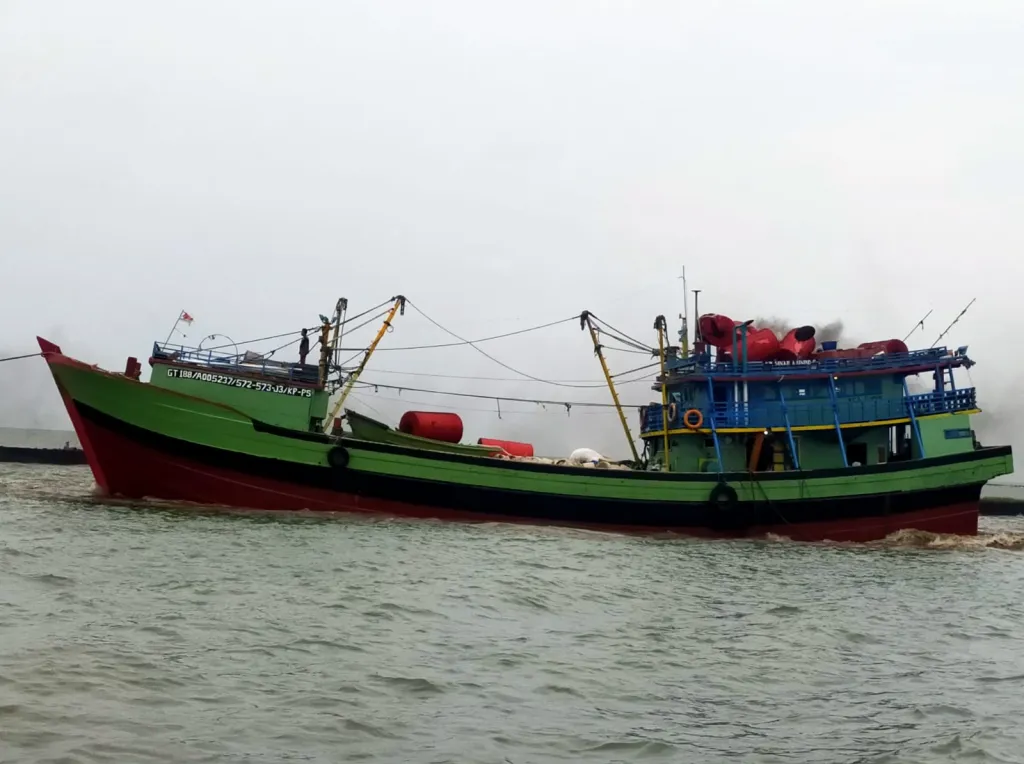
Lawyers argue Sinar Arindo-6 was outside national waters as prosecutors cite shark finning evidence
By: L.N. Reklai
KOROR, Palau (April 30, 2026) Defense lawyers for an Indonesian fishing vessel are asking the Palau Supreme Court to toss out a major forfeiture case, arguing the ship was seized in disputed waters and that Palau has no legal right to take it.
Counsel for the F/V Sinar Arindo‑6 says every official coordinate places the vessel in an undelimited overlap zone between Palau’s and Indonesia’s 200‑mile EEZ claims, not in “Palau’s waters” as defined by Palau’s own laws and international law. They warn that going ahead with forfeiture would let the courts effectively draw a maritime boundary that diplomats are still negotiating—and would breach Palau’s treaty obligations under the UN Convention on the Law of the Sea.
The defense also attacks the evidence, claiming steel leaders were found only in a later dockside search, not during the at‑sea boarding, and that shark fins were located after questioning non‑English‑speaking crew without an interpreter. They argue the bulk tuna cargo is ordinary commercial fish, not contraband, and cannot simply be swept into forfeiture while it rots at the dock.
Prosecutors counter that regional surveillance flagged the Sinar Arindo‑6 operating inside Palau’s EEZ, and that officers found deployed purse seine gear, no license or logbooks, finned shark carcasses, shark fins and steel leaders on board—enough, they say, to justify forfeiting the vessel, its gear and all 40 tons of catch.
The court must now decide whether to shut the case down, narrow it, or push into a full hearing on where the vessel was really fishing—and how far Palau can go to enforce its conservation laws in still‑contested seas.
(See detailed explainer on Page 4)
