


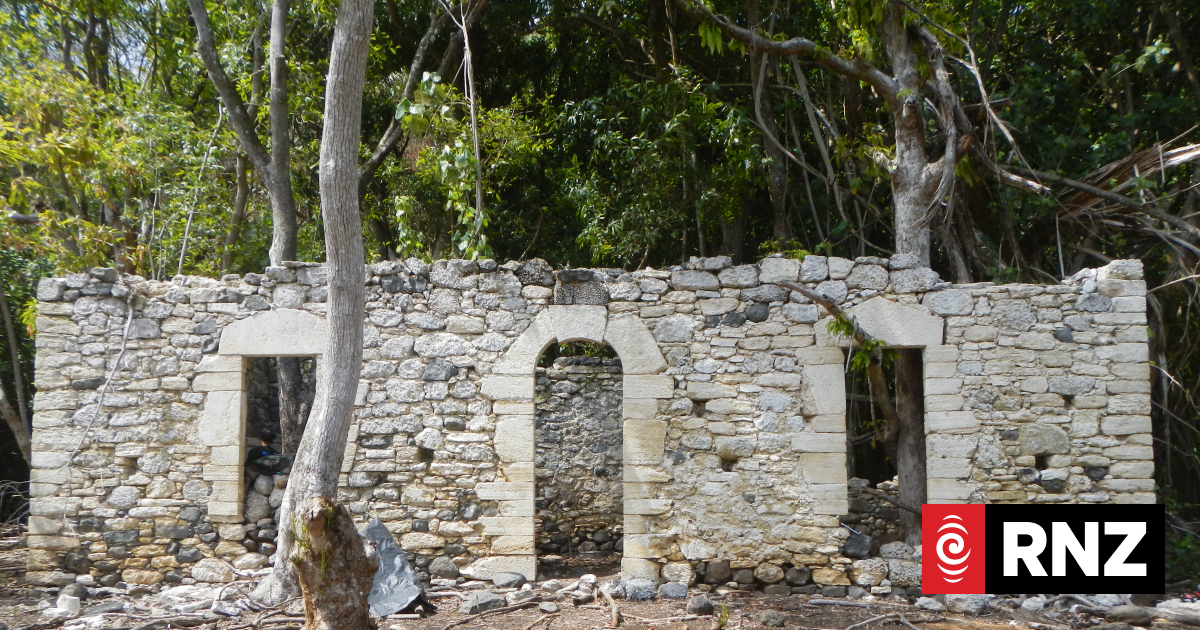
North facing façade of a house on Akamaru Island.
Photo: Associate Professor James Flexner, University of Sydney
A team of archaeologists has used an advanced dating technique to establish a precise construction timeline for houses built out of coral in French Polynesia.
Led by the University of Sydney and published in the journal Antiquity, the study is the first time uranium-thorium dating, also known as U-Th dating, has been applied to date historical coral architecture.
This method produces precise age estimates without the need for extensive excavation.
Associate professor James Flexner, an Australian Research Council Future Fellow in the Faculty of Arts and Social Sciences and member of the Vere Gordon Childe Centre, led the research on Mangareva, a group of islands in French Polynesia.
Coral was the main material for houses there before timber became dominant in the 1870s.
He said the indigenous people learned the building technique from French Catholic missionaries.
“They built cathedrals, churches, schools, communal bread ovens, watch towers and small stone cottages out of locally sourced coral from nearby shore reefs, as well as beach rock corals from exposed formations on land,” he said.
Ten coral samples from the Mangarevan structures were dated by the University of Queensland’s Radiogenic Isotope Facility.
The university said Europeans kept detailed records of their own buildings but wrote almost nothing about the everyday homes constructed by local Mangarevan families.
“What surprised us was that several coral blocks returned dates earlier than expected,” Flexner said.
“A few even pre-dated European arrival, suggesting the builders may have reused older coral taken from nearby sites.”
Dating the coral helped the researchers track how everyday life in the Pacific evolved following European contact.
“Some of the evidence we found within the walls of the coral structures, including glassware, cooking pots and ceramics, indicated activities such as feasting events, whereas others pointed to changes in habits of everyday domestic life, from how a family prepares and eats meals together, to how people move throughout the home, how they might pray and worship, or how they sleep.
“People think of coral mainly in the context of bleaching and climate change today, but each coral block used for the construction of these houses retains a chemical record of the environment in which the coral grew, offering a historical archive of coral reefs and past ecological change.”
The U-Th dating method was originally used in Polynesia to date prehistoric coral and cave formations, including the initial discovery of the Tonga archipelago and Mangareva Islands, Hawaiian sacred sites, and coral blocks from marae, ancient temples in Mo’orea.
Flexner hopes future collaborations will extend the work to neighbouring archipelagos where coral construction also flourished.
