


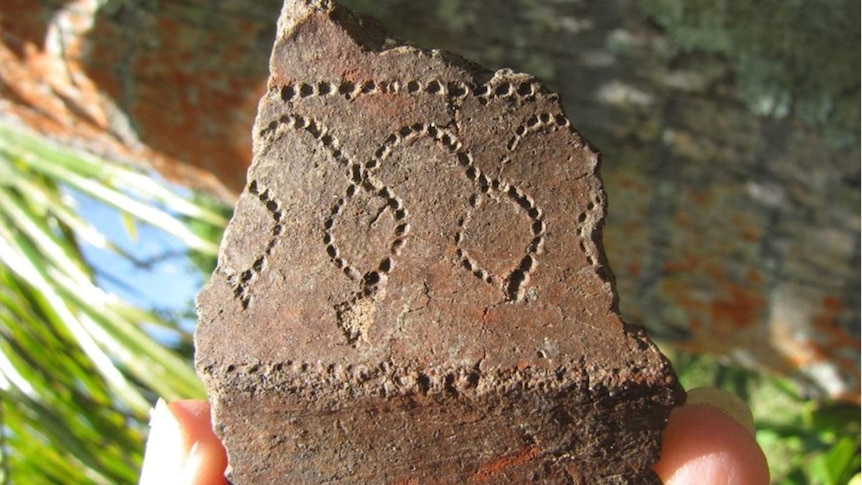
It’s taken for granted that most of the Pacific are the direct descendants of the Neolithic population known as the Lapita culture.
South-east Asian in origin, the Lapitas spread through the Pacific 3,200 years ago before the Papuan gene began to mix in about 1,000 years later.
The Laptias have left their trace across the Pacific in the form of distinctive pottery fragments and a shared language group, forms of which are spoken by all Pacific Islanders.
But in Palau, there are no such pottery fragments to be found, and their language, whilst a form of the shared language group, is distinctly different from the rest of the Pacific, making Palau an unknown gap in the history of Pacific settlement.
Now, a new study on the DNA of ancient Palauns has found that, unlike other Pacific Islanders, the South-east Asian and Papuan genetic mixture occurred before settlers first arrived in Palau.
Independent researcher Joanne Eakin, who was part of the team that brought the study together, says that the study contradicts established assumptions on the settlement of Palau and the Pacific more generally.
“The initial settlement of remote Oceania was not simply the result of a direct migration from Taiwan through the Philippines; we show that the path to Palau followed a more complex pattern,” she said.
