


The recent ANU–UPNG book on the economic history of Papua New Guinea, Struggle, Reform, Boom and Bust, divides PNG’s post-independence history into four periods, basically by decades: the seventies and eighties (early struggles); the nineties (reform and crisis); the noughties (boom years); and the tens (the quiet bust).
The book’s quantitative analysis ended in 2022. With data now available up to 2025, what period is the PNG economy now in?
It was already clear by the time the book was finished, and was therefore noted in it, that PNG had exited in 2022 the period of “quiet bust” it had been stuck in since 2014. So, for this analysis, we end “the tens” in 2021, and define a new period, the twenties, from 2022 to 2025.
The table below contains the key updated data.
Clearly, things have improved significantly in recent years. The book’s main indicator for economic performance is non-resource GDP per person. This fell at an average rate of 1.1% in the tens (2014–2021), but has recovered in the twenties to 2.3%, not far off the 2.8% achieved in the boom years. (Population growth of 2.7% is assumed.)
GDP per person growth is actually lower in the twenties than the tens but, since the benefits of the enclave resource sector substantially flow offshore, this is not a good indicator of PNG economic performance.
Formal sector employment has also performed better in the twenties. This fell at an annual average rate of 1.8% in the tens, but has increased so far in the twenties at an average rate of 2.6%.
What explains the improved economic performance of the last few years?
PNG is a commodity economy, and in recent years has benefited from high commodity prices. The PNG-specific commodity price index that was constructed for the book fell in the tens, but has risen in the twenties. While the index is still below its 2012 peak, it is higher in the twenties than it was for the noughties as a whole, and much higher than it was any time last century. The high prices for energy in the last few years (due to first the Ukraine and then the Iran war), and for gold, are enormously beneficial to PNG.
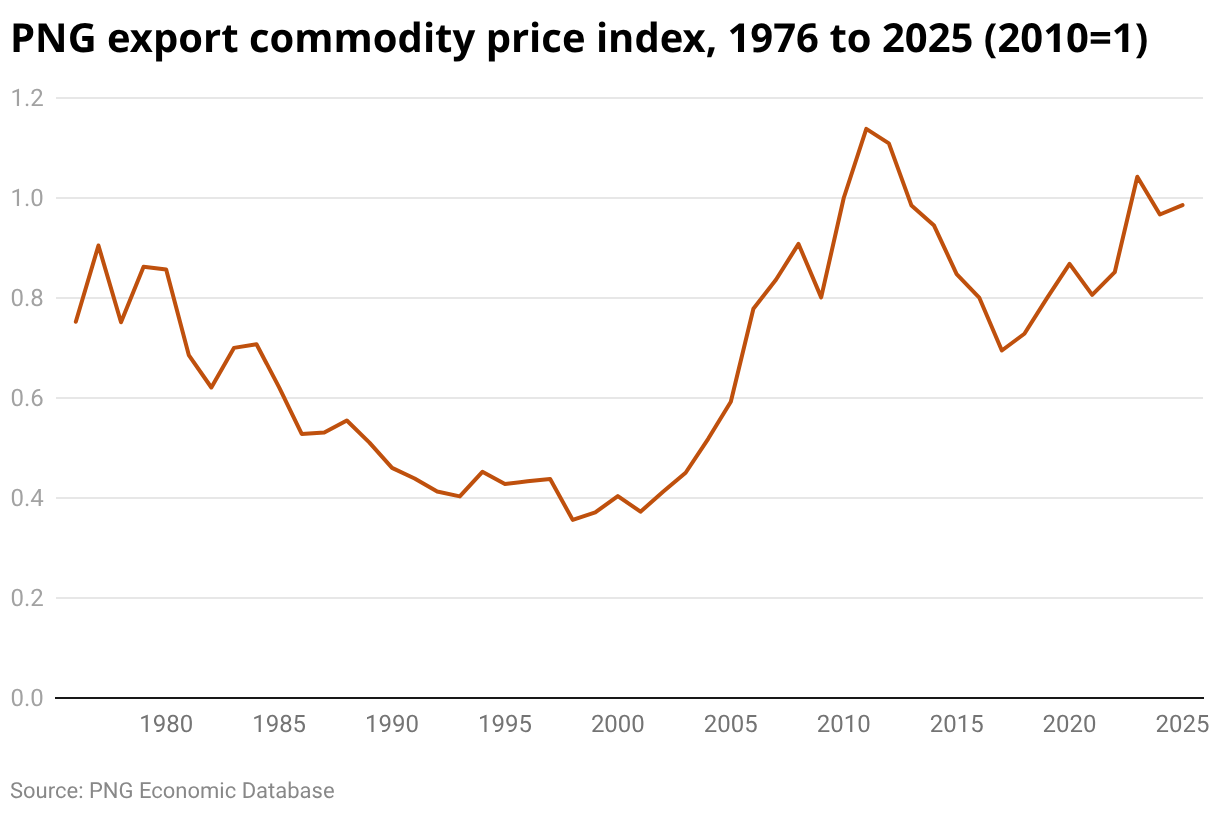
As is explained in the book, high commodity prices are a necessary but not sufficient condition for the broader economy to do well. 90% of PNG’s commodity exports are in the resource sector. For high resource prices to translate into broad-based growth, there must be “revenue-ready projects”, that is, projects that pay lots of tax and dividends to the government when commodity prices are high. This revenue in turn is spent by the government, thus stimulating the rest of the economy.
The “quiet bust” of the 2010s was caused in part by a resource revenue drought, with the ratio of resource revenue to GDP the lowest of any of the four post-independence periods. That revenue drought has now been broken, partly because commodity prices have risen, and partly because PNG LNG debt has been paid off leaving more profits to be taxed and dividends to accrue to government. Resource revenue has risen in the twenties to 3.8% of GDP, more than triple the 1.2% of GDP seen in the tens, and not far from the 4.9% seen in the boom years.
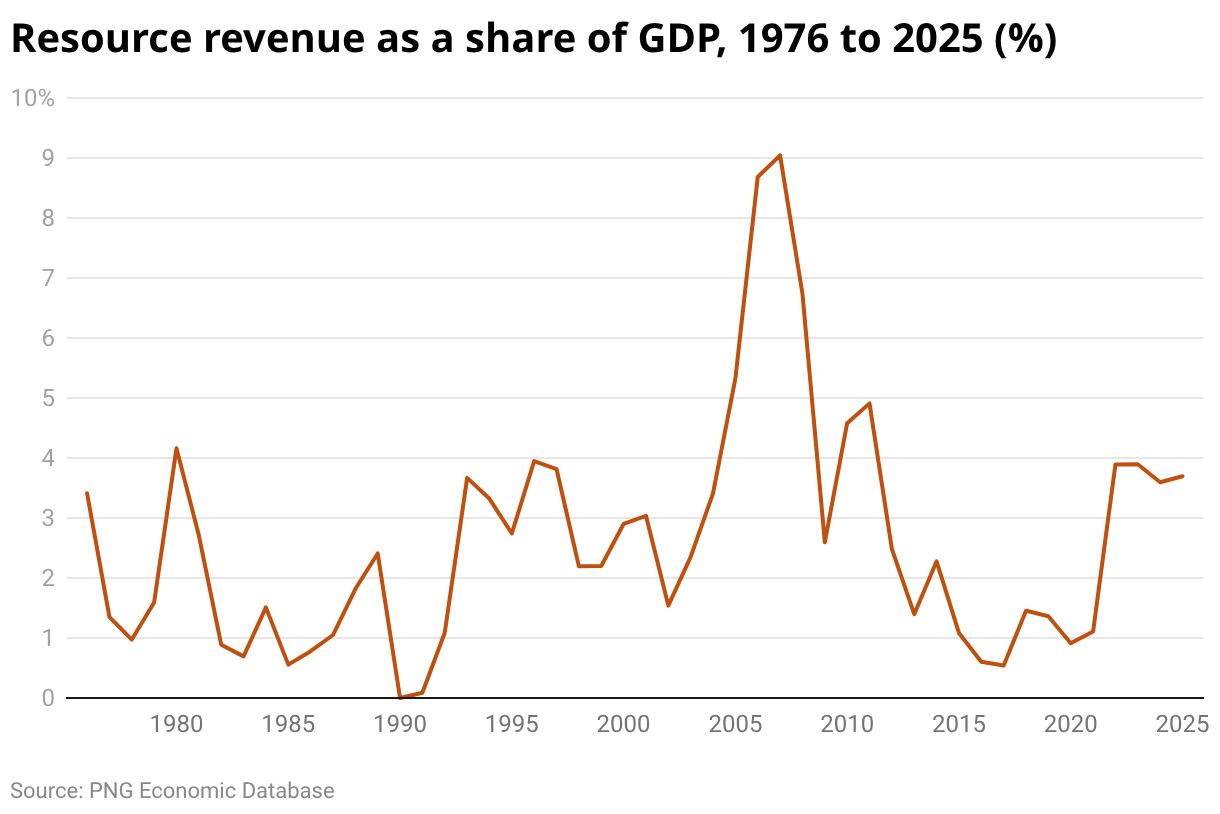
With commodity prices and resource-revenue-to-GDP both up, it is not surprising that the PNG economy is doing much better now than it was during the quiet bust. While these factors represent good luck for the current government, it also deserves credit for its major central banking reforms, which have reduced, though have not entirely eliminated, foreign exchange rationing, identified by businesses as their main constraint on growth during the 2010s. This has involved a managed depreciation of the PNG kina against the US dollar of more than 20% over the last three-and-a-half years.
Not only is economic performance better in the twenties than during the bust, but it is impressive by the country’s post-independence standards, with both non-resource GDP growth (2.3% vs 0.5%) and employment growth (2.6% vs 1.6%) well above the post-independence averages.
How does the economic performance of the last few years compare to the boom years of the noughties? Here the picture is more complicated. On the one hand, non-resource GDP per person growth is not that different from the growth achieved in the boom years: 2.3% average so far in the twenties compared to 2.8% for the noughties. This difference could be explained by the lack of new mega-resource projects. PNG LNG construction was a significant contributor to the boom of the noughties, and there has been nothing like it since that construction was completed in 2013.
The main disappointment is that employment is not growing faster, a point also emphasised by the World Bank in its most recent PNG economic analysis. Reported private sector employment growth for 2022 to 2025 is 2.6%, which is about the population growth rate, and only about half the growth rate achieved in the boom years (5.0%), when employment growth was high even before the start of the PNG LNG construction. Why hasn’t employment growth been faster in the twenties? Perhaps it reflects a lack of confidence that conditions will remain good. There is also no sign of a pick-up in private investment (outstanding bank credit to the private sector remains flat relative to GDP).
Summing up, it is still too early to put a label on the twenties. Looking ahead, there is a lot of uncertainty.
On the one hand, PNG will likely continue to benefit from high energy and record gold prices and, eventually, one of the long-awaited, and long-negotiated new resource projects will arrive and stimulate the economy.
On the other, El Niño will dampen both agricultural and resource sector growth this year and next (with Porgera and Ok Tedi output both at risk due to the need of both mines for inland water). And the next global shock and downturn may be just around the corner, if it hasn’t already arrived.
For now, what we can say is that high commodity prices, a recovery in resource revenue and economic reforms have helped boost non-resource economic growth over the last few years to near-boom levels. However, until formal sector employment growth exceeds population growth, concerns about jobs will remain front and centre, and it will be hard to describe the economy as booming.
The Australian National University (ANU)–University of Papua New Guinea (UPNG) PNG Economic Database has been updated to include 2025 data and can be found at https://crawford.anu.edu.au/devpolicy/png-economic-database.
