


In late August, Samoa’s Cabinet approved labour mobility reforms, effective immediately and aligned with the government’s 2023 policy for temporary labour migration.
The reforms set an annual mobilisation cap of 10,000 workers, down from 12,000 in the 2023 policy, with 5,000 each for New Zealand’s Recognised Seasonal Employer (RSE) scheme and Australia’s Pacific Australia Labour Mobility (PALM) scheme. They end direct referrals of new workers by current workers, village leaders or employers: every request for replacement or additional workers must now be routed through Samoa’s Labour Employment Export Programme (LEEP) Division of the Ministry of Commerce, Industry and Labour.
Candidates must register through one of the 51 Electoral Constituencies (ECs), the districts used for parliamentary elections, and registration is restricted to unemployed people aged 21–45, who must produce character references from both their local mayor and pastor. A 20-year lifetime participation limit applies.
The reforms also introduce fees: WST50 (50 Samoan tala, about A$28) for workers, annual fees of WST1,000 (about A$550) for village committees and WST10,000 (about A$5,500) for agents, and recruitment fees for employers of A$ or NZ$50, 40 or 30 depending on the number of workers recruited.
The government has, however, backtracked on a 60:40 requirement governing the mix of returning and new workers. Introduced in July 2026 (it was not in the 2023 policy), it was removed following strong lobbying by employers with longstanding recruitment relationships in Samoa.
Major growth in Samoa’s engagement in the RSE and PALM schemes, during and immediately post-Covid, explains the government’s interest in closer oversight. A new report on Samoa’s first 18 years in the RSE scheme (financial years 2007–08 to 2024–25) provides evidence against which to review the reforms.
Samoa has been one of the main sources of RSE labour, alongside Vanuatu and Tonga, since 2007. Annual Samoan arrivals have grown from around 1,100–1,300 in the early years to a peak of 4,160 in 2022–23, before settling at around 3,800–4,000 since then.
At the end of March 2026, over 6,200 Samoans were offshore (3,306 RSE workers and 2,950 under PALM), equivalent to about 8% of Samoa’s residents aged 20–49 — roughly the age group eligible under the new reforms. Because 95% of those offshore were men, the equivalent of 16% of Samoan men aged 20–49 were away on the two schemes, compared with only 0.9% of women.
Samoa’s RSE participation has always been highly gendered. Women have made up fewer than 10% of Samoan RSE arrivals in any given year, and the share has fallen to just 1.3% in 2025–26.
Samoa’s female participation in PALM is higher than RSE, but still low at around 10% for seasonal work under short-term PALM and 12% under long-term PALM. Samoan cultural values and practices and family care expectations have contributed to the low prevalence of women in offshore work.
Given it is predominantly men taking up jobs offshore, Figure 1 shows male RSE migrants absent per 1,000 resident population in Samoa by age group, over three periods: 2008–12, 2017–19, 2023–25. It shows a marked increase in the absence of men aged 20–49 at any one time, and this excludes those working in Australia under PALM.
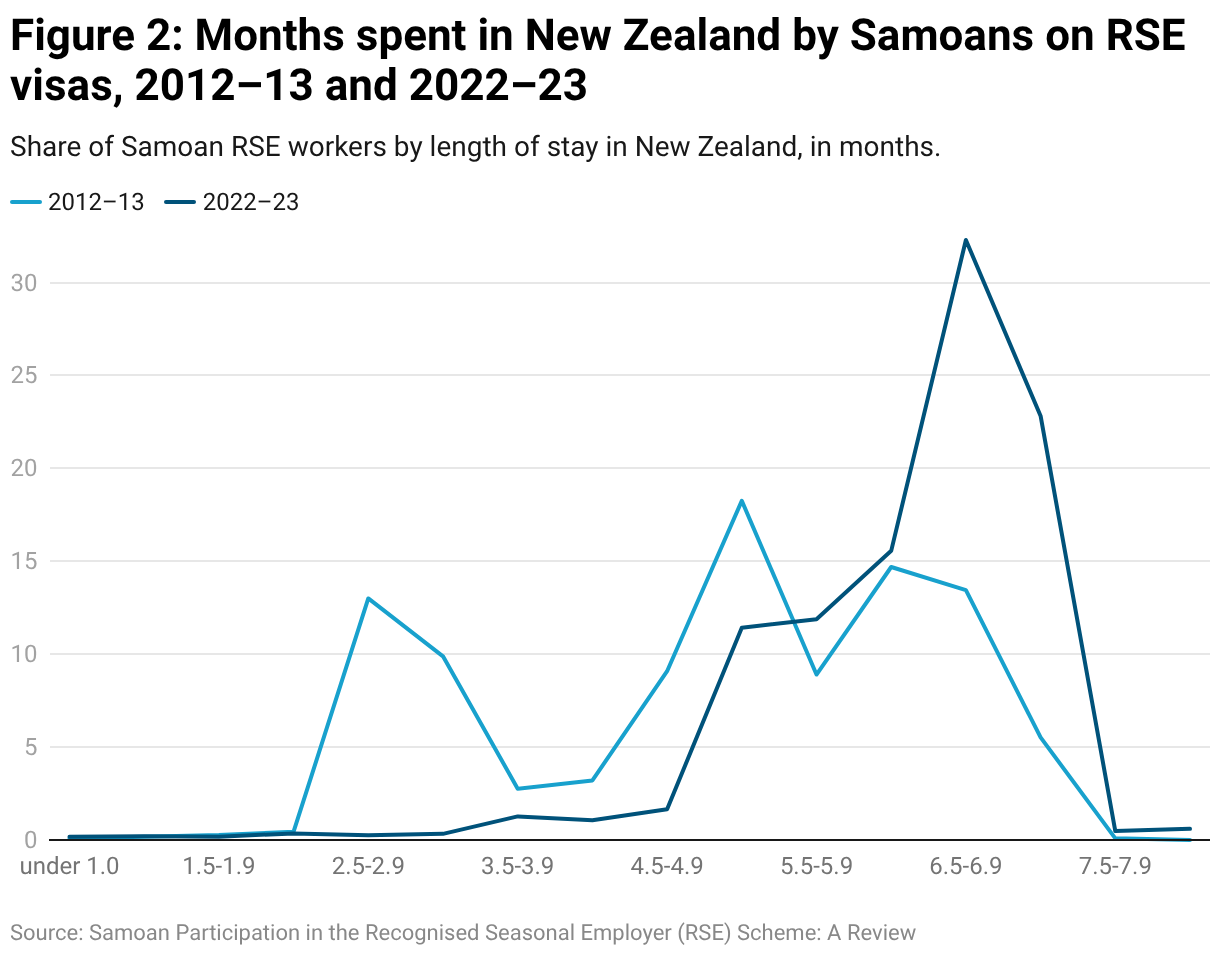
There has also been an increase in the length of RSE workers’ absence each year. In 2012–13, 38% of Samoans spent fewer than five months in New Zealand. A decade later, in 2022–23, 70% of all Samoans stayed six months or longer, i.e. more than half the year in New Zealand (Figure 2). The longer contracts in New Zealand are linked to a push by Immigration New Zealand to get employers to recruit fewer workers, but maximise them over the full contract period, in the interests of efficiency.
Data on length of stay in Australia is unavailable, but short-term PALM allows up to nine months’ employment and long-term PALM up to three years (at Samoa’s request; four years for other Pacific countries). The current split between PALM-short and -long Samoan workers is 50:50 (short-term 1,475; long-term, 1,470 in July 2026).
At the village level, the loss of the Taulelea, or untitled men — known as the “malosi o le nuu” (the strength of the village) — who perform agricultural, domestic and community work, is an issue. Local women’s committees must pick up this communal work, adding to their burden.
More broadly, concerns continue about the loss of skilled, experienced workers from Samoa’s domestic economy. These losses are not solely linked to temporary labour migration, but also to an increasing outflow of Samoans through long-term migration pathways to Australia, New Zealand and other countries on the Pacific rim.
A recent survey of 408 businesses found that “labour migration is placing material pressure on Samoa’s private sector through workforce departures, skills shortages, staff retention costs, replacement challenges and productivity impacts”. Of the businesses surveyed, 47% reported departures linked to RSE, PALM or StarKist pathways, with 2,375 resignations self-reported across 2023 and 2024.
So how do the government’s labour mobility reforms address these concerns?
The annual cap of 10,000 (5,000 per scheme) sits well above current volumes for RSE and PALM. While a domestic cap potentially forecloses future growth, both the RSE and PALM schemes have effectively plateaued in terms of worker numbers, so a cap is nominal at this stage.
Distributing worker registrations across the 51 ECs appears to be supported by evidence. The 2021 Census shows the schemes reaching almost everywhere: 88% (297) of Samoa’s 339 villages and all 51 ECs had participating households.
Nationally, 10.3% of households were participating, but the distribution is highly uneven across the country, as shown in Table 1. Household participation ranged from 6% in the Apia Urban Area to 16% on Savai’i, with six of Savai’i’s 20 ECs having more than 20% of their households engaged in RSE and PALM during 2021.
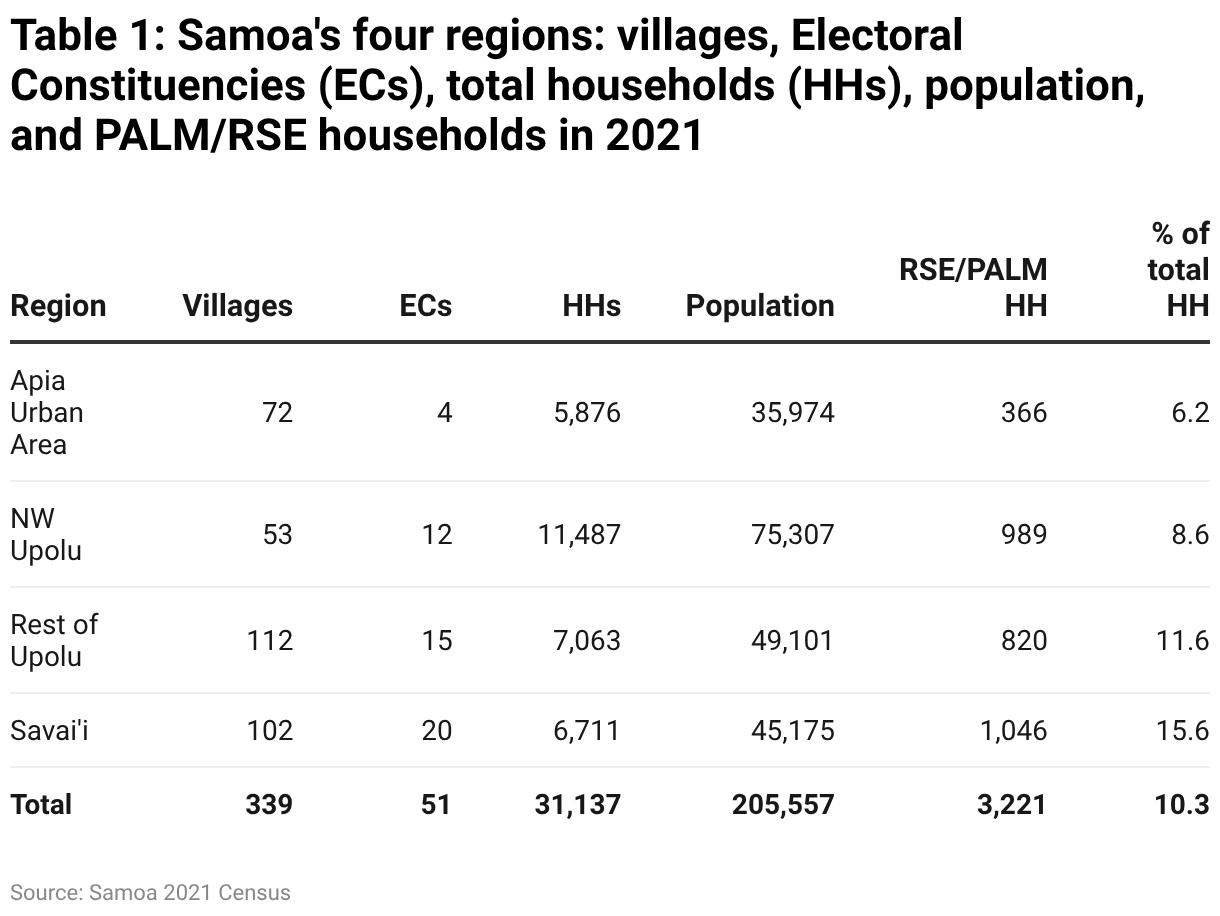
When looking specifically at men aged 20–49, nationally 9.1% of men were absent during 2021. On Savai’i however, a quarter of villages had 20% or more of their men away, compared with 10% of the villages in the Rest of Upolu, 1% in the Apia Urban Area and none in North West Upolu, despite those areas’ larger populations (Table 1). These patterns of inequity are what the government’s new recruitment policies are designed to reshape.
Restricting recruitment to the unemployed responds to concerns about the loss of skilled workers from the domestic economy. However, if the constituency-based recruitment model succeeds, it will shift mobilisation towards the Apia Urban Area and North West Upolu constituencies that have participated least. These areas — not the rural villages of Savai’i — are where Samoa’s private sector employers and their workforces are. Spreading opportunity more evenly and shielding domestic firms from labour loss are both legitimate objectives, but the reforms pursue both at once without acknowledging the tension between them.
Removing the 60:40 requirement, while understandable given strong employer preferences for return workers, also undercuts the equity objective. Returnees already make up 68–70% of Samoan RSE arrivals each year. If employers have the freedom to retain experienced workers, and recruitment of new workers is now restricted to a shortlist of candidates — that is, a work-ready pool — managed by officers of the local constituency council (Fono Faavae) in partnership with LEEP, rather than through employers’ preferred approach of direct recruitment, returnees will naturally crowd out the new entrants the constituency model is designed to admit.
Finally, the 20-year limit will have little impact on actual participation. Of the RSE men first recruited in 2008, 40% never returned and only 13% worked ten or more seasons over the 17 years to 2025. Sixty-six per cent of men have had four or fewer seasons, and average seasons worked have fallen from 3.9 for men recruited in 2008–13 to 2.8 (2014–19) and 1.8 (2020–25).
RSE recruitment is now underway for 2026–27, and it remains to be seen what impact, if any, these reforms will have on employers’ recruitment decisions. Samoa’s next Census, scheduled for November 2026, will provide the real evidence on whether the reforms — which require a more concerted, targeted approach to recruitment — are reshaping Samoa’s engagement in labour mobility as intended.
