


In June 2025, health workers in Tafea Province, Vanuatu, reported a cluster of severe respiratory illness among infants. Laboratory testing later confirmed Bordetella pertussis, the bacterium that causes pertussis, also known as whooping cough. The cluster became part of a prolonged outbreak across Tafea and Shefa provinces that continued until it was officially declared over in July 2026, prompting a sustained Ministry of Health response.
Whooping cough is highly infectious and can be especially dangerous for babies and young children. It can also be difficult to recognise early. Initial symptoms may look much like those of a common cold, before the characteristic coughing fits appear.
This matters in the Pacific, where health services often support populations spread across many islands and transport and laboratory confirmation can take time. The first sign of an outbreak may be noticed by a nurse in a health centre, a provincial surveillance officer reviewing reports or a village health worker who sees that an illness is appearing more often than usual.
This is where 7-1-7, a global target for outbreak detection and response, can make an impact. It calls for a suspected outbreak to be detected within seven days of emergence, notified to the relevant public health authorities within one day, and then key early response actions initiated within seven days.
The numbers are deliberately simple, and the tool does not require expensive technology. It can be used by health workers at different levels of a system and applied during an outbreak, while there is still time to adjust the response, rather than waiting for a review after the event.
The target was proposed in a 2021 Lancet commentary by Tom Frieden, former director of the US Centers for Disease Control and Prevention, and colleagues at Resolve to Save Lives. It was a response to the observation, sharpened by COVID-19, that global health-security frameworks had measured capacity (does a country have a laboratory or a surveillance system?) rather than performance (how quickly was the last outbreak detected and contained?). The format echoes China’s earlier 1-3-7 malaria-elimination target, which helped drive that country to WHO malaria-free certification in 2021. The 7-1-7 Alliance was formed in 2023 to support adoption, and by 2024-25 more than 90 countries were using or piloting the approach.
Time-based targets make sense because infectious diseases grow exponentially: each day of delay in detection or response translates into many more cases. A 2023 retrospective study in Lancet Global Health across Brazil, Ethiopia, Nigeria, Uganda and Vietnam found that applying 7-1-7 was feasible, helped identify concrete bottlenecks and was associated with improved timeliness after adoption. Because the metric needs only dates rather than sophisticated informatics, it works in resource-limited and geographically dispersed settings, where delays are typically longest and outbreak consequences most severe.
When Burnet Institute began supporting the adoption of 7-1-7 in Vanuatu in 2025, we worked alongside the Vanuatu Ministry of Health to understand where the approach could fit within existing surveillance and response systems, and how it could be adapted to the realities of a small island state.
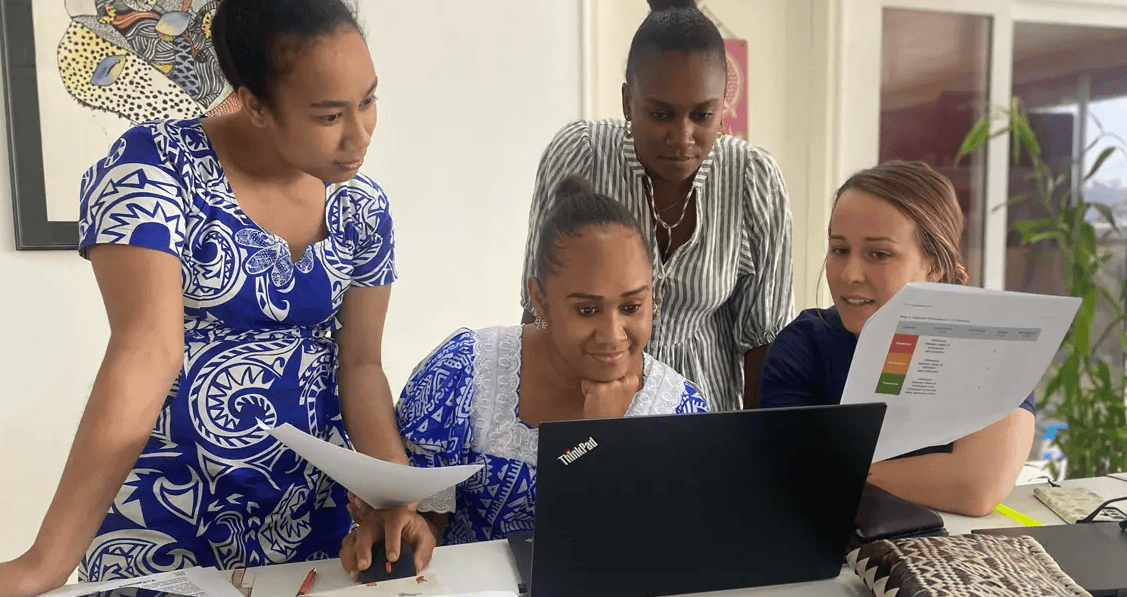
National and provincial surveillance officers, disease control teams and One Health partners took part in training and practical exercises. The move from training to real-world use came during the 2025 pertussis outbreaks in Tafea and Shefa province — surveillance officers applied the approach on the ground and Burnet supported with technical mentoring.
In Tafea, the review recorded 26 days from outbreak emergence to detection, one day from detection to notification, and 24 days to complete the key early response actions.
The review gave the team a shared timeline and made visible what was already supporting the response. Vanuatu was not starting from scratch — existing vaccine-preventable disease guidelines provided clear technical direction, and an electronic notification system allowed reports from provincial health offices, laboratories and hospitals to reach the national surveillance team quickly. The activation of emergency operations helped coordinate action, while national surge support strengthened capacity in the province.
Provincial teams agreed that unusual clusters and suspected outbreaks should be notified and investigated as soon as clinical or surveillance concerns arise, rather than waiting for laboratory confirmation, which can take several days or weeks. They emphasised more consistent use of the electronic notification system and the establishment of clear after-hours and weekend notification procedures, including on-call surveillance focal point coverage for priority diseases. The assessments also highlighted the need for standard protocols and reminders to ensure suspected cases are tested promptly at first presentation.
During responses, responsibilities for key actions, including laboratory follow-up, liaison with pharmacy and medication provision, and overall response should be clearly assigned in advance.
Outbreak reviews can produce a long list of issues, some of which require considerable time and resources to address. Using 7-1-7, teams can separate the changes that can be implemented immediately from those that need longer-term planning, funding or system-strengthening. The same process also gives proper attention to the people, systems and earlier capacity-building efforts that are already working well.
The Vanuatu Ministry of Health has now included 7-1-7 in the country’s 2026 National Surveillance Workplan, and it is being incorporated into routine provincial surveillance training across all six provinces. Vanuatu health leaders are also presenting their experience internationally, allowing lessons from a small island state to contribute to wider learning about outbreak response timeliness.
There will not be a single model for applying 7-1-7 across the Pacific. In Fiji, discussions with the Ministry of Health, The Pacific Community (SPC) and others have identified possible pathways to integrate it into outbreak response teams’ work, standard operating procedures, training and national planning.
As the 7-1-7 technical lead organisation in the Pacific, Burnet’s role is to provide technical continuity by helping partners adopt the framework, build capability, apply it during outbreaks and share the lessons learned across the region.
7-1-7 may be a global target, but its value is realised locally. It helps ensure local healthcare workers have the knowledge, relationships and confidence to act so that each outbreak will leave the health system stronger and better prepared for the one that follows.
