


Contemplating the future of Grey Lynn’s abandoned Carlile House
Morning Report
* This article has been updated to clarify Auckland Council was approached by the church regarding demolition, but this was prohibited.
Leaders of a church that owns a historic abandoned building in central Auckland have been in talks with Auckland Council about the possibility of demolishing it.
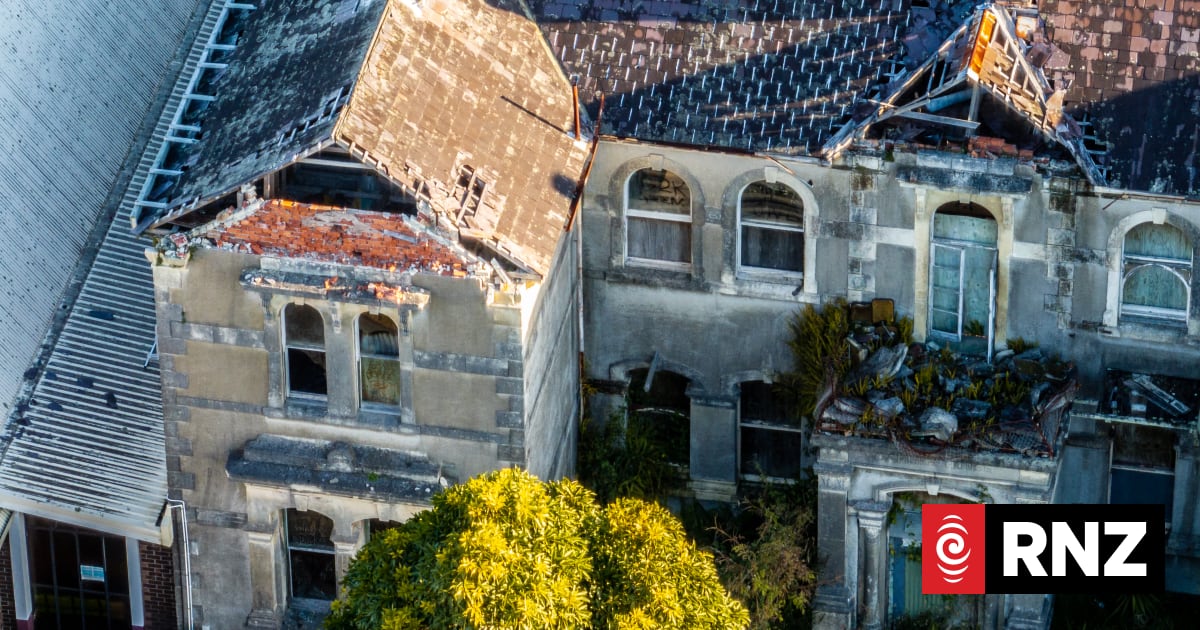
The once-grand, two storey Carlile House in Auckland’s Grey Lynn was built in 1886 and has had many uses over its long life – including as an Anglican children’s home, and an alternative school.
But in recent decades it has fallen into ruin and the church that owns it do not have the money to restore it to its former glory.
RNZ looks at the history and future of the building as part of our Abandoned Auckland series.
Architect and Grey Lynn local Graeme Burgess looks over a barbed wire and corrugated iron fence at the historic Carlile House on Richmond road in Grey Lynn.
“Right now, because of the fence running through here it actually feels so guarded, and it’s like something that nobody can actually appreciate.”
The building was grand in size and stature, but Burgess said after years of neglect it was heart-breaking to see the state it had ended up in.
“[It’s] difficult to watch something so grand and so wonderful slowly falling apart. But there are reasons why it’s in the state that it’s in at present. And those reasons are incredibly complex.”
The United Church of Tonga, which owned the building, did not have the money to do it up.
The church did not want to be interviewed for this story, but said it was working through its options for the building, and would put forward a plan in coming months.
Auckland Council said it had been approached about the possibility of demolishing the building by the church, but as it was a Category 1 Historic Place, that was prohibited.
The building was a Category 1 Historic Place
RNZ / Marika Khabazi
Graeme Burgess hoped the church and council could find a way to make use of the place.
“I would hope that’s not the discussions they’re having. I hope that the discussions they’re having would be about how the place can be retained to the greatest extent possible.”
Local artist John Reynolds, who has lived opposite Carlile house for decades, was less optimistic – given the roof of the building had partially caved in.
“At the current rate of decay, in 18 months it’ll be collapsing in on itself, if not before.”
Reynolds believed the church had no interest in restoring the building, and the council had not done enough to help find a resolution.
In 2019, Auckland Council offered to buy the building, but the church declined.
At the time it was estimated re-developing it would cost $10 million to $20 million.
Reynolds would like the large property to be turned into social housing.
“It could be many houses, and it could be housing for people that needs housing. It could be a win for the community, a win for the church, and actually a win for the heritage nuts.”
Local historian Tania Mace said Carlile house was originally built with money bequeathed by early Auckland businessman Edward Costley.
“He lived a very frugal life, he never owned his own home. In the end when he passed away he made a number of bequests and this was one of them. And the people of Auckland were shocked to find he was extremely, extremely, wealthy.”
It was originally a training facility for disadvantaged young boys to learn technical skills.
Later it was an Anglican children’s home, the headquarters of an evangelical outreach mission, an alternative school, and briefly a remand home, before eventually being bought by the United Church of Tonga in the late 1970s.
Auckland Council compliance manager Adrian Wilson said the heritage of the building should be protected by its owners, but the council had no power to compel this.
