


Papua New Guinea’s many parties in parliament make for fragmented politics. In previous posts, one of us (Laveil) used the effective number of parties (ENP) index to measure fragmentation at elections and in the previous parliament. In this post, we extend the analysis to the current parliament.
Although most candidates stand as independents, most winners come from parties. Since 1977, an average of 81% of winners in each election belonged to parties, reflecting the tendency of parties to endorse the candidates they judge most likely to win. PNG’s parliament had 109 seats between 1975 and 2011, 111 seats between 2012 and 2021, and 118 seats since 2022.
A simple count of parties in parliament overstates fragmentation, because many parties hold only one or two seats. The ENP index corrects for this by weighting parties by their size. It is calculated as one divided by the sum of the squared seat shares of each party. A parliament with two equal parties has an ENP of 2; a parliament with one large party holding 80% of seats and four small parties holding 5% each has an ENP of about 1.6, because the small parties add little to the effective total. The higher the ENP, the more fragmented the parliament. The index can also be calculated from vote share (electoral ENP) instead of seats (parliamentary ENP). We use the parliamentary ENP throughout this post.
The chart below (Figure 1) shows three measures for each election: the total number of parties, an ENP that excludes independents and an ENP that treats each independent as a one-member party. The ENP excluding independents is consistently the lowest of the three. In the 1990s the ENP including independents rose above the total number of parties, because so many independents were elected.
The ENP including independents has fallen since 2002 for two reasons: fewer independents have won seats (down from 38 in 1997 to 10 in 2022), and the ENP excluding independents has also fallen.
The total number of parties has likewise trended down since 2002, though it levelled off in 2017 and rose again in 2022. Since 2012 the number of parties has risen while the ENP excluding independents has fallen: more parties have entered parliament, but most MPs sit with a handful of larger parties.
PNG’s parliament is highly fragmented by international standards. Its ENP including independents of 6.7 in 2022 ranked 10th of 139 countries with elected parliaments. In the region, PNG is less fragmented than Vanuatu (9.1) but more fragmented than Solomon Islands (6.2), New Zealand (3.8), Fiji (2.6), Australia (2.4) and Samoa (2.3). (See online table and download data from the 139 countries.)
Fragmentation in PNG does not stay fixed between elections, because MPs frequently switch parties (Figure 2). In the 2017-2022 parliament, 75 MPs switched parties at least once, and 28 switched more than once. In the current parliament, 48 MPs have switched at least once, and eight more than once.
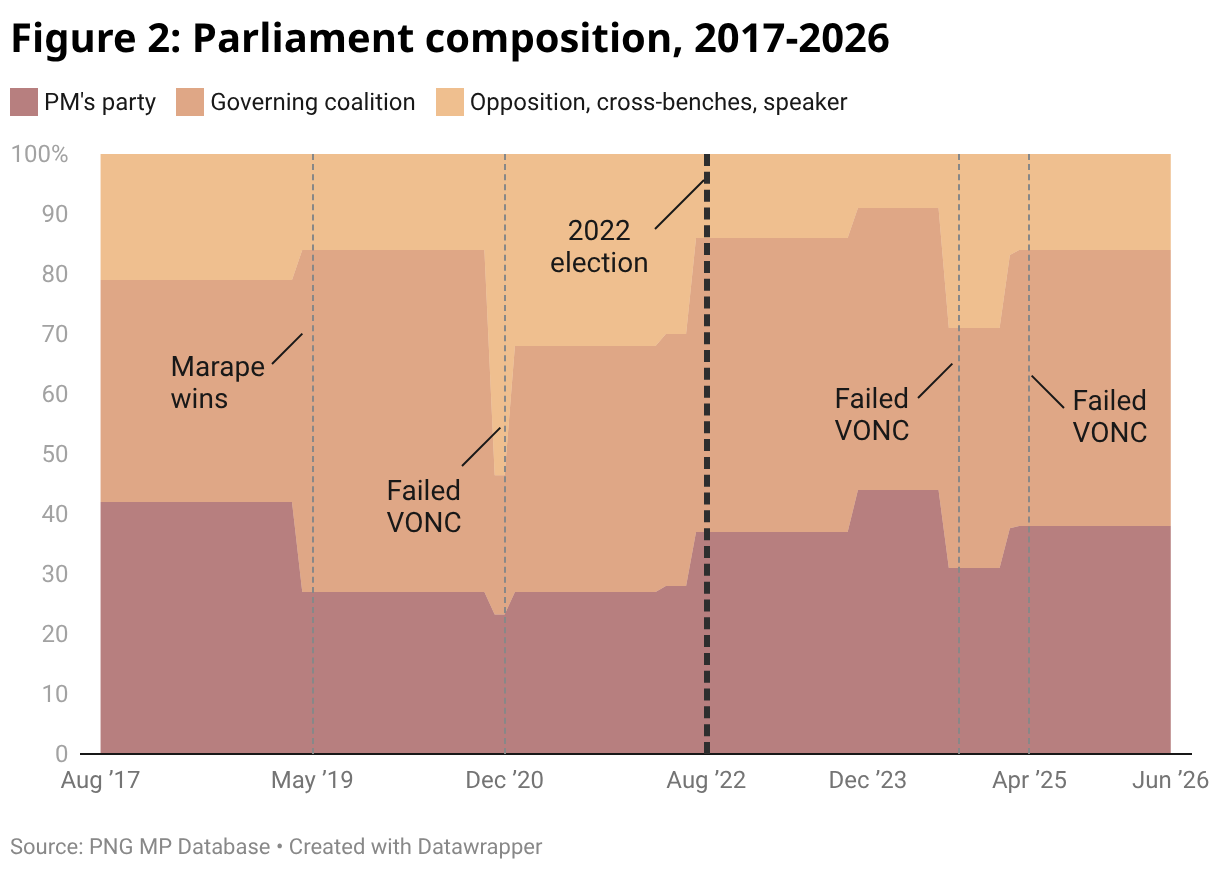
Because party sizes shift during a parliament, so does the ENP of parliament and of government. Switches cluster around votes of no confidence (VONCs). Between 2017 and 2024, MPs could not move a VONC in a “grace period”: the 18 months after an election. The 12 months before an election is known as the dissolution window when a successful VONC would trigger an early election. MPs have never mounted a VONC in this period likely because they fear the high turnover rates of elections or would like to gather as many resources as they can before elections. In 2025, another 18-month grace period was added, triggered by any unsuccessful VONC. The chart below (Figure 3) tracks the ENP including independents since 2017.
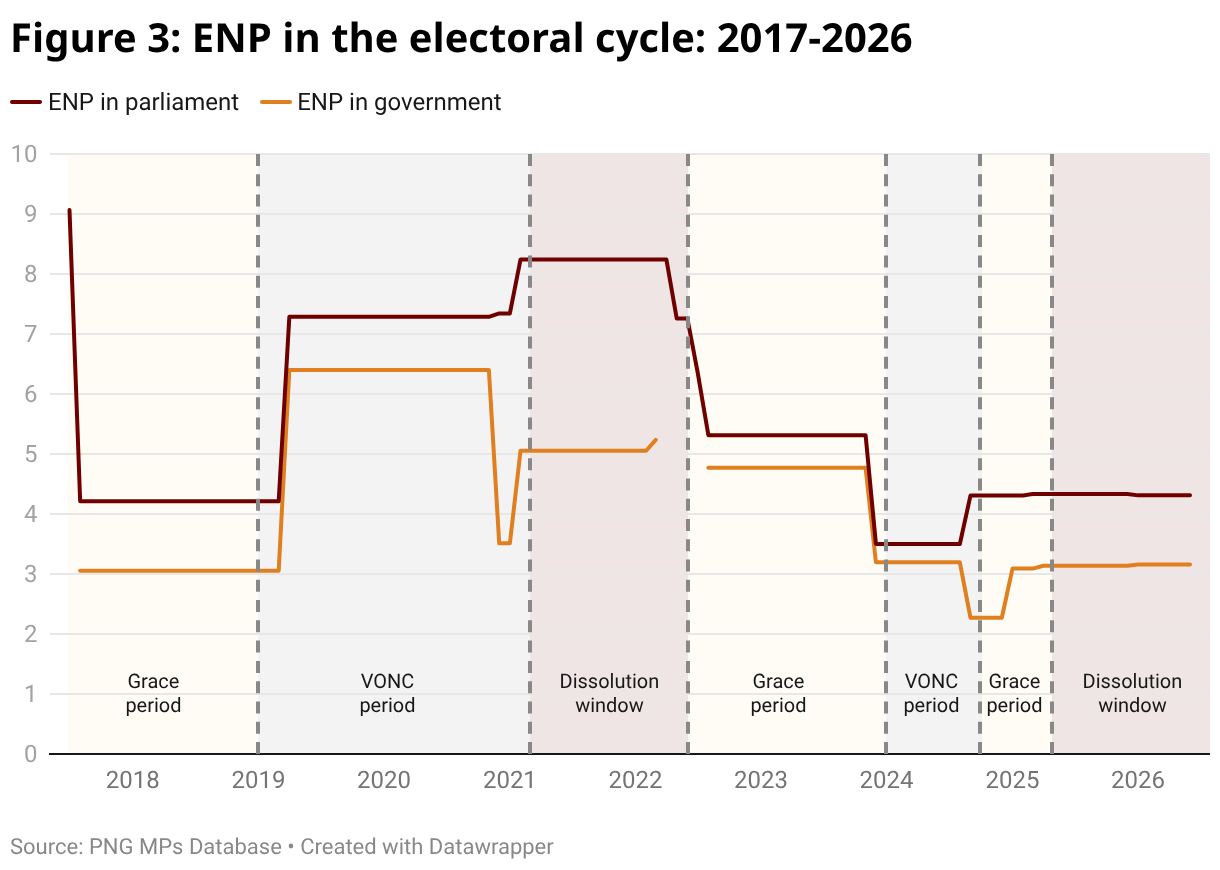
Five points stand out. First, fragmentation falls sharply once a government is formed after an election, as independents and small parties join larger ones. Second, the ENP of parliament is higher than that of government, because only some parties join the governing coalition. Third, the ENP of parliament and of government move together, except in December 2020 and September 2024. Fourth, in the two failed VONCs before 2025, parliament became more fragmented while the governing coalition became less so because several MPs and parties left government for the opposition to unseat the prime minister. During the April 2025 VONC, however, both ENPs were stable. Fifth, the current (11th) parliament is less fragmented than the 10th, with an average ENP of 4.5 now against 6.5 then.
The ENP has been stable since 2025, almost certainly because of the new failed-VONC grace period. Fewer MPs have switched parties in the current parliament, because the shorter window for changing government offers fewer rewards for doing so. Instead, MPs have tended to remain with their large coalition parties, which hold ministries and a greater influence over finances. Some MPs in government have declined to join the prime minister’s party to preserve their bargaining power.
The Finschhafen MP Rainbo Paita, who challenged for prime minister in the failed 2024 VONC, is an example. Paita was originally a member of the PM’s party, PANGU. After the VONC he chose not to rejoin PANGU on returning to government, keeping his new party (Our Party) separate. With 15 MPs behind him, he secured three ministries. This tactic, used by Paita and other coalition parties, has kept fragmentation from falling further.
Political fragmentation in PNG has fallen since 2002 because most MPs are now elected from a smaller number of large parties. Within each parliament, fragmentation falls further as independents and small parties join large ones in search of resources and influence. Since 2017, fragmentation has risen around VONCs but stabilised after the 2025 failed VONC grace period reduced the incentives for MPs to switch parties.
Access the ENP research annex here.
