


A Fijian high chief Ratu Tevita Mara wants to reduce the military’s powers and restore iTaukei (indigenous) rights.
“[We need] a military that defends the nation and never rules it, courts, prosecutors, and elections beyond the control of any government and the strongest protection of our (iTaukei and Rotuman) land, seas, and custom,” the former military-general said this week.
Ratu Tevita, who is the traditional head of the Lau province, made the comments in a written submission from the Vanua o Lau (Lau people) to the Constitutional Review Commission (CRC).
“Repeal section 131(2) [of the 2013 Constitution] which gives the military an open-ended mandate over the nation’s well-being,” he said.
“Return the Republic of Fiji Military Forces (RFMF) to ministerial control and parliamentary oversight.”
The son of Fiji’s first prime minister and president, Ratu Sir Kamisese Mara, he has become increasingly vocal in the political arena and warned the government last month that time was nearly up for it to deal with Fiji’s drug crisis.
“The window to act on Fiji’s drug crisis is closing,” he said, in yet another salvo fired at the Sitiveni Rabuka-led coalition government as the general election looms.
In Lau’s submission to the CRC, obtained by RNZ Pacific, Ratu Tevita said the issue of whether the term ‘Fijian’ was appropriate as a common national identity was best decided by the public.
“Return the question to the people through proper consultation led by the Great Council of Chiefs (GCC) and restore ‘Fiji Islander’ as the common civic name,” Ratu Tevita, who is co-deputy chair of the GCC, said.
The statement contradicts what he said in a statement in April.
He also canvassed the idea of the constitution’s immunity clause being “examined’ as well as a review of the “secular state” clause, while guaranteeing freedom of religion for all.
The sweeping immunity provisions have protected those involved in past military and political coups from criminal prosecution and civil liability.
Fiji’s 2013 Constitution
RNZ Pacific / Kelvin Anthony
Ratu Tevita said the 2013 Constitution was imposed on the people and a new constitution needed to reflect the will of the people in the villages, the provinces, the churches and the communities.
“Every submission we make is for iTaukei, for the Indo-Fijian, for the Rotuman and for every community in Fiji,” he added.
Ratu Tevita, a former military-general, fled to Tonga in 2011 and went into exile after the then-Prime Minister Frank Bainimarama wanted him tried for treason.
The royal family sheltered him in their Nuku’alofa palace, where he worked as an advisor to King Tupou VI.
The Bainimarama administration banned him from re-entering Fiji – something that only became possible after Prime Minister Rabuka’s government came into power in December 2022.
The coalition government wants to amend the current Constitution before the general elections, and set up the independent commission in March to consult widely on the issue.
The Commission officially closed submissions on 10 July and said on its website that a wide range of public and organisational submissions were received during the consultation period.
Constitutionally-entrenched
An iTaukei political sociologist, distinguished professor Steven Ratuva, said that modern constitutions must address the “long tail” of trauma, corruption, and institutional decay left by decades of political instability.
Professor Ratuva, of Canterbury University in Aotearoa, also challenged what he called the constitutionally-entrenched “Fijian” label for the country’s citizens.
He argued it was imposed by colonial administrators and did not reflect how indigenous communities self-identify.
“The word iTaukei is a word which the iTaukei used to define themselves. When we talk to each other, it’s full of mana. It’s full of the connection with the land,” he said.
Professor Ratuva added the name “Fiji” originated from a European interpretation of the Tongan pronunciation “Fisi,” evolving from the islands’ original name Viti, before being formalised during the colonial era.
“This is very much an introduced European framing and that is what a lot of iTaukei don’t realise, as labels can be degrading as well as empowering.
He said the term created a “boxing” effect similar to New Zealand’s “Pacific Islander” classification, which flattens distinctive sub-identities. He called for more nuanced identity provisions that respect in-group definitions, while avoiding fragmentation.
Meanwhile, civil society organisation Dialogue Fiji said that the review process was “rushed and opaque.”
“This commission is presiding over the shortest major constitutional review in Fiji’s history,” its director, Nilesh Lal said.
“That should be a warning sign for anyone serious about democratic reform.”
“Constitutional engineering in ethnically divided societies requires careful deliberation on power-sharing, electoral systems, decentralization, and minority protections,” Lal said.
Professor Mosmi Bhim, a political science researcher from Fiji National University, said in a personal submission that Fiji risked reverting to authoritarian rule.
“Repeated coups have kept Fiji from consolidating democracy, with the country currently in a similar transitional phase to that experienced at independence,” Professor Bhim said.
She added that coup makers currently immune from prosecution should be banned from contesting elections.
On electoral reforms, she called for removing the single national constituency in favour of smaller constituencies, implementing a 30 percent quota for women, and reserving one seat for Rotumans as an endangered indigenous group.
Another scholar of Indian heritage, Dr Romitesh Kant warned the Commission against repeating the country’s constitutional cycle of coups.
Dr Kant, who researched constitution-making for his master’s thesis at the University of the South Pacific (USP) said the country’s history ” oscillated between elite compromises and imposed constitutions, with public participation used merely to legitimise pre-determined outcomes.”
He also argued that Fiji should not abandon a common identity, but cautioned against returning to a system that hardened ethnic separation.
“The 2013 provisions, imposed in a militaristic, authoritarian manner, deepened ethnic insecurity … common identity should not become “ethnically blind,” ignoring real inequality,” he said.
“The recurring wound in Fiji’s constitutional history has been that people are invited into the process, but political elites control the final settlement,” he said.
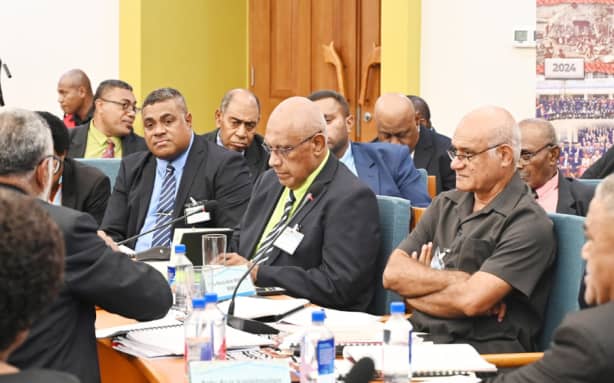
The Great Council of Chiefs (GCC), or Bose Levu Vakaturaga, a traditional body made up of idigenous Fijian (iTaukei) chiefs, convened for a two-day meeting at their new complex in the capital Suva. Picture from May 2025.
Fiji Government
The GCC called the the current constitution “illegitimate”, saying it “weakened traditional governance and stalled economic progress”.
Its chair Ratu Viliame Seruvakula called for specific support for iTaukei to become “genuine wealth creators” rather than “passive recipients of state benefits.”
“When indigenous people thrive economically, the entire national economy expands,” Ratu Viliame said.
The National Federation Party (NFP), a coalition partner in the Rabuka-led government, has urged the Commission to incorporate elements from both the 1997 and the 2013 Constitutions into a new document.
NFP leader Biman Prasad was the former co-Deputy Prime Minister and Finance Minister under the current administration and resigned last October after facing corruption charges.
Prasad warned the Commission that holding the next general elections by February 2027, under a new constitution, was “strictly impractical”, given the extensive work required for consequential legislation and electoral changes.
The NFP also recommended removing references describing Fijians of Indian descent as “descendants of indentured labourers.”
In a statement on social media this week, the Commission said it was compiling submissions and would review feedback from stakeholders before delivering its final recommendations.
“The review process remains a critical step in shaping Fiji’s legal and political framework moving forward,” the statement said.
