


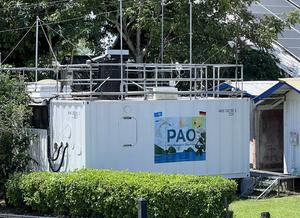
In 2016, the Alfred Wegener Institute, together with the University of Bremen, the Palau Community College, and the Coral Reef Research Foundation, opened a research station at what is probably its warmest location: Palau. The archipelago lies in the heart of an area that is characterised by the cleanest air in the world. Moreover, this region is where the composition of the stratosphere – the layer of the atmosphere that contains the ozone layer – is determined for the whole planet. This makes the location ideal for studying the distribution of trace gases and particles in the atmosphere and their impact on the global climate, from Europe to the polar regions. Over the last ten years, the observatory has developed into one of the largest in the entire tropics and the largest in the Western Pacific.
“Palau is a strategically important location for atmospheric research,” says Prof. Markus Rex of the Alfred Wegener Institute, Helmholtz Centre for Polar and Marine Research (AWI). Driven by the highest ocean temperatures on our planet, the air above Palau rises into the stratosphere. On its way upwards, it acts like a lift, transporting pollutants, greenhouse gases, and aerosols to the upper levels of the atmosphere; altering its chemical composition, not only locally but globally. What enters the stratosphere above the Palau region influences a large number of climate processes worldwide,” says Markus Rex. The ozone layer is also located up there, and to understand exactly how it is being depleted over the Arctic and Antarctic, we need to fully comprehend the atmospheric processes over the tropical western Pacific. For this reason, AWI’s polar researchers were drawn to the small island of Palau, where they are now making a significant contribution to our understanding of atmospheric processes not only there but, in particular, in the polar regions, using a wide range of scientific instruments. “With our observatory, we can observe these atmospheric processes and better understand how they affect the local environment, but also how they alter the polar regions. This, in turn, has a direct impact on us, our climate and our weather in Europe.”
Palau is a small island nation in the broad expanse of the Pacific Ocean, surrounded by some of the world’s healthiest coral reefs and blessed with the cleanest air on Earth. The country adopted some of the world’s highest environmental protection standards in order to safeguard its reefs and natural resources. Nevertheless, Palau is particularly affected by climate change, which is largely caused by emissions from other parts of the world. Air pollution from Asia also repeatedly reaches the island and is then detected by the observatory as a temporary deviation from the otherwise astonishingly clean air. Surangel Whipps Jr., President of the Republic of Palau, highlighted the observatory’s importance for his country on the occasion of the station’s anniversary. It helps the nation to better understand the environment of the island and to protect it even more effectively. And it strengthens Palau’s position in international negotiations on climate protection, which is particularly important for the small island nation.
The Palau Atmospheric Observatory consists of two laboratory containers housing a wide range of scientific instruments. Using research balloons, lidar – laser radar – systems, infrared spectrometers, and other instruments, researchers measure ozone levels, water vapor, clouds, aerosols, and many other trace gases in the atmosphere. “Through ten years of continuous measurements, we have established an unprecedented long-term record of atmospheric ozone profiles, closing a critical data gap,” says Dr. Katrin Müller of AWI. At the same time, the data help improve our understanding of how climate and weather patterns in Palau may change in the future. For this reason, researchers regularly share their findings with local communities. “Together with our partner, the University of Bremen, we regularly contribute to teaching at Palau Community College and Palau High School, allowing us to contribute to imparting a better understanding of climate issues, particularly for young people.”
Highlights from the Past Ten Years
2016: Following the start of initial pilot measurements in 2015, continuous operations began and the observatory officially opened. Since then, the Palau Atmospheric Observatory has helped close important knowledge gaps regarding the atmosphere over the Western Pacific:
- Researchers were able to characterize, for the first time, the ozone climatology of the Western Pacific, including the long-term occurrence, distribution, and variability of atmospheric ozone. An important gap in the global environmental monitoring network has been closed.
- Measurements have clarified the origin of air masses in the stratosphere above Palau and the transport pathways through which they arrive there.
- Long-term datasets enabled researchers, for the first time across all seasons, to describe the role of cirrus clouds in the so-called “cold trap” of the tropical tropopause region. This cold trap is a frigid atmospheric layer that prevents water vapor and many trace gases from rising into higher levels of the atmosphere.
2022: Former German Foreign Minister Annalena Baerbock visited the observatory to learn about its research activities and local partnerships. In the same year, the team used its instruments to track how particles from the eruption of the Hunga Tonga underwater volcano in the South Pacific spread throughout the global stratosphere. The eruption was one of the most powerful since modern records began.
2024: Former German Foreign Minister Annalena Baerbock highlighted the observatory on several occasions during her second Pacific tour to Australia, New Zealand and Fiji as an important contribution by Germany to cooperation with the Pacific Rim states.
2026: A new observatory outpost in Palau’s central rainforest region is opened. The Palau Atmospheric Observatory is now an official partner in numerous important international observation networks and programs. In collaboration with the US National Oceanic and Atmospheric Administration (NOAA) and the University of Colorado, expanded balloon measurements of stratospheric aerosols are incorporated into the monitoring programme. The Palau Atmospheric Observatory is an official partner in many important international measurement networks and programmes (PGN, SHADOZ; NDACC, B2SAP).
Disclaimer: AAAS and EurekAlert! are not responsible for the accuracy of news releases posted to EurekAlert! by contributing institutions or for the use of any information through the EurekAlert system.
