

In January 2025, Fiji’s Minister for Health Dr Ratu Atonio Lalabalavu declared a national HIV outbreak. New case notifications rose twelvefold in seven years, from 131 in 2018 to 1,583 in 2024. Modelled estimates put the real number of people living with HIV at about 6,100, meaning more than 40% of those infected do not know it. Of patients who started antiretroviral therapy in 2024 and for whom exposure data was recorded, 48% named injecting drug use as their primary route of infection. Fiji’s HIV epidemic is not primarily sexual; it is a syringe epidemic.
A rapid assessment commissioned by the World Health Organization and the United Nations Development Programme and conducted by the Kirby Institute at the University of NSW Sydney, published in December 2025, gives the clearest account yet of how HIV is spreading among people who inject drugs in Suva. Every person interviewed had shared a needle or syringe at least once. About half injected crystal methamphetamine the first time they used it, often with a syringe already used by someone else. Most injected daily. Pharmacies, the only realistic source of sterile equipment, frequently refuse to sell syringes without a prescription. The practice has no basis in Fijian law but persists.
The rapid assessment documents a practice called koda: blood is drawn from a vein into the barrel of a syringe, mixed with the drug crystals and reinjected. It is commonly used because it is said to produce a more intense effect. It is also an efficient mechanism for HIV transmission. The drug is mixed in potentially infected blood, in a syringe that will often be passed on.
Bluetoothing, the practice of drawing blood from one person’s injection site and injecting it into another, has dominated public commentary but was reported by only two of 56 participants. The driver of transmission is shared syringes, forced by the near-total absence of sterile equipment.
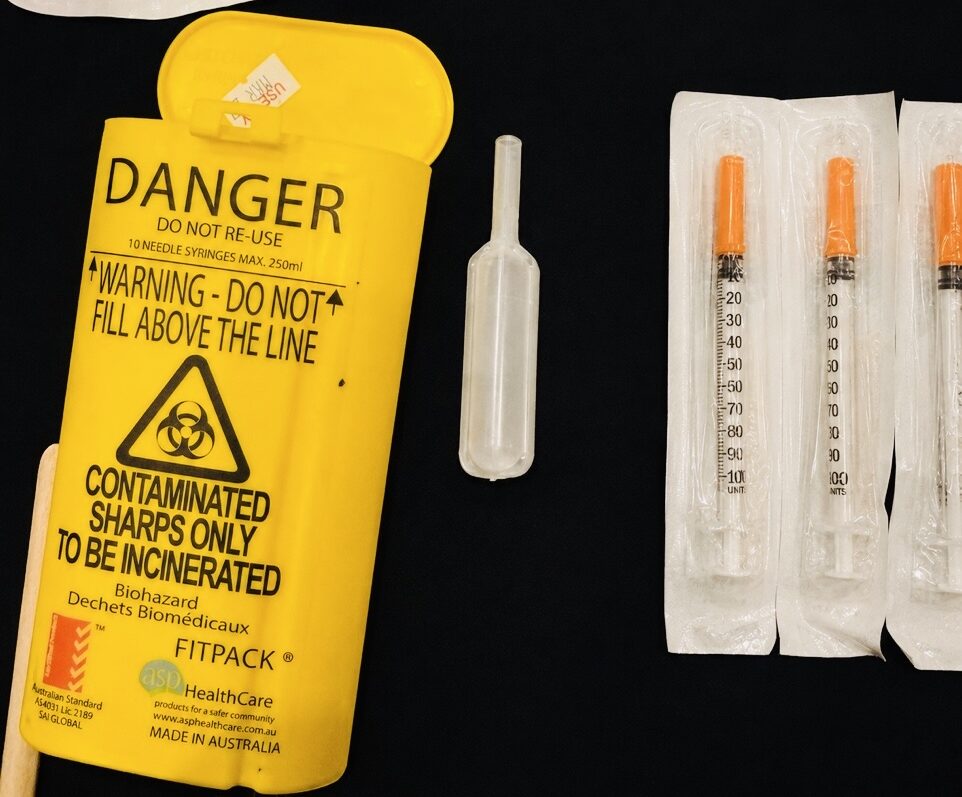
None of this is surprising to public health researchers. What is surprising is that the solution has been available for decades and is not in use in Fiji. A needle and syringe program (NSP) provides free sterile equipment to people who inject drugs, without prescription, registration or any requirement to return used kit. NSPs cut HIV transmission, do not increase drug use and are highly cost-effective. Australia has run them since 1987. New Zealand, Portugal, Switzerland, Canada and dozens of other countries have built them into standard public health infrastructure. The countries that moved early avoided or contained epidemics that, elsewhere, became catastrophic. In Indonesia and the Philippines, where authorities did not implement such schemes, HIV epidemics among people who inject drugs grew quickly and proved very hard to reverse.
Fiji’s legal framework, comprising mainly the HIV/AIDS Decree 2011, the National HIV Surge Strategy 2024-2027 and the National Counter Narcotics Strategy 2023-2028, provides the policy foundation for action. In addition, Fiji is a signatory to the 2021 UN Political Declaration on HIV and AIDS. In December 2025, in response to the publication of the assessment, the Health Ministry confirmed that a NSP would be implemented.
The latest update from Lalabalavu during the June 2026 budget indicated that preparations for the NSP’s implementation were “nearing completion”. Meanwhile, in the extended period of time between announcement and delivery, people are contracting HIV and hepatitis C, developing infective endocarditis and dying in emergency departments. One healthcare worker quoted in the assessment described a steady flow of young people arriving in septic shock, many of whom do not survive.
The barriers are not legal or technical. They are cultural and political. Some health officials, police and religious leaders told Talanoa discussions (community consultations) that providing sterile equipment amounts to endorsing drug use. The assessment’s reply, paraphrased: Fijian society is defined by dignity, compassion, care and reciprocity, and those are the values a NSP enacts. The Medically Supervised Injecting Centre in Sydney, Australia, is run by the Uniting Church. In Tonga, religious leaders have worked alongside health agencies on HIV prevention. The moral question is whether to withhold help and watch the epidemic grow.
The recommended model is practical, low-cost and immediately implementable. Free sterile needles and syringes should be available through sexual and reproductive health (SRH) hubs already serving key populations in Suva, through community pharmacies without prescription, through peer distribution networks and through community-based organisations. Services should be low threshold: no registration, no requirement to return used equipment and no HIV test as a condition of access. The research found that the main barriers to access are fear of exposure and stigma, not lack of interest. Participants described entering pharmacies and inventing stories about diabetic grandmothers to explain why they needed syringes. They described leaving empty-handed when the pharmacist looked suspicious or deciding to share rather than face the counter.
Implementation should proceed in stages. First, pharmacies should be encouraged, through engagement between the Ministry of Health and the pharmacy sector to sell single-use syringes over the counter without prescription. This requires no new infrastructure and no budget. It removes the most commonly reported barrier overnight. Second, within months: SRH hubs in the Central and Western Divisions should be resourced to distribute sterile needles and syringes alongside HIV testing, condoms and referral. Medical Services Pacific’s (MSP) Moonlight Programme, which already reaches sex workers, men who have sex with men, transgender individuals and people who inject drugs through night-time outreach in Suva, is a natural delivery platform. Third, within a year: a peer distribution model, drawing on people with lived experience, should be established and funded. The rapid assessment notes that there is no drug user organisation in Fiji and that building one is critical.
Australia and New Zealand’s aid investment in Fiji’s HIV response, channelled partly through the International Planned Parenthood Federation and civil society organisations, has so far focused on testing, counselling and condom distribution among key populations. The moonlight testing program has achieved reactive case rates of nearly 9%, strong evidence that it is reaching the right people. An 8.9% positive rate also means one in every 11 people tested in the Suva night-time economy is newly diagnosed. Testing identifies cases but does not prevent transmission. The next phase of aid investment should include direct support for NSP establishment: commodity procurement, peer workforce development and integration of harm reduction into existing SRH service delivery.
Modelling estimates in the Kirby Institute report project total HIV cases in Fiji reaching 25,000 by 2029 without intervention. The trajectory is already visible in the data. Cases among 15–19-year-olds jumped from six in 2022 to 165 in 2024. Deaths recorded among people newly diagnosed in 2024 include eight children under 15 years. No version of this epidemic gets better on its own, and no harm reduction program is sophisticated enough to reverse a concentrated epidemic once it becomes generalised. Hence, the window for prevention is now.
The people interviewed described wanting to access services and described positive experiences at MSP’s clinic: welcoming, discreet and non-judgemental. They said they would go to an NSP if one existed. One participant put it plainly: “Either protect them or lose them.” Fiji has the values, the legal framework, the civil society infrastructure and the international support to act. What is missing is the willingness to make the first move — to supply free needles, without prescription or registration.
