


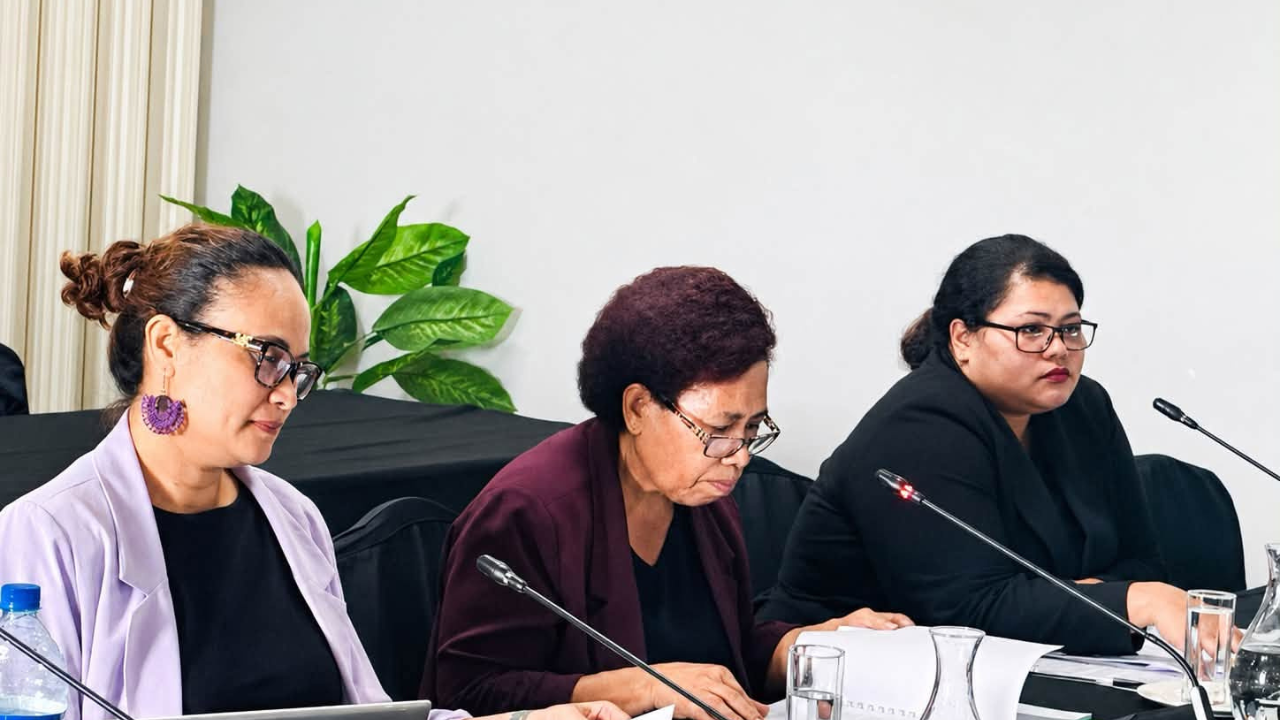
The FHRADC team presenting their submissions to the Constitution Review Commission [Photo: Human Rights Commission Fiji/FACEBOOK PAGE]
The Human Rights and Anti-Discrimination Commission acknowledges public concerns that preserving the 2013 Constitution’s immunity provisions indefinitely is not in the best interests of future generations.
The HRADC says the Constitution is the Supreme Law and a moral compass for the nation.
The permanent protection of these immunities, in the Commission’s view, entrenches historical political conflicts within the Supreme Law long after their practical purpose has ceased and those covered have passed away.
It says continued inclusion risks memorializing treasonous actions, constitutional disruptions, and extra-constitutional political change. Future generations may see this protection as an implicit endorsement or legitimization of conduct that violated democratic principles.
The Commission stresses that this may lead to the perception that unlawful actions can achieve constitutional protection without accountability, undermining efforts toward strengthening constitutional supremacy, the rule of law, and democratic accountability.
The HRADC views it as an unreasonable and unjust burden on future generations to inherit a document that permanently protects conduct that violated the constitutional order they are required to uphold.
Balancing respect for the Supreme Court’s Opinion of August 2025 with Fiji’s long-term democratic development, the following forward-looking approach is proposed to preserve the original purpose of the immunities while recognizing the Constitution must evolve.
The HRADC proposes inserting a sunset provision into the 2013 Constitution, expressly stating that all immunity provisions be automatically expunged in thirty years.
Within this timeframe, all those involved in the conduct granted immunity would have passed into history. More importantly, future generations will inherit a clean document, free from exceptional provisions linked to past political upheavals.
The eventual removal recognizes that the passage of time renders such exceptional provisions unnecessary and that this history belongs in the public record, academic writings, and national forums. They need not be permanently enshrined once their transitional purpose is achieved.
Maintaining the immunities indefinitely risks transforming a transitional mechanism into a constitutional principle, subverting the fundamental rule that all individuals are equal before the law.
As custodians of Fiji’s constitutional future, the present generation should ensure future generations inherit a Constitution that reflects democracy, constitutional supremacy, the rule of law, equality, accountability, human rights, and the peaceful transfer of power.