


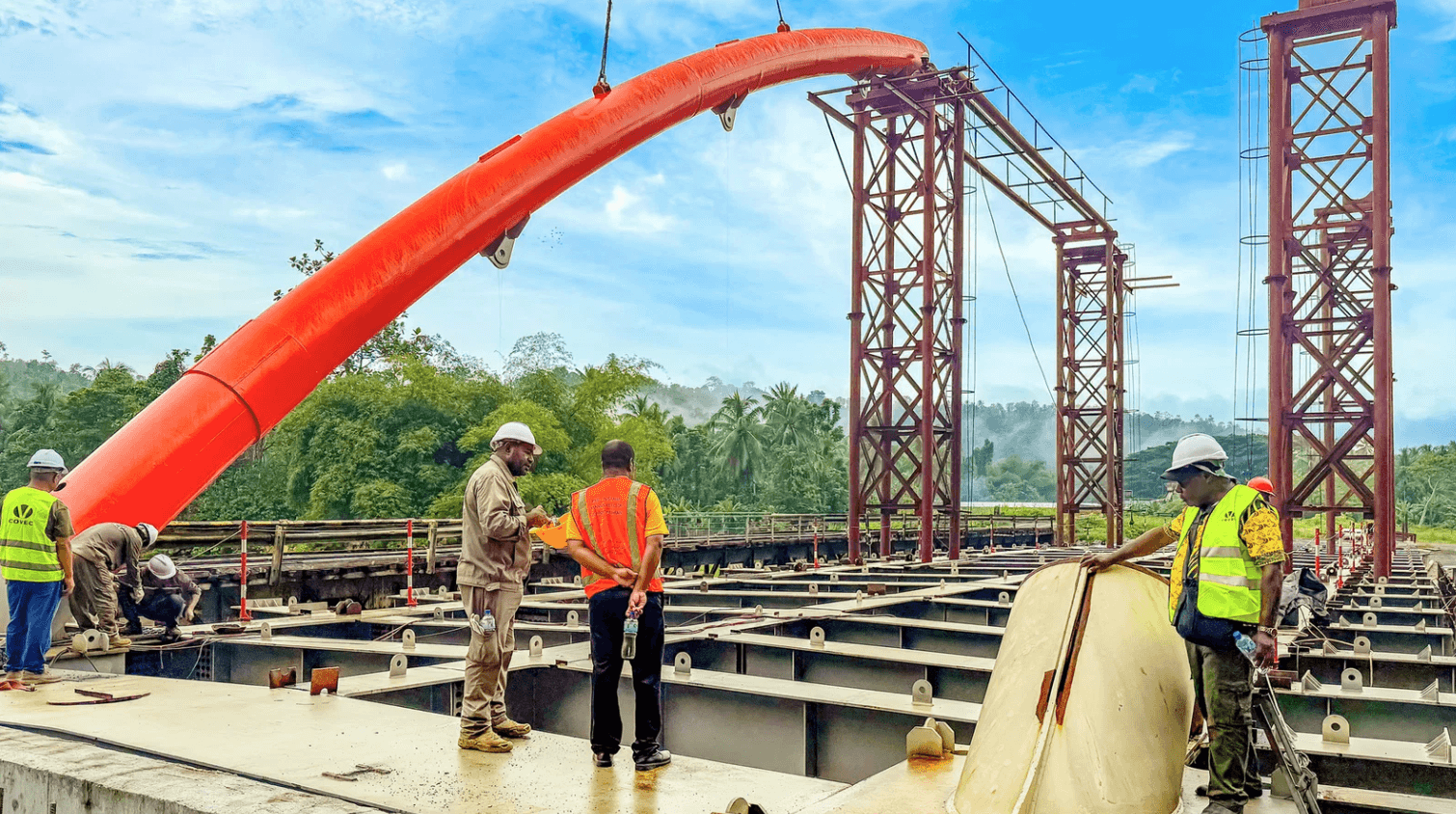
The World Bank and the Asian Development Bank (ADB) have both recently made changes to their construction procurement policies. These aim to promote more employment and skills development for the residents of the countries receiving the loans.
But do these changes go far enough to have a major impact? Are the new requirements sufficient to provide the social licence that foreign firms and the multilateral agencies want? Will the changes overcome the reputational damage caused by the past reliance of construction firms on imported skilled workers for large projects?
The PNG Government, in its national budget papers for 2025, has forecast for each year to 2029 the cost of its major investment in the Connect PNG Infrastructure Program. This includes the construction of roads, bridges, airstrips, school buildings, health facilities, maritime ports and coastal wharves, and improving electrical access and refurbishing renewable energy infrastructure.
Large international companies have also committed to significant infrastructure investment into the future, as shown in the data presented for the PNG Government’s Infrastructure Tax Credit Scheme. Private sector investment in large resource projects including Wafi-Golpu, Frieda River and Papua LNG are also expected to go ahead. These projects will drive strong demand for technical and professional workers over the next decade. For PNG skilled workers to be employed in place of imported workers, the PNG Government and the loan providers will have to make a concerted effort to make this happen.
The World Bank’s Managing Director of Operations, Anna Bjerde, announced on 1 August 2025, after a week-long visit to Fiji, Papua New Guinea and Australia, that the Bank was making a major change in its procurement requirements for infrastructure projects. These changes require companies bidding for international civil works contracts for construction, transport and energy infrastructure to commit to ensuring that 30% of their labour cost is expended on employing a local workforce.
The goal of the change is to boost domestic job creation and skills development. The World Bank’s expectation is that the focus on aggregate labour costs, rather than on local-worker headcount, will promote a preference by contractors for more skilled workers.
On 16 September 2025, the President of the ADB announced a similar requirement in its construction contracts to achieve “meaningful local job participation on projects the ADB finances”. This involves a requirement in construction contracts for a local-labour quota of at least half of all person-days worked. Compared to the World Bank’s new requirement, this quota is a blunter instrument, as explained below. However, the ADB is also instituting two other measures to enhance the capacity of local firms and to help them respond to the contract requirements. Still, these changes alone do not address the skills imbalance between local and foreign workers.
Charles Kenny from the Center for Global Development has criticised the World Bank’s new procurement requirement. He judges that it is not likely to “have much effect on contracting decisions or employment, nor any on broader development outcomes”. He notes that the World Bank has not provided any evidence that increased local employment will result. Nor has the Bank provided any data from its projects on whether the requirement will change the skill mix of workers engaged in-country.
My research for the ADB in 2016 showed that foreign companies employed local workers but at a low skill-level and often with high turnover. That research found that the most common practice for foreign road and bridge construction firms is to hire workers from local villages while the firms are working in the vicinity. Young men are hired as security guards and women are hired to collect rocks for gabions (cages of wire mesh) used as retaining walls. As a risk minimisation strategy, foreign firms preferred to import skilled workers to operate equipment and perform jobs requiring trade skills.
These imported skilled workers account for much of the labour cost of a large project. The question that needs to be answered is how much of the labour cost. Research by Peter Johnson, based on PNG evidence, has shown that between 1990 and 2002, two-thirds of the wages (68%) paid by Porgera Joint Venture went to international employees and one-third (32%) went to PNG national employees. This indicates that the World Bank’s new mandate for 30% of labour costs to be allocated to local workers may be too low to change the existing skill imbalance. For PNG, a 30% labour cost requirement is not likely, in many cases, to encourage contractors to offer higher-skilled, better paid jobs for local workers.
The new contract arrangements need to deliver an outcome that addresses directly the local skills shortage. Procurement requirements should include setting up and supporting skills training linked to established training providers. The ADB has also recently developed an alternative, more direct way of providing the skills needed. International firms, as part of their contractual requirements, are required to form relationships with training providers to provide traineeships.
The ADB approach, called Build4Skills, is to set up traineeships for skills development by integrating them into ADB-funded infrastructure projects in the energy, transport, water, urban and social sector. The traineeships are to be financed from the project loan, typically by earmarking 0.5% of selected civil works contract budgets. This ensures predictable and sustainable funding and the easy integration of training resources into project costs. This is a more efficient way of producing skills outcomes compared with the ADB’s past practice of funding training programs separately with little involvement from construction employers.
Two pilot projects in Mongolia and Pakistan have shown that this integrated approach has made it easier for the ADB and partner firms to include skills development in infrastructure investments. These changes have been at little extra cost and have achieved better coordination between the employer and training providers.
The social licence foreign firms and the multilateral development banks are seeking has to be based on real measurable outcomes achieved through skills formation. Simple metrics about outputs which offer only a one-off, short-term benefit will have little impact.
