



We’ve just received the results back from our latest poll of Australians’ attitudes to aid. The results were simultaneously disappointing, all too predictable and surprising.
Let’s start with disappointment. As the chart below shows, whereas last year I concluded that Australians’ views about aid had been shakily improving, in this year’s poll the share of people who think their country gives too much aid has risen considerably.
Figure 1: Results of Development Policy Centre surveys on Australian attitudes to aid since 2015
Notes: The sample is nationally representative (n=1049). The question was: “Every year the Australian government gives aid money to poorer countries. Currently less than $1 out of every $100 of federal government spending is given as aid. Which one of the following options best reflects your opinion about aid spending?”. A time series of results from our polls alongside all other people’s polls is available here.
The sample is nationally representative (n=1049). The question was: “Every year the Australian government gives aid money to poorer countries. Currently less than $1 out of every $100 of federal government spending is given as aid. Which one of the following options best reflects your opinion about aid spending?”. A time series of results from our polls alongside all other people’s polls is available here.
I wouldn’t panic about the rise just yet. As you can see in the chart, annual results bounce up and down. We also changed polling firms this year. And, even when pollsters follow best practices, their samples vary in subtle ways, something referred to as “house effects”.
Noise and house effects may explain some of the rise in antipathy to aid. And a year on its own isn’t a trend. Even so, eyeballing the chart makes me think the improvement my statistical software thought it found last year may have actually been one of falling hostility to aid until 2022, then a rise. We’ll know more next year, but for now I’m feeling less optimistic about Australians’ views about aid than I was 12 months ago.
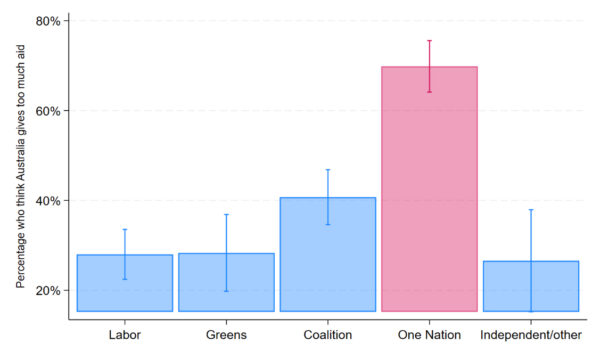
The all too predictable finding is to do with One Nation supporters. As the next chart shows, they have very different views about aid spending than their compatriots do.
Figure 2: People who say Australia gives too much aid — by party
Source: Author’s calculations.
And then there’s the surprise. Alongside responses to our aid question, this year the survey firm also gave us data from a question they asked about the degree of financial pressure people said they were facing.
Needless to say, I was curious: were people suffering from financial stress more likely to say Australia gave too much aid? I was curious, but also confident I knew the answer. Surely, people who were struggling wouldn’t want money sent overseas?
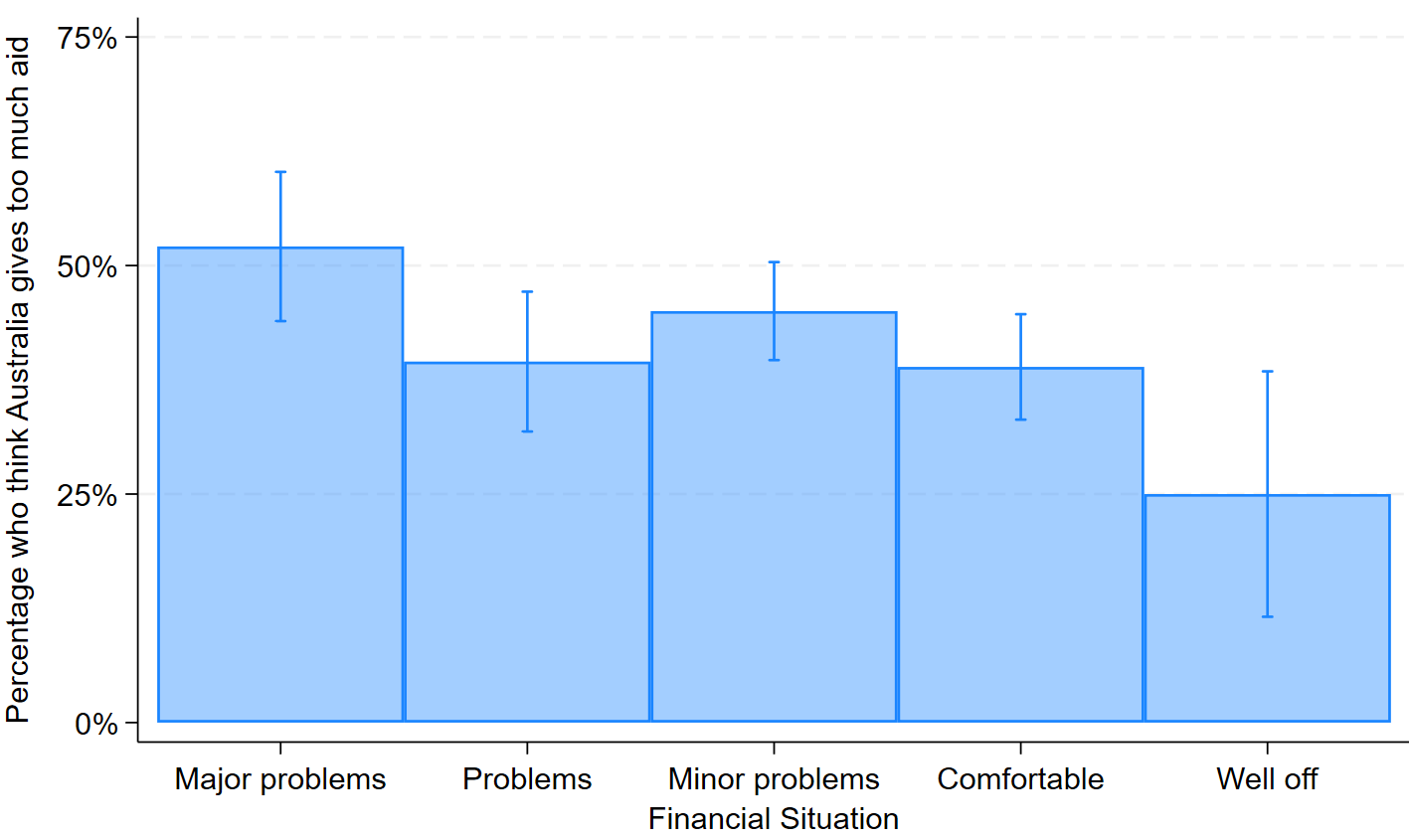
When I had a look, I found a surprise though. The next chart shows views about whether Australia gives too much aid, broken down by the responses to the question on financial problems. (I’ve changed the survey firm’s response categories so the labels fit on the chart but they capture the general gist.)
Figure 3: Share of Australians who think their country gives too much aid broken down by financial stress
Source: Author’s calculations.
At least one difference is clearly visible: respondents who said they were well off were 20 percentage points less likely to say Australia gave too much aid than people who faced minor financial problems. This, needless to say, was a large enough difference to be statistically significant.
(For those readers unclear about what statistical significance is, a handy — albeit not entirely technically correct — way of thinking about statistical significance in the context of this blog is as follows. Even when pollsters do everything right and get a sample that’s broadly representative, there will still be noise in the data. Purely by chance, the average attitudes of respondents will differ somewhat from those of the Australian population. And when I talk about statistically significant in this blog I mean there’s a difference large enough that, given the number of people we sampled, we can be confident it isn’t simply a product of random sampling noise.)
At the other end of the spectrum, the group of respondents who said they were facing major financial problems seem more likely to say that Australia gives too much aid than people only facing minor problems. However, this difference isn’t statistically significant. There may be a difference but we can’t be certain it’s not simply a product of sampling noise alone.
What’s more, there is no obvious difference between people who say they’re struggling and people who say their lives are fairly comfortable. Struggling and living a reasonably comfortable life seem very, very different states of being to me, yet that difference isn’t associated with differing views about aid.
Although I haven’t charted them here, I got similar results when I looked at the relationship between financial stress and the view that Australia gives too little aid. Similarly, I found nothing when I added controls into my regressions in an attempt to see if the relationship between financial stress and views about aid was real but obscured by correlations with other respondent traits. I also didn’t find any clear differences when, as an alternative, I looked at people’s stated income rather than the financial stress they felt.
Being well off makes people more favourably disposed to aid. But financial struggles aren’t obviously associated with thinking Australia gives too much. That certainly surprised me.
