



Analysis – Moana Pasifika’s exit from Super Rugby has cast a spotlight on the sustainability and future of the competition.
The team was placed into liquidation in May and last week it was confirmed the club would not be involved in Super Rugby in 2027, after New Zealand Rugby rejected several rescue bids, saying none met the required commercial and financial thresholds.
While officials insist the competition is growing, Moana’s collapse has prompted questions over whether the franchise is an isolated casualty, or is it a sign the tournament’s underlying business model is under strain?
Super Rugby chief executive Jack Mesley is adamant the competition is in strong health.
“We’re really pleased,” Mesley said.
“Across our key metrics and what we’re looking to achieve, it’s been another great year.”
Mesley said Super Rugby was on track to post positive results for a third consecutive season, pointing to rising attendances, television audiences and digital engagement as evidence the competition is building momentum.
He said total season attendance across Super Rugby increased by 11.7 percent from 2025 – although those stats could be somewhat skewed by Christchurch’s new Te Kaha Stadium selling out several games and attracting more than 73,000 fans during Super Round in April.
“This is third year in a row that we’ll post attendance growth across the competition. I think we had 7 percent in 2024 and 6 percent in 2025.”
Fehi Fineanganofo of the Hurricanes scores a try during the Super Rugby Pacific Final – Hurricanes v Chiefs at Hnry Stadium, Wellington.
Masanori Udagawa/Photosport
According to figures released by Sky, the organisation’s streaming platforms experienced audience growth of 16 percent this season.
Sky also reported an increase in its social media audiences, with a 13 percent growth in video views on Super Rugby Pacific content across the regular season.
Mesley said there was still plenty of room for improvement.
“There’s headroom, right? There’s a lot of opportunity still out there. We know there’s still empty seats that we want filled.
“We’ve got to continue to do what we’re doing. I think everyone looks for a silver bullet. There’s no silver bullets, but we’re on a good trajectory. Things are improving in Super Rugby. We are growing. Our product continues to get better, so we’re going to continue to focus on those things and continue to push for growth.”
Yet those encouraging audience figures tell only part of the story. Behind the scenes, many within the game remain concerned about whether the competition’s current financial model is sustainable.
Moana Pasifika are the second Super Rugby franchise to disappear in three seasons, after the Melbourne Rebels went bust at the end of 2024. Their demise has sharpened concerns about the financial health of the remaining clubs.
It is understood the five New Zealand sides – the Hurricanes, Chiefs, Highlanders, Crusaders and Blues – all lost money last year. The finances of the championship winning Hurricanes are expected to look rosier after this season’s championship winning run, but clubs cannot rely on hosting the final to make ends meet.
Hurricanes chair Malcolm Gillies told NZME’s Rugby Direct podcast in April that he did not think Super Rugby was sustainable in its current form.
“If it stays the way it is now, I fear for it. If there’s change, then I believe we’ve got a product. But if it doesn’t, I believe it’s going to die. That’s my honest opinion,” Gillies said.
Gillies is not alone in that view. Other sources spoken to by RNZ believe structural change is inevitable, with one describing full privatisation of the competition as “inevitable”.

Chiefs’ Damian McKenzie during the Chiefs vs Highlanders, Super Rugby Pacific match at FMG Stadium, Hamilton.
DJ Mills/Photosport
Private investment is already well established at the Hurricanes and Highlanders, and the Chiefs are believed to be heading in the same direction. The Blues and Crusaders operate under a mixed ownership model, where 60 percent of the franchise is owned by the provincial unions in their respective catchment areas.
Crusaders chief executive Colin Mansbridge told RNZ that full privatisation is an option. That would involve New Zealand Rugby giving up the broadcast rights to the clubs and allowing the competition to be run independently of the governing body.
It would also mean the clubs would have to pay the players wages, with NZR currently covering player contract costs.
“All those things are always on the table,” Mansbridge said.
“I think that the model that we’ve got now, where there’s more independence in terms of the way the competition’s been managed, has definitely made a difference.
“The more commitment you can get to the competition in and of itself, rather than it being just part of a broader ecosystem and just a cog in the wheel, but actually treating it as a primary product in and of itself. That’s a good thing.”
Mansbridge believes the private investment in New Zealand clubs has made them better.
“All the clubs have independent capital in them and I think they’ve added something to the quality of the governance in those clubs and they’ve added something to the quality of the competition through those people encouraging innovation and change, and I think Hurricanes is an excellent example of that this year.”
The Super Rugby clubs could argue that under the current system their private investors are not seeing much of a return. Some believe there needs to be a change in business model to increase investment in the competition and use that private capital to promote it.
Those conversations are already underway. Mesley said competition organisers’ had circulated a survey to each club canvassing views on issues ranging from competition format and eligibility rules to the prospect of greater privatisation.
“We send out surveys to the clubs just to continue to build our knowledge base and continue to look for ways to improve,” Mesley said.
“Whilst I’m really pleased in the direction of travel and really pleased that we’re seeing growth, there is room for improvement and we seek to find that out and to adjust and course-correct where needed.”

Fehi Fineanganofo of the Hurricanes celebrates.
© Photosport Ltd 2026 www.photosport.nz
One of the clearest messages from clubs is the desire for more home fixtures, which generate valuable gate revenue. With just 10 teams next year, it could mean a return to a home and away format over 18 rounds. But RNZ understands a complete home and away format is unlikely due to the increased length of the competition.
A 10 team competition would also allow fewer byes in the draw, which would shorten the length of the season. Administrators believe that could make Super Rugby less clunky and easier for fans to remain engaged in.
“We would naturally want more. I think most of the clubs would want more games, and so we would advocate for more,” Mansbridge said.
What the playoff format looks like from next year remains to be seen, but it is understood New Zealand Rugby and most stakeholders are still in favour of a six-team finals format.
The rationale for this is to help ensure Australian teams feature in the playoffs, therefore retaining interest in the competition from the bigger Australian market.
Many fans and pundits are critical of the ‘lucky loser’ format, in which one of the beaten teams in the first week of the playoffs still advances to the semi-finals.
Mansbridge said he doesn’t mind the status quo.
“I think we’ve got the right number of teams competing and I do quite like the format myself,” he said.
“Others aren’t necessarily as excited about it as – and they’re critical of this concept of lucky loser, but frankly a team that’s worked their butt off to get to that part of the season, giving them an opportunity for a second chance, I’m actually OK with that personally.”
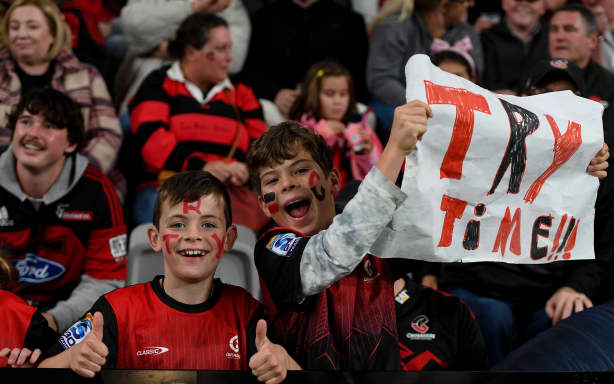
Fans during the Super Rugby Pacific Super Round match between the Crusaders and Waratahs at One NZ Stadium, Christchurch, 24th April 2026.
Photosport
Beyond tweaks to the existing competition, administrators are also considering how Super Rugby might grow over the longer term.
NZR and Rugby Australia officials are hoping the inaugural Anzac Test between the All Blacks and Wallabies, which has been confirmed for Brisbane next April, will create interest in the early rounds of Super Rugby.
There has also been talk of expansion into Hawaii or the West Coast of the US or a merging of Super Rugby and Japan’s League One competition.
Mansbridge said he could envision that happening at some point down the line, though he believes Super Rugby must consolidate its position in New Zealand, Australia and the Pacific before expansion.
“I actually think the best competitions are disciplined in the way they expand and they’re thoughtful about where they go, why, and how,” Mansbridge said.
“Just tacking on the coast of the US, for example, as a tack-on, I’m not sure is enduring.
“I’d probably be more thinking about how do we do better in our own patch first, Australia, New Zealand, and the Pacific. How do we make that really, really hum?
Mansbridge believes Japan is a more obvious port of call for any expansion, but given how happy the Japanese are with their League One competition – they have growing interest, strong commercial revenue and are able to attract top players – RNZ understands any ‘expansion’ into Japan would more likely come in the form of pre-season or post-season crossover fixtures.
Expansion would also likely have to be done in twos (with two new teams created) to maintain balance in the draw.
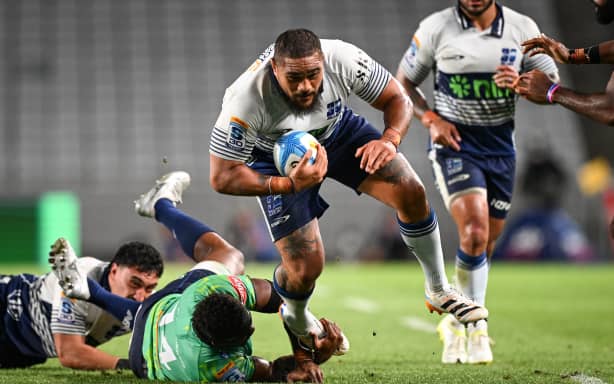
Ofa Tu’ungafasi of the Blues, Blues v Fijian Drua, round 7 of the 2026 Super Rugby Pacific rugby union competition at Eden Park.
Andrew Cornaga/Photosport
One idea that appears unlikely to progress is a player draft. Although it remains popular with many fans, it is understood the Players’ Association has little appetite for a system that could force players and their families to relocate at short notice.
A draft is seen as a way to more evenly spread talent around the competition, but would require a loosening in eligibility rules so that a New Zealand player could turn out for an Australian side and still remain eligible for the All Blacks.
One thing is certain, there won’t be any major changes to Super Rugby next year, as the competition seeks to consolidate its position in Australasia and the Pacific.
But the debate over what comes next is only just beginning.
