


A Fiji high chief Ratu Tevita Mara has warned the government that time is nearly up for it to deal with the country’s drug crisis.
“The window to act on Fiji’s drug crisis is closing,” Ratu Tevita said, in yet another salvo fired at the coalition government, as the general election looms.
Ratu Tevita, the son of Fiji’s first prime minister and president Ratu Sir Kamisese Mara, said Fiji could be breeding a new generation of drug dealers and it was time the National Security Council acted urgently.
The former military officer, who is the traditional head of the Lau Province, made the comments after [https://www.rnz.co.nz/news/pacific/614885/dozens-of-packages-containing-white-substances-wash-up-around-fiji more than 60 parcels containing “white substances” washed up in various locations across Fiji.
Police said 27 parcels were discovered in the Lau group, and were being tested at a forensics lab in Suva. Another 35 parcels were found floating along Munia Island, while cocaine was found in Kadavu Island.
Fiji police and the country’s military have joined forces in roadblocks across the country to crack down in the drug crisis/
Supplied / Fiji Police
Ratu Tevita said the surge in narcotics washing up across the Lau group and other maritime provinces was escalating fast, and the timing was hard to ignore.
“The drugs washing ashore on our villages and populated coastlines do not arrive by accident,” he said.
“This is beginning to look like a well-orchestrated plan and our people are left defenceless while Suva holds yet another forum,” he said, alluding to the recent National Drug Security Forum held at the Grand Pacific Hotel in the capital.
The Fijian government’s information director Samisoni Pareti did not respond to RNZ Pacific’s questions.
“If a package of drugs meant for Australia ends up on a Fijian beach, what do the people of our maritime provinces actually gain from our security pact with Australia under the Vuvale Partnership?”
The Department of Foreign Affairs and Trade in Canberra did not respond to questions.
The Vuvale Partnership is a comprehensive bilateral agreement between Australian and Fiji. In March, Prime Minister Sitiveni Rabuka announced the two countries were working to upgrade the framework into a new treaty, which would help Fiji tackle regional challenges, including transnational organised crime and illicit drug networks.
Rabuka’s coalition government is treating the escalating drug crisis as a top national security priority, warning the issue threatens the indigenous way of life.
Intravenous drug use, particularly through highly dangerous practices like needle sharing, is also the main driver behind Fiji’s rapid rise in HIV infections.
Health minister Atonio Lalabalavu said the government had been proactive about trying to get the HIV crisis under control, unlike the previous administration under Frank Bainimarama.
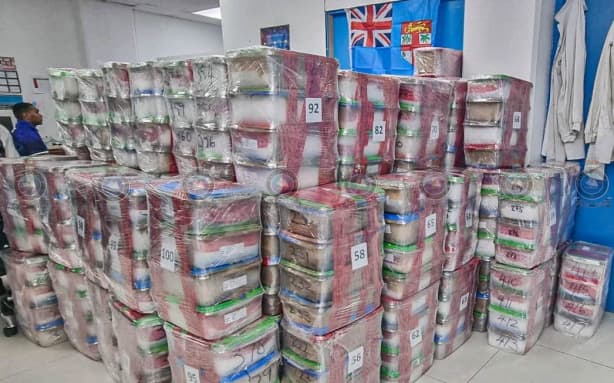
About 1.1 tonnes of methamphetamine was found concealed in containers in the Fijian town of Nadi, police said on 21 January, 2024.
Supplied/ Fiji Police
Warning of ‘new generation of drug dealers’
Ratu Tevita said Fiji carried the risk while other countries reaped the rewards.
“I am issuing a direct warning: if the government continues to neglect our communities in the face of this crisis, the day will come when our own youth realise the true worth of these finds. Through that gross negligence, we will have bred an entirely new generation of drug dealers,” Ratu Tevita said.
“No forum will keep drugs off the beaches of our islands in Lau – only practical, funded, community-led action will.
“We are seafarers. We know our seas and our weather like the back of our hands. Empower us to use that knowledge.
“The drug crisis was above all, a national security issue and the National Security Council needs to meet urgently and agree on an immediate response. Our national security structures and systems have been tested severely and found wanting.”
Fiji Police Force spokesperson Ana Naisoro declined to comment, saying that Ratu Tevita “didn’t specifically refer to police” in his comments.
A spokesperson for the Republic of Fiji Military Forces, Lieutenant Colonel Dr Eroni Duaibe, did not respond to RNZ Pacific’s questions as well.
“The growing regularity of these wash-ups is a direct challenge and threat to our joint security operations against drugs.”
The drug crisis demanded a whole-of society response, he added.
“The government must restore the necessary regulations and provide the tools and resources; traditional leaders must be empowered to act. Every layer of our society has a role – but only if the government steps back from the podium and into genuine partnership with the Vanua,” he said.
“We do not need more navy bases or police patrol boats. We need traditional guardians who are resourced, backed by law, and trusted to act.
Ratu Tevita is asking the government to:
- Restore the customary and village by-laws removed by the previous government. He claims their removal has left a dangerous vacuum, and it must be filled without delay – through proper parliamentary process if necessary.
- Equip and support communities on the ground – the gear, the constabulary support, and drug test kits so that finds can be verified at once and dealt with without delay, before anything disappears into the wrong hands.
- Redirect the money spent on endless conferences straight to our coastal communities who are carrying this burden. He claims the forum on drugs is one more exercise in institutional self-congratulation while Fiji’s beaches are contaminated.
- Ban unregistered and uninspected yachts and foreign vessels from our maritime zones – an immediate and non-negotiable measure.
Earlier this month, Ratu Tevita blasted a forum on the state of the Fijian economy held in Suva, labelling it as a “talkfest”.
The two-day event was organised by Dialogue Fiji, a civil society organisation focusing on creating a national space for meaningful discussions on Fiji’s economic situation.
The forum was “timely”, especially as it was held ahead of the national budget announcement this week, Dialogue Fiji’s CEO Nilesh Lal told reporters.
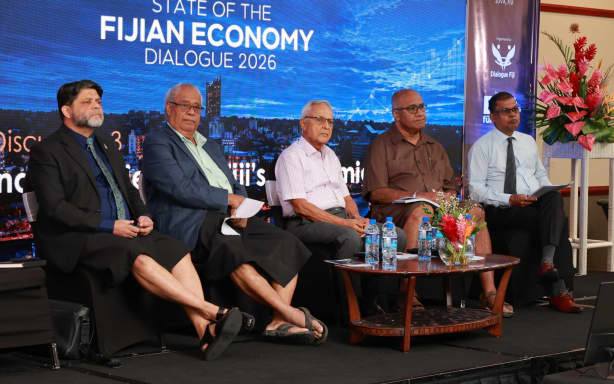
Left to right: Aiyaz Sayed-Khaiyum, Savenaca Narube, Mahendra Chaudhry, Manoa Kamikamica, Biman Prasad.
Facebook / Dialogue Fiji
In April, he weighed in on the debate on a common national identity for Fijians.
He spoke out after the Great Council of Chiefs (GCC) – the institution that represents culture, identity and heritage of the iTaukei people – proposed to reserve the term ‘Fijian’ exclusively for indigenous Fijians.
Ratu Tevita, who is a member of the GCC, said at the time that ethnic diversity made Fiji unique and should be protected.
“Common identity in Fiji is one that touches the very soul of our nation and it deserves honest, respectful, and consultative resolution. We owe that much to each and every one who calls Fiji home,” he said.
Fiji’s first indo-Fijian prime minister, Mahendra Chaudhry, who still leads the Labour Party, had called the idea “racially divisive” while civil society organisations said it undermined equality and democratic principles.
In February, Ratu Tevita said Fijians needed to decide their own future rather than looking backwards at the colonial era under the British Monarchy.
Ratu Tevita, who received his father’s traditional titles of Turaga Tui Nayau, Sau Ni Vanua Ko Lau and Tui Lau in July last year, had previously been reticent to comment on national politics.
However, he made the comments after Prime Minister Sitiveni Rabuka revealed that King Charles III had invited the GCC to Britain for “a session on constitutional matters”.
Ratu Tevita fled to Tonga in 2011 and went into exile after the then Prime Minister Frank Bainimarama sought to arrest him and charge him with treason.
The Tongan royal family sheltered him in their Nuku’alofa palace, where he worked as an advisor to King Tupou VI.
The Bainimarama administration banned him from re-entering Fiji – something that only became possible after Rabuka’s government came into power in December 2022.
He returned to Fiji in 2023 and now there are [https://www.rnz.co.nz/news/pacific/566423/political-dynamics-in-fiji-are-unpredictable-will-ratu-tevita-mara-step-into-politics predictions that he could well enter politics and become prime minister in the future.
However, Ratu Tevita has not publicly declared any official intention to enter Fijian party politics.
[RELATED] https://www.rnz.co.nz/news/pacific/598231/fiji-economic-forum-draws-sharp-criticism-from-high-chief-over-inclusivity
[RELATED] https://www.rnz.co.nz/international/pacific-news/591984/chief-calls-for-consultation-on-fijian-identity-debate
[RELATED] https://www.rnz.co.nz/international/pacific-news/588460/fijian-pm-rabuka-s-biggest-election-threat-could-come-from-within-academic-says
[RELATED] https://www.rnz.co.nz/international/pacific-news/586124/decide-for-ourselves-ratu-tevita-mara-warns-fiji-against-looking-back-to-britain
