


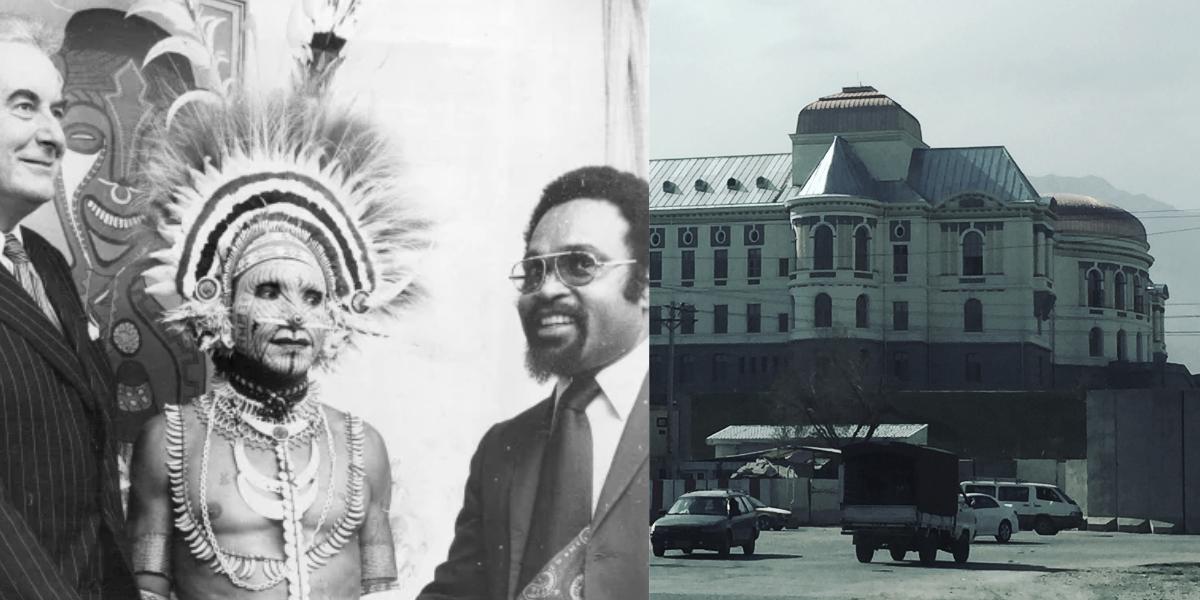
In a new Development Policy Centre discussion paper, we examine how institutional design shapes patterns of cooperation, competition and conflict in developing countries, focusing on civil service administration in Afghanistan (2001-2021) and Papua New Guinea since independence in 1975.
A central message of our research is that institutions are not neutral containers of governance. They create incentives. And in fragile or politically complex contexts, those incentives can just as easily produce conflict as cooperation.
A common starting point in development policy is that strengthening institutions — for example, civil service commissions or administrative rules — may improve governance outcomes. Our findings suggest that this view is incomplete.
Institutions are always embedded in historical, political and social contexts. In Afghanistan, attempts to build a modern, merit-based bureaucracy after 2001 were shaped by deep distrust among political actors and a legacy of highly centralised rule. In PNG, inherited Westminster-style institutions have interacted with local norms such as wantokism and “big-man” politics.
In both cases, informal networks — of patronage, kinship and political loyalty — have often had greater influence than formal rules. This means that institutional reforms, even when technically sound, do not operate as intended unless they align with underlying incentives.
One of our key findings is that institutional design can inadvertently create incentives for rivalry and conflict.
In Afghanistan, the post-2001 settlement accorded priority to short-term stability by distributing ministries and senior positions among political factions. While this helped accommodate powerful actors, it also created overlapping mandates, duplication and competition across institutions. Government departments became arenas of rivalry rather than coordination.
This situation resulted in low stability in key institutions, where a turnover in leadership would also lead to the replacement of heads of key departments. For instance, even the Finance Ministry, which was relatively meritocratic and governed by civil service constraints, experienced changes in over 50% of its senior positions under each minister from 2009 to 2021.
Excessive centralisation further reinforced these dynamics. With authority and resources concentrated in Kabul, control of the state became highly valuable, increasing the stakes of political competition. In a low-trust environment, this encouraged actors to compete aggressively for control rather than cooperate. Following the disputed 2014 presidential election, a power-sharing National Unity Government was formed, with the two rival candidates becoming President and Chief Executive. Although intended to promote unity and stability, the arrangement soon became vulnerable to internal power struggles, as competition over key decisions and senior appointments weakened the government and civil service.
PNG presents a different configuration of similar challenges. Decentralisation post-1975 independence created multiple layers of government, but with blurred responsibilities. The reversal of some of these reforms at later stages, such as the abolition of provincial elected assemblies in 1995, undermined rather than empowered local administration. The establishment of the District Services Improvement Program (DSIP), which gave Open MPs significant influence over the distribution of funds, arguably institutionalised a form of political patronage and weakened local administrations.
Amid weak institutional capacity, overlapping roles across national, provincial and local levels have often led to weak coordination and delays in service delivery. Low ministerial stability, due to persistent political instability, has reinforced these problems.
These examples illustrate a broader issue: institutional arrangements that appear rational in design can produce counterproductive outcomes if they generate the wrong incentives.
In both Afghanistan and PNG, patronage and clientelism have played a central role in shaping institutional dynamics.
In Afghanistan, the allocation of public office frequently reflected political bargaining rather than merit. Ministries and senior positions were treated as resources to be used to reward allies and maintain coalitions. This contributed to high turnover in leadership, instability within institutions and weakened administrative capacity.
In PNG, patronage operates through both political and administrative channels. Appointments are often influenced by political, regional or kinship ties, and public resources can be used to build electoral support. These dynamics encourage cooperation within networks but limit cooperation across them, while also fostering destructive forms of competition.
Importantly, these patterns are not merely inherited from the past; they are reinforced by contemporary institutional arrangements. In PNG, funding mechanisms such as the DSIP have expanded the discretionary control of MPs, while in Afghanistan, senior appointment processes shaped by the post-Bonn Agreement (2001) political settlement embedded patronage within state institutions.
Both countries have witnessed substantial reform efforts. In Afghanistan, civil service reforms supported by international partners helped create pockets of professionalism or “islands of efficiency“, particularly in some ministries. A new cohort of educated officials improved administrative capacity in specific areas.
Similarly, PNG has implemented multiple waves of reform, including decentralisation and public sector restructuring, including for example the creation of sometimes-effective Provincial Health Authorities.
However, in both contexts, these efforts have had uneven and often limited impacts. Reforms have tended to produce the above-mentioned islands of efficiency rather than system-wide change. Where underlying political incentives remain unchanged, reforms are vulnerable to being undermined or co-opted.
Our analysis suggests three practical implications.
First, institutional design must focus on incentives, not just structures. It is critical to consider how actors are likely to respond to new arrangements in practice.
Second, reforms need to be grounded in context. Imported models — whether centralised or decentralised — may not work as intended if they are not aligned with local political realities.
Third, addressing patronage and political competition is essential. Without engaging with these dynamics, institutional reforms are unlikely to achieve sustained improvements in governance.
The experiences of Afghanistan and PNG highlight a fundamental challenge: building effective, impartial state institutions is not simply a technical task. It is deeply political.
While the goal of a professional, neutral civil service remains important, achieving it requires more than formal institutional design. It demands careful attention to the incentives created by institutions and to the broader environment in which they operate.
As we argue in our paper, without such attention, institutional reforms risk reinforcing the very patterns of negative competition and conflict they are intended to overcome.
Download the full discussion paper from the Development Policy Centre website.
