


MAKING FRIENDS:
Chinese pressure to squeeze Taiwan’s international space should not hinder the nation from engaging with the world with confidence, a lawmaker said
-
By Chen Yun and Chen Chih-cheng / Staff reporters, with CNA
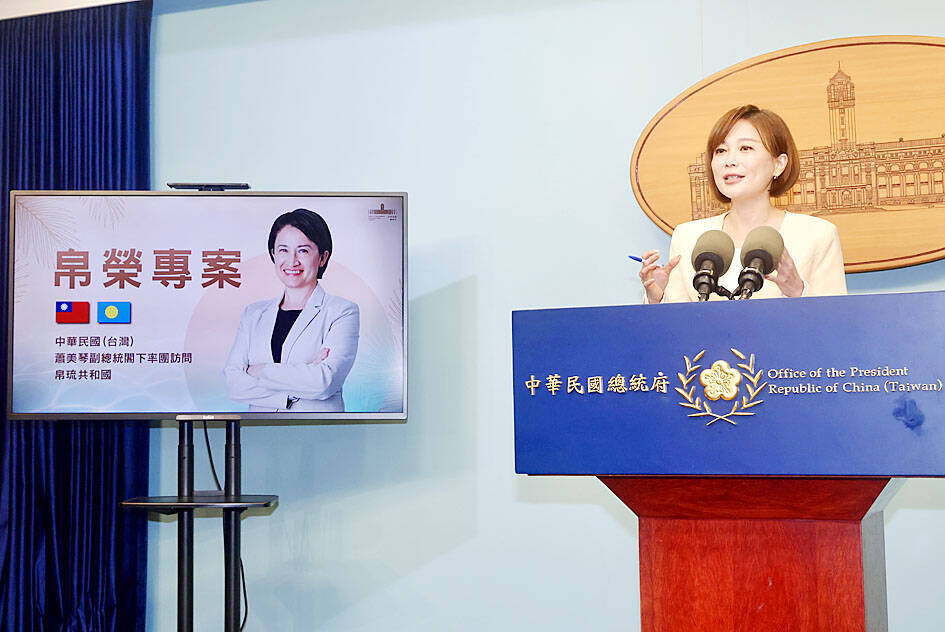
Vice President Hsiao Bi-khim (蕭美琴) is to embark on a five-day visit to Palau later this week to bolster diplomatic relations with the Pacific ally, the Presidential Office said yesterday.
Hsiao is to meet with Palauan President Surangel Whipps Jr and other government officials during her visit from Saturday to Wednesday next week, Presidential Office spokesperson Karen Kuo (郭雅慧) told a news conference.
She is representing President William Lai (賴清德) on the trip, following an invitation from President Whipps for the two Taiwanese leaders to visit, Kuo said.
Photo: CNA
Lai has set three goals for Hsiao’s trip.
First is to deepen bilateral ties, with Hsiao expected to meet Whipps and other senior officials to strengthen exchanges between the two sides, Kuo said.
Second is to support the promotion of sustainable tourism in Palau through visits to key attractions and joint efforts to boost the island nation’s tourism sector, she said.
Third is to observe progress under the Taiwan-Palau cooperation initiative, reviewing results in areas such as healthcare, agriculture and public infrastructure, she added.
Hsioa’s delegation is to include Deputy Minister of Health and Welfare Lin Ching-yi (林靜怡) and Deputy Minister of Foreign Affairs Baushuan Ger (葛葆萱), Kuo said.
Asked about travel arrangements, Kuo said the foreign affairs and national security agencies had fully assessed intelligence and security considerations for the trip.
Lai’s recent visit to Eswatini was delayed when three islands along his planned route revoked overflight permissions amid pressure from China.
Ger said direct flights would be arranged with consideration for safety, comfort, convenience and dignity.
The trip would be Hsiao’s first visit to a diplomatic ally since taking office as vice president, he said, adding that every aspect of the itinerary is being carefully coordinated.
The Ministry of Foreign Affairs will continue to work closely with the Palauan government to ensure that the visit proceeds smoothly and achieves its diplomatic objectives, he added.
National Cheng Kung University political science professor Wang Hung-jen (王宏仁) said the government’s willingness to publicize Hsiao’s itinerary despite Chinese opposition suggests it has contingency plans.
It also suggests that Taipei and its diplomatic partners are prepared to withstand Chinese pressure to maintain bilateral relations, he said.
Beijing’s tactic of boycotting tourism and agricultural products to coerce other countries is no longer as effective, he added.
Democratic Progressive Party (DPP) caucus secretary-general Fan Yun (范雲) said that Lai’s Eswatini visit showed everyone that “we will not stay home just because someone is bullying us.”
Taiwan and its allies around the world, as well as those willing to befriend the Republic of China, are naturally happy to visit each other, she said.
“Palau has long been a diplomatic ally, and if lawmakers can conduct parliamentary diplomacy there, there is all the more reason for the vice president to visit,” she added.
DPP caucus chief executive Chuang Jui-hsiung (莊瑞雄) said that Taiwan’s biggest source of obstruction in the international arena is China.
When China intensifies its pressure on Taiwan’s international space, Taiwan cannot respond by staying home, he said.
“Instead, it must further enhance its visibility on the global stage and engage with the world with confidence,” he said. “This is especially true with countries that maintain diplomatic relations with Taiwan, where every effort should be made to overcome challenges.”
Taiwan also hopes to gain stronger support from friends across the international community, he added.
Additional reporting by Lin Che-yuan
