


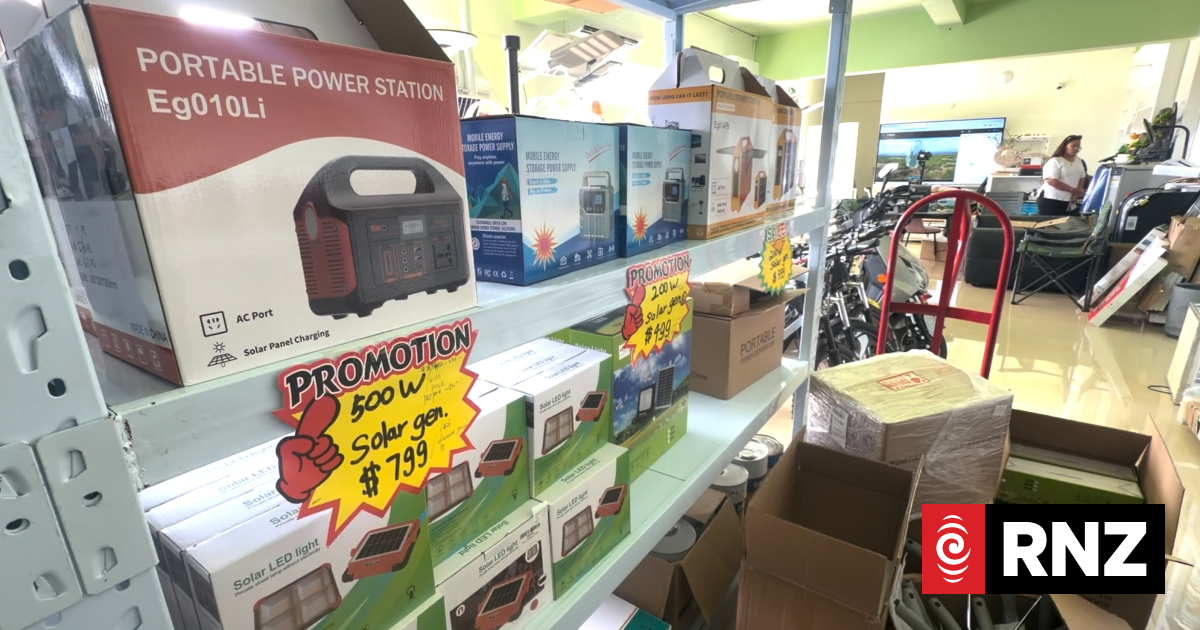
Solar energy providers reporting a surge in interest in the CNMI.
Photo: Mark Rabago
High power costs are forcing more residents in the Northern Mariana Islands (CNMI) to explore the possibility of disconnecting from the main public power grid altogether.
This comes as solar energy providers in the US territory report a surge in interest following Super Typhoon Sinlaku and months of concern over electricity costs.
The growing interest in off-grid living comes as homeowners seek protection from both rising utility bills and future power disruptions caused by severe weather, according to local solar energy businesses.
Even as the Commonwealth Utilities Corporation (CUC) announced a decrease in its often-maligned Fuel Adjustment Charge for June, solar providers say many residents remain unconvinced that conventional electricity costs will stay low for long and continue to view renewable energy as a more predictable long-term investment.
Stacey Wang, chief executive officer of Saipan Green Energy and Construction, said solar systems have become significantly more affordable than when the company first began promoting the technology more than a decade ago.

Solar energy providers reporting a surge in interest in the CNMI.
Photo: Mark Rabago
Following Sinlaku, which severely damaged the CNMI’s power infrastructure, Wang said inquiries from residents increased substantially as people looked for alternatives to prolonged outages and fluctuating utility costs.
She said many prospective customers are attracted by the prospect of relying on sunlight rather than paying future fuel-related surcharges.
The company estimates that a typical two-bedroom home can operate largely independently of the grid with an 8- to 10-kilowatt solar system and battery storage. Depending on household size and electricity usage, installations generally range from about US$6000 for smaller systems to as much as US$20,000 for larger homes.
Wang said the economics of solar power have changed dramatically since the technology was first introduced in 2012, when equipment costs were substantially higher. She added that the company has strengthened its focus on typhoon-resistant mounting systems and structural design following lessons learned from Sinlaku.
Jeannifer Cubangbang of SweetGlamIslandChic’s Green Energy Solutions said she has also seen growing interest from residents hoping to eliminate monthly electricity bills.
According to Cubangbang, some households can fully disconnect from the grid with systems costing less than US$14,000, while larger homes may require installations closer to US$18,000.
She said her own solar setup survived Sinlaku without damage and has dramatically reduced what was once a monthly power bill of around US$750.
The trend comes as CUC announced that its Fuel Adjustment Charge will decrease from US44.489 cents per kilowatt-hour in May to US41.280 cents per kilowatt-hour beginning 1 June after lower international fuel oil prices.
The utility said the reduction reflects declining global fuel costs reported by Mobil Oil Mariana Islands. It noted that while the June rate is lower, the utility had previously calculated that the fuel surcharge for May could have exceeded 60 cents per kilowatt-hour based on fuel prices at the time.
However, it chose not to seek regulatory approval for such an increase and instead maintained the lower rate that took effect in mid-May.
For many residents still recovering from the impacts of Sinlaku, however, the latest reduction appears unlikely to slow interest in solar energy, particularly among those seeking greater energy security during future storms and less exposure to fuel-price volatility.
