


Australian aid
The Albanese government’s fifth federal budget sees Australia’s Official Development Assistance (ODA) increase in nominal terms from an estimated $5.097 billion in 2025-26 to $5.450 billion in 2029-30. This increase is partly the result of the government’s applying its promised 2.5% annual increase to “base ODA” from 2026-27 to 2036-37 (see breakdown in Table 1). When adjusted for inflation, however, Australia’s aid spending is estimated to fall by 3% between 2026-27 and 2029-30 and by 7% since Labor’s first budget in 2022-23. As a result, allocations for several of Australia’s core multilateral contributions have been reduced or ceased and “reprioritised” to fund bilateral and regional programs as the global energy and economic shocks from the US-Israel war with Iran continue.
Devpolicy’s analysis of the 2026 budget can be found on the blog, the podcast and our YouTube channel. Relevant sections of the Australian Aid Tracker have been updated with the latest figures.
Analysis of the 2026 budget has also been published by the Australian Council for International Development, the Lowy Institute, the Development Intelligence Lab and the Australian Global Health Alliance.
The 18 members of the Pacific Islands Forum (PIF), including Australia and New Zealand, have formally invoked the provisions of the 2000 Biketawa Declaration “to support a coordinated regional response to the emerging energy crisis affecting the Pacific region”. The last time PIF leaders invoked the Declaration was in 2020, at the beginning of the COVID-19 pandemic. Foreign Minister Penny Wong has said that Australia is working with other development partners “to back in a Pacific-led response to these global shocks”.
Ahead of the budget, the government announced that Australia will provide $30 million in budget support to assist Fiji’s response to the fuel crisis. Australia and Fiji have also joined eight other PIF countries in ratifying the treaty governing the Pacific Resilience Facility (PRF), a regional climate fund that will focus on community-level adaptation projects and will be principally financed via interest earnings on capital contributions.
Commenting on recent high-profile player signings by the PNG Chiefs, including their living arrangements and tax status, Prime Minister Anthony Albanese stated that “I can’t think of any aid and assistance in our region in the Pacific, and we’re part of the Pacific family, that will be more important than support for the PNG Chiefs”. The components of the government’s ten-year, $600 million Pacific rugby league package that support the inclusion of the Chiefs’ franchise in the National Rugby League competition from 2028 are not ODA-eligible and are not counted toward Australia’s ODA spending by DFAT.
Vanuatu’s Prime Minister Jotham Napat has accused both Australia and China of “using their interests to try to undermine us” as Canberra and Beijing pursue competing bilateral agreements with Port Vila as part of their wider regional strategic contest. Napat says that the Vanuatu government has now reached consensus positions on both agreements. An earlier version of the Nakamal Agreement with Australia was ultimately rejected by Vanuatu in 2025 on the grounds that it could constrain the latter’s ability to obtain infrastructure financing from China.
The government has provided responses to two committee inquiry reports tabled in the previous parliament, one on alignment with Pacific Island countries’ priorities (November 2024) and the other on supporting the rights of women and children (November 2023).
DFAT is conducting a survey seeking feedback on AusDevPortal, its aid transparency website. The survey will be open until 12 June.
Regional and global aid
The World Bank has approved a new, six-year country partnership with PNG, worth US$1.2 billion, that will focus on job creation, agriculture and private sector development.
A new report by the US government spending watchdog has found persistent delays in US funding disbursements under its longstanding compact agreements with Palau, the Federated States of Micronesia and the Republic of the Marshall Islands. These delays are attributed to compact states’ inability to complete required audit reporting in the face of rising costs, as well as the impacts of the Trump administration’s hiring freeze on the State Department.
A group of developing country shareholders and clients, including China and Brazil, have reportedly pushed back against the Trump administration’s efforts to weaken the World Bank’s climate change strategy, which expires in June, arguing for a one-year extension of the strategy to facilitate an independent evaluation.
A new outbreak of Ebola virus disease in the Democratic Republic of Congo (DRC) and in neighbouring Uganda has been declared a “public health emergency of international concern” by the World Health Organization (WHO). As of 27 May, there are over 900 suspected cases and an estimated 220 deaths. The dismantling of USAID, along with other donors’ health aid cuts and ongoing conflict in the DRC, have impeded more timely detection of and response to the outbreak. The Africa Centres for Disease Control and Prevention and the WHO are seeking US$319 million in funding to support a coordinated emergency response over the next six months. There is as yet no vaccine for the strain of the virus behind this outbreak.
A bipartisan group of US legislators is urging the Trump administration to honour US$600 million in congressionally approved funding for Gavi, the Vaccine Alliance, before the funding expires at the end of September.
Speaking on the sidelines of the World Health Assembly in Geneva, Indonesia’s health minister, Budi Gunadi Sadikin, confirmed that he has discussed nominating for the WHO Director-General position with President Prabowo Subianto.
The UK used its co-hosting of an international development conference to launch a new “International Coalition to End Violence against Women and Girls”, which includes Australia as one of its eight founding members. A parliamentary inquiry report released earlier this year highlighted the negative impacts that the Starmer government’s large and ongoing aid cuts are having on efforts to advance gender equality.
The Gates Foundation and technology company Anthropic have launched a new US$200 million, four-year partnership focused on extending the benefits of AI to “global health, life sciences, education, and economic mobility … “.
Books, reports, articles, podcasts etc
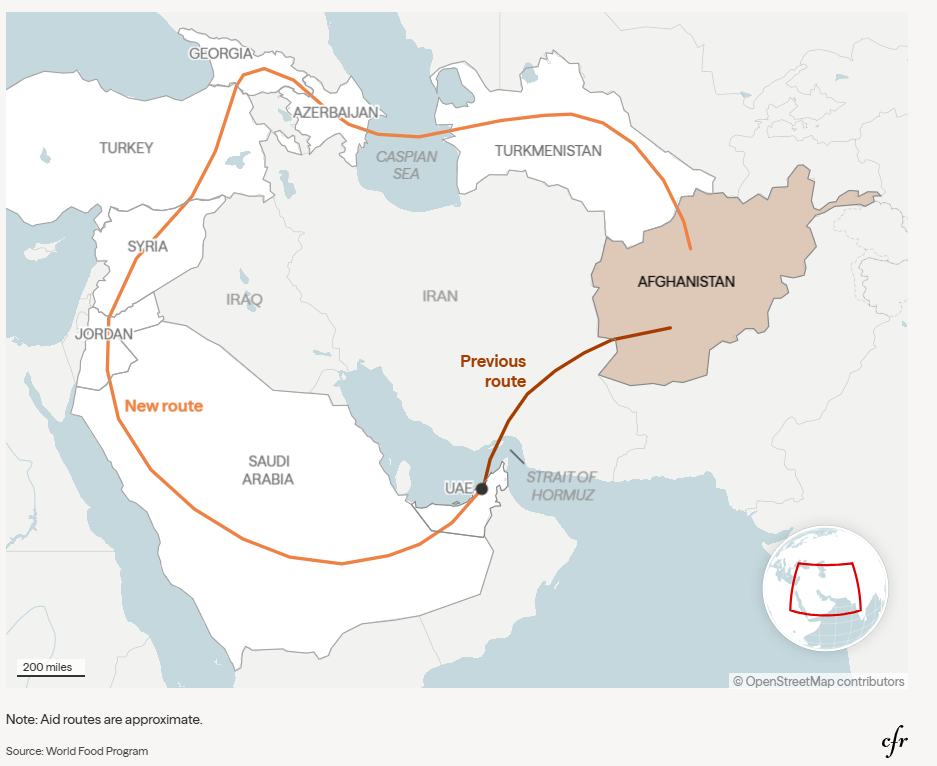
Sam Vigersky from the US Council on Foreign Relations looks at how the US-Israel war with Iran has disrupted supply routes and increased humanitarian costs, including for the people of Afghanistan, for whom the war is compounding an already dire food security crisis.
Figure 1: How the US-Israel War with Iran disrupts aid routes to Afghanistan
Maia King from King’s College London unpacks the concepts of “ownership” and “partnership” in development cooperation. She finds that donor-defined applications of these terms often fail to give local actors the necessary agency to meet their domestic constituents’ understandings of accountability, legitimacy and contestability.
The role of evidence in shaping GiveDirectly’s journey to becoming a US$1 billion charity is among the articles contained in the first edition of In Development, a new online magazine “dedicated to exploring how progress happens — or doesn’t happen — in the developing world”.
