

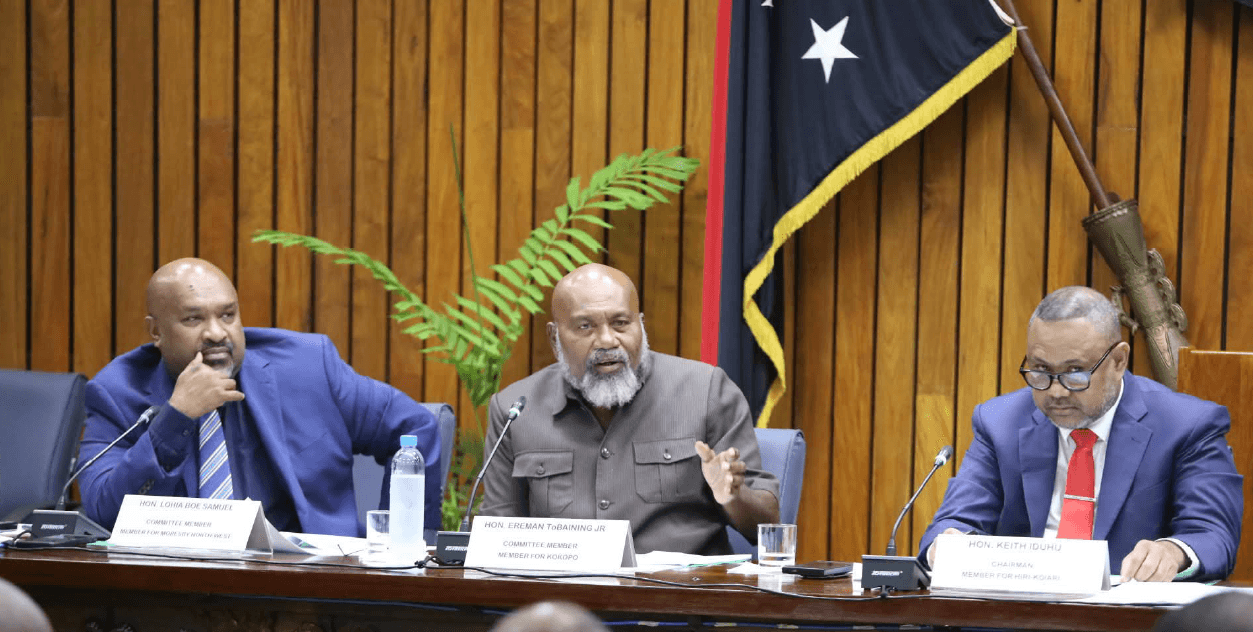
In a recent post on the Devpolicy Blog, Andrew Donigi hailed the report of the Special Parliamentary Committee on Customary Land and Land Reforms in Papua New Guinea as a further step along a well-trodden path of reform that has sought to reconcile the fundamental principles of customary land tenure with the demands of good governance. However, this appears to be a much bigger step than those previously taken after the 2005 National Land Summit.
Amongst the committee’s numerous recommendations are those contained in the provisions of a Customary Land Tenure Bill attached as an appendix to the report. In its current form, the Bill proposes three major innovations.
First, to abolish the Customary Land Division of the Department of Lands and Physical Planning and replace it with a separate Customary Land Authority (CLA) with its own board of trustees.
Second, to repeal the amendments made to the Land Groups Incorporation Act and Land Registration Act in 2009 and make “clans” submit fresh applications for recognition by the CLA before they can be authorised to issue “customary land leases” to third parties.
And third, to require the holders of such leases to make all rental or compensation payments to the CLA in the first instance, before the CLA redistributes a proportion of this money to individual clan members.
The first of these proposals has been on the table for more than a decade. A review of the land reform process in 2018 observed that it had been endorsed by PNG’s National Executive Council in 2016, but that decision was soon abandoned in the face of strenuous opposition from the Lands Department. The proposal continues to resurface because of persistent doubts about the capacity of departmental staff to administer the legislation for which they are currently responsible, but it is not clear whether their shortcomings count as evidence of corruption, incompetence, political interference, a lack of resources or a combination of all these things.
The second proposal is based on a belief that the 2009 amendments do not go far enough to ensure that incorporated land groups (ILGs) truly represent the wishes and interests of the customary landowners whom they claim to represent. In a previous discussion paper, I pointed out that the many legal safeguards built into those amendments were not matched by evidence of effective implementation on the part of relevant government officials, and that is why the so-called “voluntary customary land registration” scheme was thought to have failed by the time of the 2019 National Land Summit.
If the first proposal is meant to solve the implementation problem, then one has to wonder why the addition of new safeguards cannot be accomplished by making further amendments to the existing legislation rather than getting rid of ILGs altogether.
The committee’s answer seems to be that the very idea of a “land group” needs to be cast aside because land groups cannot possibly be authentic entities if they cannot prove that they are “clans” — in other words, what we anthropologists would call unilineal (patrilineal or matrilineal) descent groups. However, there are perfectly good reasons why the Land Groups Incorporation Act has never included the word “clan” since it was first passed in 1974.
There are some parts of PNG where local people do not recognise the existence of such descent groups and therefore have no word for “clan” in their own language. There are other places where people do have a word like this, but where membership of such groups is not simply determined by descent through the male or female line. And even where unilineal descent groups do seem to be part of the customary social fabric, there is no reason to assume that their primary social function lies in the allocation of rights to the use of customary land.
So what will happen if the 2026 bill gets to be enacted and certified in its current form? Since the 2009 amendments came into effect in 2012, about 1,600 ILGs have received certificates of recognition from the Lands Department, but fewer than 130 of them have managed to secure registered titles over blocks of former customary land. There is currently no legal way to revoke these titles without evidence that they were issued by mistake or through some fraudulent action on the part of the registrar.
The 2026 bill allows three years for ILGs that only have certificates of recognition to reconstitute themselves as “clans” and then try to get new certificates on the basis of a new bundle of evidence to be submitted to the CLA. Those groups that have been established on some other basis, like a common place of residence rather than descent from a common ancestor, may not bother to do so. But that does not necessarily mean they will disappear. There are hundreds of ILGs registered before 2012 whose executives failed to apply for reincorporation under the terms of the 2009 amendments, but who continue to receive and redistribute royalties and other landowner benefits under the terms of the Forestry Act and the Oil and Gas Act. It is most unlikely that the government would risk the outbreak of serious public disorder by trying to block such payments.
The third proposal in the new bill could also prove to be rather unpopular. Although it is based on a widely held belief that land group executives cannot be trusted to distribute rental and compensation payments to all group members in a transparent and equitable manner, it is just as unlikely that people will trust the executives of the CLA to do any better.
That raises the further question of who will foot the bill for the operation of the CLA itself. While the latest report contains numerous complaints about the costs incurred by land groups in their efforts to comply with the terms of the current scheme, the additional safeguards prescribed in the new scheme can only make the whole business even more expensive. There are various passages in the latest report that invoke the generosity of the government. However, the government’s past failure to subsidise the existing scheme does not give much cause for optimism on that score. If the CLA is then obliged to cover a substantial portion of its own operational costs by making deductions from the revenues it collects on behalf of the customary landowners, then the customary landowners will soon be up in arms.
In my latest discussion paper on the alienation of customary land in Port Moresby, I have shown how people with money and power, including members of parliament, continue to exploit all sorts of legal and illegal mechanisms to get what they want. This suggests that the addition of more legal and institutional machinery to protect the interests of customary landowners is unlikely to put an end to the process through which those interests are betrayed.
While Donigi’s approval of the 2026 bill is evidently shared by most members of parliament, one does have to wonder whether the institutional constraints to the implementation of such drastic changes will be recognised before it is made into law.
