


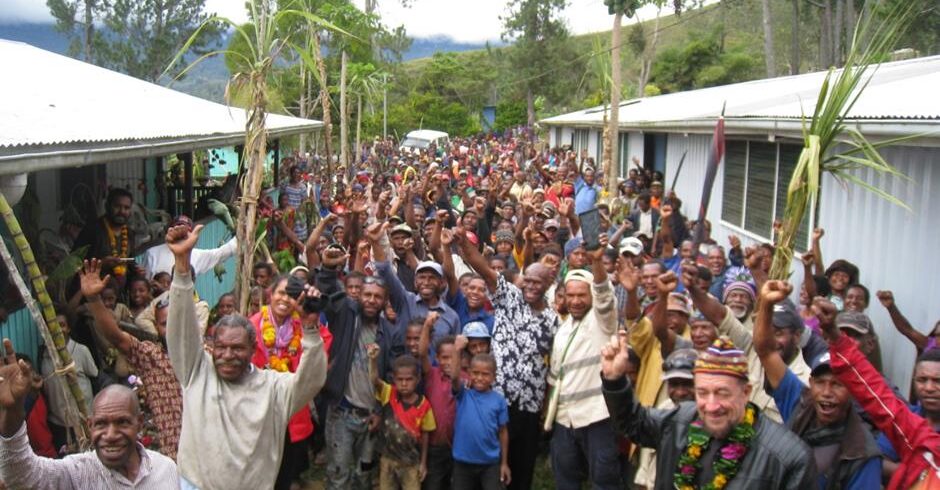
For decades, Papua New Guinea has struggled with some of the highest maternal and newborn mortality rates in the Pacific. Nationally, fewer than four in ten births take place with a skilled birth attendant, and this figure is as low as 20% in some of the Highlands provinces.
One of the most powerful protections for mothers and babies is giving birth with a skilled and caring health worker in a health facility. For many reasons this remains out of reach for many rural PNG families.
The reasons are well known: rugged geography, poor roads, limited transport, poverty, run-down rural health facilities and deep-rooted social norms around childbirth and gender roles. In many rural areas it is expected that women will deliver at home with female relatives in attendance.
Knowing the barriers is one thing. Finding solutions that change behaviour, and keep doing so over time, is another.
A recent initiative in Simbu Province funded by the Mola Foundation offers valuable insight: a write-up and analysis of this program has been submitted to BMJ Public Health.
Between 2019 and early 2026, an intervention was rolled out across 18 rural health centres. By combining modest non-financial incentives with practical improvements to rural health services, the program achieved something that has long proved elusive: it has doubled the number of women giving birth at the supported rural health centres and kept those gains over time. It is a simple idea (borrowed from a similar program in Cambodia) and built around local realities.
So what made the difference?
Rather than introducing cash payments or complex new schemes, the program focused on four straightforward, locally designed elements:
- Baby bundles (care packages) for women who come to health facilities for supervised birth: these contain all the items the mother will need for her newborn, personal items for mothers, a gift for fathers and a small amount of food rations for the postpartum period.
- Upgrades to health centres, including lighting in the birthing suite plus cleaner and more private maternity spaces, running water and essential delivery equipment.
- Upskilling community health workers (CHWs) with training in respectful, welcoming and quality midwifery and newborn care, as well as in handling common obstetric emergencies. This training has now been carried out in 12 provinces. CHWs are nursing staff with basic training and are the backbone of rural facility care in PNG.
- Community engagement, including encouraging husbands to support birth planning and welcoming families into maternity spaces.
At first glance, the baby bundle often gets the most attention. Costing around AUD40 per birth, it includes items many families struggle to provide, including nappies, baby clothes, a baby blanket, a towel, soap and a wrap, rubber thongs and an umbrella for the mother, and a valued tool (spade head, or file to sharpen axe and bush knife) for the father. But the bundle is only part of a much bigger story.
Looking at health centre data over four years, researchers found a sharp increase in facility births immediately after the program began. On average, monthly births at participating centres increased by around two and a half times. While numbers didn’t continue climbing indefinitely, they stayed close to double pre-intervention levels two years later. In a context where many incentive programs see a short-lived spike followed by a return to old patterns, this sustained change matters.
A mother of triplets received three baby bundles at Yampu, Enga Province (Glen Mola)
Researchers also found that women and their husbands consistently said they preferred giving birth at a health centre because it felt safer for themselves and their babies. What had changed was that the health centre now felt like a place they were welcome to use and give birth. Three factors stood out.
First, reducing shame and financial stress. For families struggling to meet their daily needs, the expectation that parents should arrive with clothes, wraps and supplies for a newborn can stop women from going to a facility at all. Fathers in particular described feeling ashamed if they could not provide all the items health centre nurses demanded of them.
The baby bundle removed that pressure. Instead of embarrassment, families spoke about pride and appreciation for the health workers who provided the bundles as a “gift”, in line with local customs of reciprocity.
Second, better experiences of care. Improved privacy, lighting and cleanliness mattered deeply to women. So did being treated kindly. Women repeatedly said they trusted upskilled CHWs who showed empathy, stayed with them during labour and explained what was happening.
Third, changing men’s roles. Traditionally in many PNG communities, men have kept their distance from childbirth. But the program actively encouraged male involvement in antenatal, labour and delivery care, gently challenging existing norms.
Men who supported their partners through labour described a deeper appreciation of what women experience during birth as well as a stronger commitment to making sure future deliveries happened at health centres.
An important finding from the study was that most women said they would still return to a health facility even if the baby bundles stopped. The women who had given birth in their local health facility and their husbands have become strong advocates for the program in their communities.
That tells us something crucial: incentives helped trigger first use but quality of care is what sustained demand.
In other words, incentives are not a shortcut. They work best when paired with investment in frontline health services, staff support and community trust.
In addition to reduced maternal and newborn mortality rates, the program provided significant collateral benefits. An Australian Doctors International (ADI) evaluation of the initiative found that 83% of newborns received full immunisations, almost half of mothers accessed immediate postpartum family planning services and more than 80% accessed additional services such as human immunodeficiency virus and sexually transmitted infection (HIV/STI) testing and malaria screening. Support and education for breastfeeding was also provided.
This experience aligns closely with PNG’s own ambitions represented in the National Health Plan and Australia’s longstanding partnership approach to health systems strengthening.
Rather than creating parallel programs, the intervention worked through existing government and church-run rural facilities. And the program addressed both demand and supply side of the birthing care equation and did so in ways that made sense locally. At a relatively low cost per birth, the program demonstrated strong value for money while advancing gender equality, rural service delivery and locally led development.
Incentivisation of supervised birth for rural women has been incorporated into the PNG Government’s National Maternal and Newborn Care Policy released in 2023. However, no funding has been allocated to implement this policy at a national level.
Women in rural PNG have long understood the risks of giving birth without skilled care. What this project shows is that when health services feel safe, respectful and accessible, and when families feel supported, sustained behavioural change is possible.
Note: Accurate health statistics are difficult to ascertain in Papua New Guinea due to the lack of verified population figures and the reporting of birthing outcomes. While figures often quote slightly more than four out of ten births are assisted by a skilled attendant, the population of Papua New Guinea is known to be underestimated by up to two million people. The World Bank lists the mortality rate of infants in PNG as 31 per 1000 live births (2024) with research showing mortality can be four times higher if birth occurs at home without a skilled attendant.
