

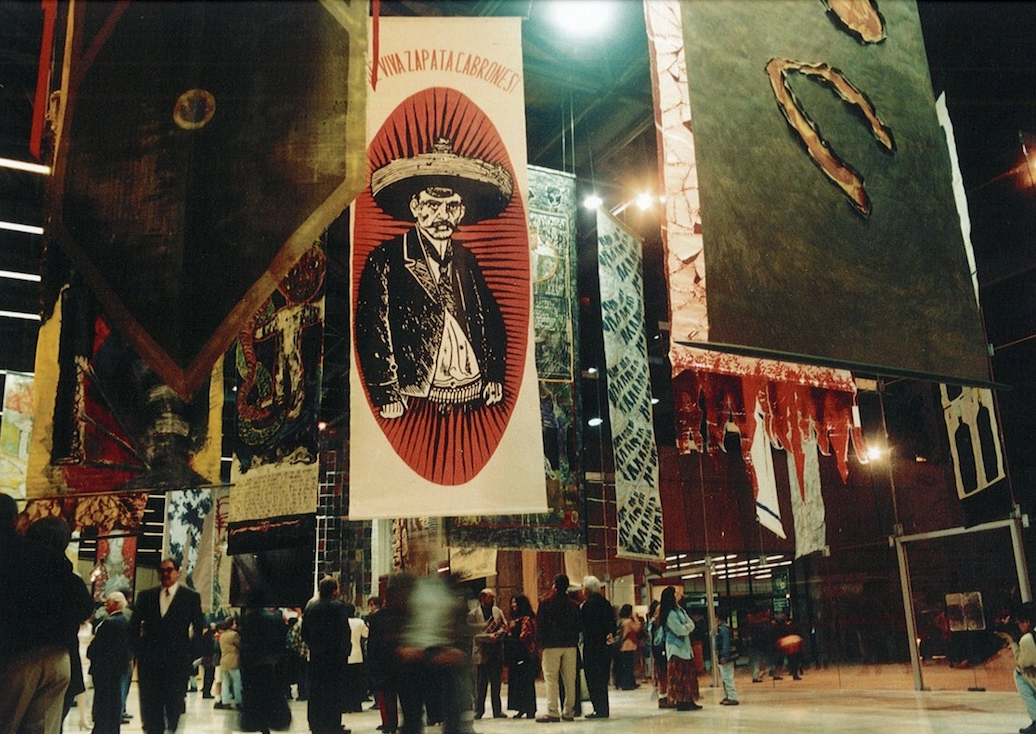
The Arnold Belkin Room at the Museo Universitario del Chopo is transformed into a suspended forest of textile memories and artistic experimentation. Twenty-five banners hang from varying heights as part of an exhibition that recovers the history and impact of the International Banner Biennial, a project spearheaded between 1996 and 2014 by artist and cultural manager Marta Palau.
The exhibition primarily features the acquisition prizes from that biennial held at the Tijuana Cultural Center (CECUT), a space that for nearly two decades became a meeting point for emerging artists and established figures in international contemporary art. Throughout its existence, 305 artists from 32 countries participated, producing a total of 353 banners.
The exhibition, curated by Abril Castro Prieto, not only examines the aesthetic dimension of the project, but also Palau’s ability to build cultural networks from the periphery of the country and challenge artistic centralism. The artist, born in Spain and arriving in Mexico in 1940 with the Spanish Republican exiles, developed much of her career in Baja California, where she spearheaded fundamental initiatives for contemporary textile art.
One of the most important antecedents of the Biennial was the Michoacan International Salon of Miniature Textiles, organized by Palau in Morelia between 1982 and 1986. That project promoted small-format textile works to facilitate their circulation and allowed for the exploration of new possibilities of textiles as a contemporary artistic language.
The International Biennial of Banners revived this itinerant vision. The pieces had to be adapted to specific dimensions inspired by the standard format of kraft paper, an economical and flexible medium that facilitated the transport of the works rolled up inside a single tube. According to Castro Prieto, this decision reveals Palau’s practical intelligence as a cultural manager: producing large-format works without demanding excessive investments from the artists.
Over the years, the biennial also became a laboratory for material experimentation. Some works challenged the traditional limits of textiles and explored new three-dimensional structures. Among them, the piece by Argentine artist Mariana Gullco, made entirely of tea bags, stands out, as does the banner by Uruguayan artist Ricardo Lanzarini, constructed from cement sacks covered in paint.
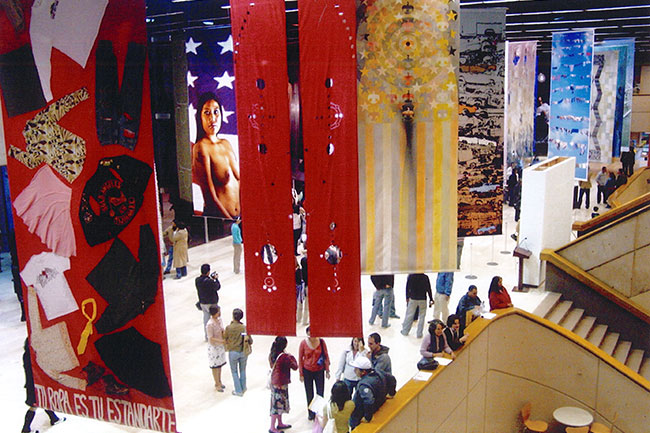
The curator emphasizes that Palau understood the need to make the biennial’s original format more flexible to accommodate other media and artistic languages. This openness allowed the project to evolve from an invitation-only competition into a platform for international dialogue where different generations and artistic approaches could coexist.
In addition to the exhibited pieces, the exhibition integrates documents and archives from the Arkheia Documentation Center of the University Museum of Contemporary Art and from the Cecut archive itself, materials that help to reconstruct the historical and collaborative dimension of the project.
