



When a Pacific Australia Labour Mobility (PALM) scheme worker in an Australian abattoir gets fewer shifts one fortnight, what happens to their family’s budget back in Fiji?
In a new discussion paper, we use high-frequency financial diaries collected from 29 Fijian temporary migrant workers in Australia and their families back home to study how remittances respond to the ups and downs of earnings abroad. We find that negative earnings shocks are passed through to families immediately, while positive shocks tend to be absorbed by the migrant. For households in Fiji where remittances are typically the primary and often only source of income, this asymmetry has clear welfare implications.
Financial diaries are a well-established methodology in financial inclusion and development economics, popularised by Portfolios of the Poor. The idea is simple: visit participants regularly and record every transaction to build detailed pictures of their financial lives over time. We extended this idea, in the Remittance Diaries, to doing this simultaneously on both sides of the transnational household: collecting weekly data from the migrant worker in Australia and their remittance-receiving family member in Fiji for up to a year.
While 29 pairs is a small cross-section, it gives us around 550 fortnightly observations per side and there is considerable variation within individuals. This depth is precisely the point: financial diaries deliberately sacrifice cross-sectional breadth for individual depth, and here the detail lets us trace income shocks from workers’ payslips in Australia, through each remittance transfer, to households’ spending in Fiji.
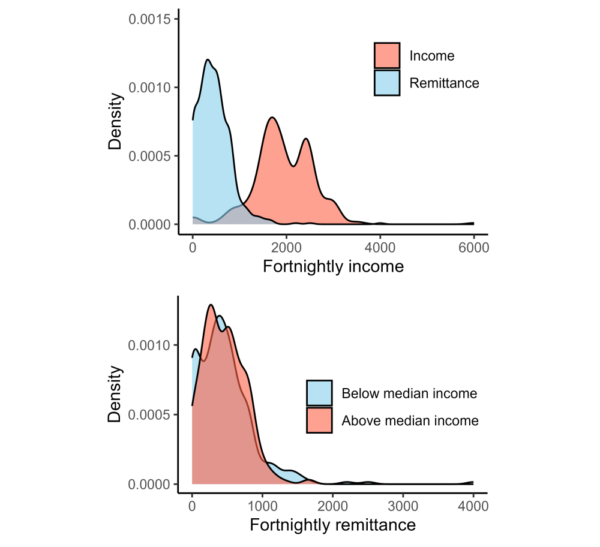
On average in our data, Fijian PALM workers earn about AUD1,943 per fortnight (after tax), send AUD459 home, spend AUD566 on other expenses, and save the remaining AUD919 — almost half of their pay. Clearly, these are not the finances of people who have been reported to be taking home less than $100 a week. Their counterparts in Fiji receive about FJD633 (approx. AUD400 at today’s mid-market rate) per fortnight, of which around 90% comes from remittances. Unlike the migrant, the Fijian household spends most of what comes in, with average savings of just FJD189 per fortnight. Our data were collected in 2022-23, so equivalent figures would be higher today.
One key descriptive finding is that regardless of whether migrants earn more than the cohort average over their stay, they tend to send similar regular amounts home. Higher earners don’t send noticeably more each pay but rather save the surplus. The regular transfer is set to cover household needs back home and stays roughly fixed. Not dissimilar to “Engel’s Law“, remittance budget shares fall with income, while the gap between income and remittances grows with income, showing up primarily as savings — an important piece of context for our within-individual results.
Figure 1: Fortnightly incomes and remittances
Source: Negative Shocks Travel Home discussion paper.
We exploit fortnightly variation within individual workers to estimate the income elasticity of remittances: what happens when a given worker earns more or less than their own average in a particular fortnight. We find that a 1% increase in earnings corresponds to roughly a 0.3% increase in remittances in the same period. For these estimates to be interpreted as causal or unbiased, we rely on the fact that PALM workers tend to be employed at fixed hourly rates, and most workers seek to maximise earnings. Variation in fortnightly earnings for individual workers comes almost entirely from employer-determined rostering, for example shift allocations, overtime availability and plant shutdowns, rather than workers choosing to work more to meet anticipated requests from back home. This power asymmetry has been well documented and indeed motivates most of the recent reforms to the scheme.
Using the dual-sided data and the fact that rostering decisions in Australia are plausibly not related to spending decisions in Fiji, we estimate a marginal propensity to consume remittance income in Fiji of around 0.7. This means that as remittance income increases or falls by a dollar, expenditures and consumption move in the same direction, on average, by 70 cents in that dollar. Fijian household spending is thus far more responsive to income fluctuations than the migrant’s spending in Australia. This makes sense, as the migrant has a savings buffer but the household in Fiji largely does not.
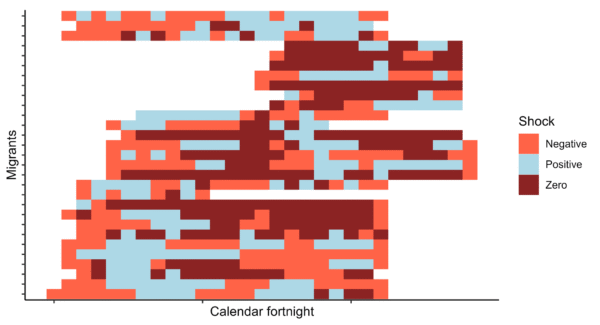
Figure 2: The incidence of positive and negative income shocks over time
Source: Negative Shocks Travel Home discussion paper
These averages mask some important patterns. When we split the data by whether a given fortnight’s earnings are above or below each migrant’s median, the contemporaneous remittance response appears to be driven primarily by negative shocks. A good fortnight doesn’t correspond to noticeably higher remittances but a bad fortnight, for example from fewer shifts or a plant shutdown, leads to an immediate and statistically significant drop in remittances sent home. The opposite pattern holds for workers’ other non-remittance expenditures: spending more when they have a good fortnight but partially smoothing their consumption when earnings drop — absorbing the odd lean fortnight. For remittance-receiving households back in Fiji, we find that expenditures respond almost symmetrically to income in both directions. Tracking income almost one-for-one, we find no evidence of consumption smoothing in Fiji as income risk in Australia is shared back home in real time.
We think this picture is relatively coherent. PALM workers know what their families need and send that regularly. Workers in our sample here don’t raise regular transfers when they earn more but rather use the extra income for expenses abroad or save it for lumpier investments and requests later. Yet, when they earn less, this shortfall passes straight through. For households in Fiji, where remittances are the main and often only source of income and savings buffers tend to be thin, earnings volatility in regional Australia directly shapes consumption volatility back at home.
Our estimates have some practical implications. The simultaneous minimum hours, pay and deduction protections now in place for PALM workers, reforms that directly targeted workers potentially not getting enough hours, could be as important, if not more so, for remittance-receiving households in the Pacific as for the migrant workers themselves. As negative shocks and volatility travel home, so too do these protections: protecting the floor of PALM workers’ earnings may, in effect, protect the consumption floor in sending countries.
The discussion paper is available on the Development Policy Centre website.
