

Felix Kim
The Japan Coast Guard (JCG) is playing a pivotal role in promoting maritime stability across the Indo-Pacific. Launched in 2017, the agency’s Mobile Cooperation Team (MCT) program formalized a long-standing maritime capacity-building effort. Experts are dispatched to train partners in maritime law enforcement, including boarding operations, search and rescue, and international maritime law.
“The durable, only way to counter gray-zone activities and violations of international laws, rules and norms is to be able to identify illicit activities and respond in ways that are compliant with international standards,” Mike Bosack, founder of the Parley Policy Initiative and a special advisor to the Japan-based Yokosuka Council on Asia-Pacific Studies, told FORUM. “This is where Japan excels. They deliver top-tier training in appropriate conduct while executing necessary law enforcement and oversight functions.”
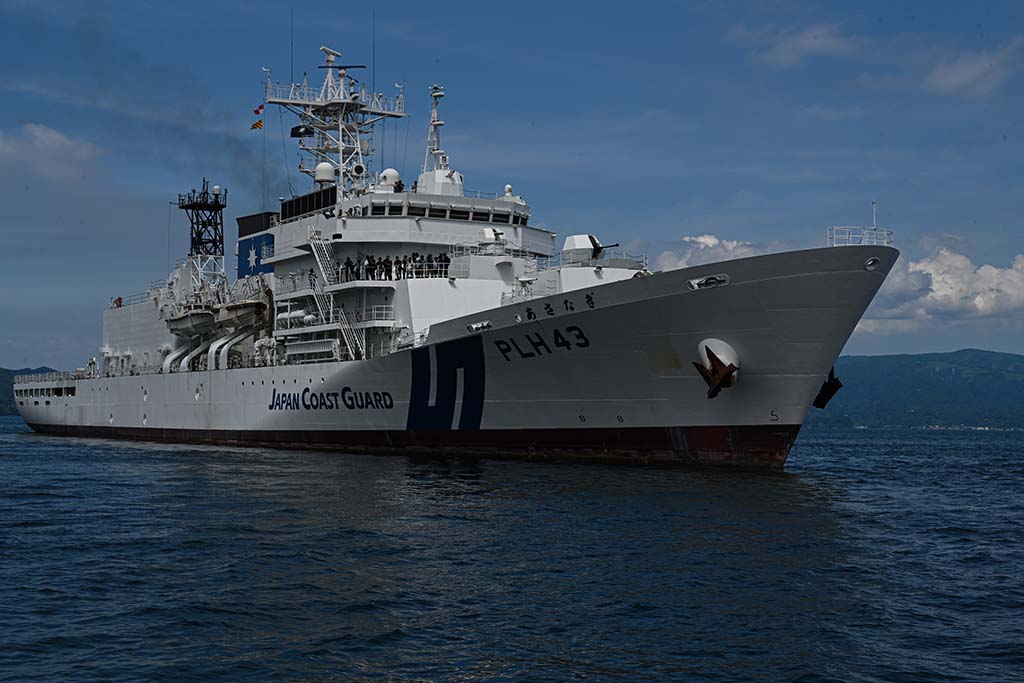
The Japan, Philippine and United States coast guards conduct a search and rescue exercise near Kagoshima, Japan, in June 2025. PETTY OFFICER 2ND CLASS KATE KILROY/U.S. COAST GUARD
Recent deployments underscore the breadth and depth of the MCT program. In Vietnam in late 2025, JCG teams provided training in inspection and arrest techniques tailored to drug trafficking cases. The missions, conducted under the Japan International Cooperation Agency, reflect Tokyo’s commitment to capacity building under its Free and Open Indo-Pacific (FOIP) strategy.
Japan also has partnered with Malaysia to host Third Country Training Programs, supporting the Malaysian Maritime Enforcement Agency in training regional counterparts. MCTs offer training-of-trainers sessions to enhance technical skills and teaching capacity. Sessions include discussion of operational challenges, reinforcing institutional learning through peer engagement, the JCG reported in December 2025.
In Palau, MCTs conduct search and rescue training as well as workshops on international maritime law, including the United Nations Convention on the Law of the Sea. The annual exchanges bolster the Pacific island nation’s ability to protect its expansive maritime zone — a capability further supported by Japan’s earlier donation of a patrol vessel.
Officers from partner nations also receive extended training in Japan. “The utility is not just about the technical skills … it is the human network,” Bosack said. “This network is what enables a program to have enduring success because technologies, challenges and threats will evolve.”
As an archipelagic nation dependent on sea lanes, Japan considers regional maritime stability a national imperative, including investing in civilian law enforcement capacity.
“For Japan, this capacity-building is important for three reasons,” Bosack said. “It’s part of a whole-of-government approach to FOIP; it allows Japan to lead in a realm distinct from the military cooperation efforts of partners like the U.S. and Australia; and it helps keep the JCG sharp.”
The comprehensive approach mirrors Tokyo’s broader assistance portfolio. From donating patrol vessels to Indonesia, the Maldives and the Philippines to coordinating multilateral exercises with the U.S. Coast Guard, Japan consistently combines equipment support with training and institutional development. In the Philippines, for example, JCG-led sessions used Japanese-donated vessels to train local officers in towing, firefighting and port security.
Japan’s MCT initiative not only strengthens regional capacity, it also reinforces a shared commitment to maritime governance based on international norms. “Anybody following the rules ought to have no cause for concern,” Bosack said.
Felix Kim is a FORUM contributor reporting from Seoul, South Korea.
