


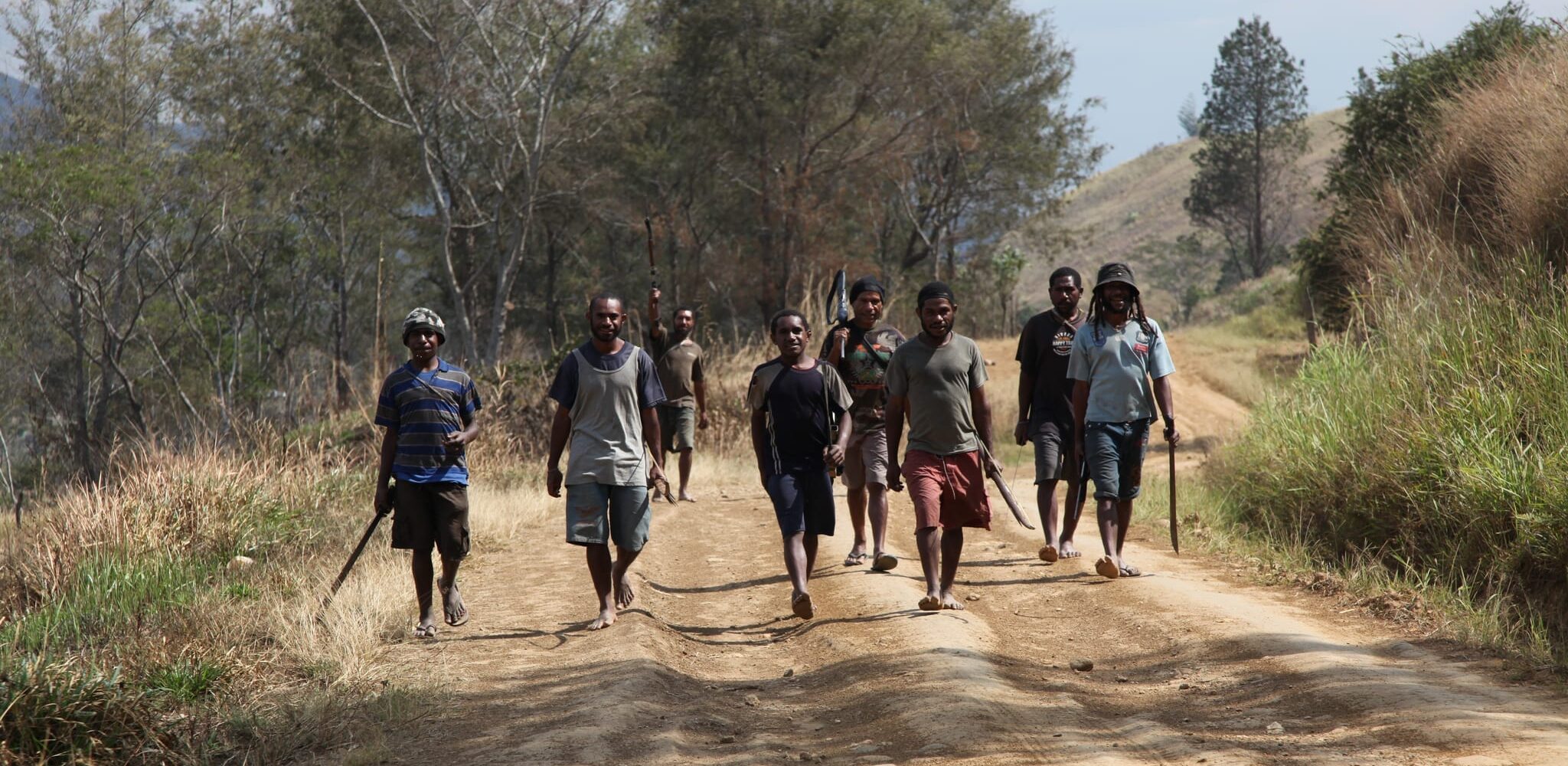
In February, Papua New Guinea launched a national gun amnesty and buyback scheme. An estimated 100,000 illegal firearms are circulating across the country. Tribal violence has killed hundreds in Enga province alone in the last three years. Schools have been destroyed; children and families displaced into highlands with no access to services. National elections next year are only expected to make things worse.
PNG is Australia’s nearest neighbour, a country with which we share a complex history and deep obligations.
It is not an outlier when it comes to fragile peace, and violence. Across the world, armed conflicts are at their highest level since the mid-twentieth century, according to the 2025 Global Peace Index of the Institute for Economics and Peace (IEP). Climate change is accelerating resource competition and youth populations are growing fastest in the places where governance is weakest. In the Indo-Pacific, most of this violence is not between states, but within communities. It is localised, driven by inequality, exclusion, unresolved grievances and a lack of opportunity.
Instability brings with it risks including irregular flows of people across borders, the spread of conflict economies and associated organised crime, avenues for unwanted external political engagement, and the potential for escalation and radicalisation that can spread beyond borders.
One year ago, the United States significantly scaled back its international development footprint, with major reductions across its aid programs. The UK, Germany and Canada have followed with cuts of their own. Global development assistance fell by more than 23% in 2025 — the steepest drop on record, according to the OECD. But this is not just a humanitarian story; it is a strategic one. For Australia, it is urgent.
The International Monetary Fund has found that every dollar invested in conflict prevention saves between $26 and $103 in conflict-related costs. That is not in accounted-for goodwill, but in hard economic terms: avoided humanitarian spending for recovery, preserved economic output and reduced displacement. Prevention is not soft policy; it is fiscal common sense.
What is often missed in policy discussions is how quickly localised tensions can escalate to violence when small shocks compound, such as a failed harvest, a disputed election result or the return of displaced populations. In many of the communities where development actors are present, the difference between stability and violence is not the absence of risk, but the presence of trusted local mechanisms to manage it.
But prevention only works when development investments are deliberately designed to address the grievances and power imbalances that drive people toward violence. And the evidence increasingly shows that the most effective prevention happens when women and young people do not just participate, but lead.
In PNG’s Southern Highlands, long-running clan disputes were fuelled by competition over land and weak systems for resolving grievances. Development programs, delivered through long-term partnerships with local communities, supported negotiation training, peace forums and small grants for communities to repair shared infrastructure — water systems, market shelters, footbridges. These shared assets gave rival clans practical reasons to cooperate.
In Mindanao, in the southern Philippines, communities recovering from displacement and political violence face ongoing risks of recruitment and inter-group tension. Through schools and youth councils, peacebuilding has been integrated with child protection and livelihoods support. More than 1,100 children and young people across 34 schools have taken part in peace initiatives. Former female combatants were trained as community counsellors, as leaders in sustaining peace. Local governments are now engaged to continue this work.
None of these programs required large budgets. They did require sustained presence, trusted local relationships and a deliberate focus on the conditions that keep communities stable. And critically, they can be measured. Prevention outcomes — early warning indicators, social cohesion, localised violence — are being tracked with the same rigour we apply to any other development investment, through partnerships like that between World Vision and IEP.
Australia now sits at the centre of an increasingly contested strategic environment. Great power competition is intensifying across the Indo-Pacific. Climate change is accelerating pressures across communities, destroying livelihoods, driving displacement and straining already fragile institutions. We know that where governance is weak and grievances go unresolved, instability doesn’t stay local for long. It creates openings for external influence and internal desperation, and undermines the regional order Australia depends on.
As a middle power with deep relationships across the region, Australia is uniquely placed to lead on prevention, but not through military posture alone. Our international development program can prevent conflict through sustained, locally trusted work that addresses the root causes of instability before ignition. Australia has strong foundations, but lacks a clear public framework for how diplomacy, defence and development work together to prevent violence before it escalates. The recent OECD peer review of Australia’s aid program identified this gap.
There is a practical opportunity for Australia to embed conflict prevention more systematically across its development program. This could be advanced through three steps:
- explicitly integrating conflict prevention objectives into country strategies in high-risk contexts
- investing in locally led programs that strengthen social cohesion, particularly those engaging women and young people
- adopting clearer indicators to measure prevention outcomes, including changes in localised violence, trust and grievance resolution.
Locally embedded organisations with sustained community relationships are often best placed to deliver this work.
Australia already invests in this work — through its development program, its Pacific partnerships and through organisations operating with sustained community presence across the region. With the US reorienting its engagement in the Indo-Pacific, the task now is to scale and systematise it as a deliberate national security investment.
Prevention is cheaper than response. Stability is cheaper than crisis. The question for Australia is not whether conflict prevention works, but whether we are willing to invest in it deliberately, measure it properly and treat it as core to our national interest.
