


As a stream of bubbles rose up to the surface, Palau’s president, Surangel Whipps Jr., delivered his remarks. This was no ordinary press conference; this was the world’s first live, underwater interview, transmitted through Li-Fi light technology to a boat at the surface.
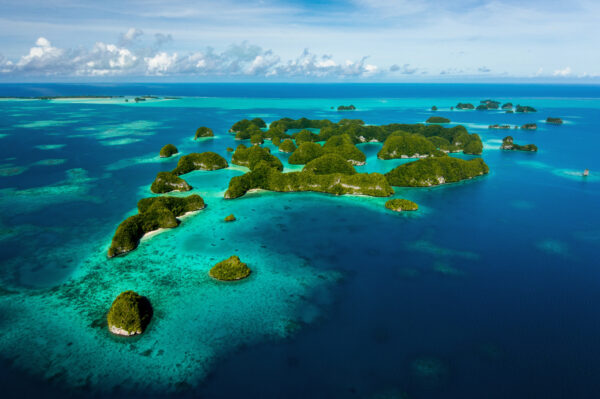
Tourists continue to explore the island-archipelago’s lush landscape and history. But underwater, Palau’s pristine coral reef systems are being strained by warming waters, wreaking havoc on once-vibrant ecosystems. This contrast highlights Palau’s current dilemma.
Below water, warming oceans eat away at the very coral reefs that sustain Palau’s identity and economy; above water, policy decisions in Washington and elsewhere are moving at a glacial pace that is disconnected from the urgency needed to address the challenge.
Palau must now navigate between two rocky realities: one that is ecological and existential, the other a geopolitical minefield with little room for error.
Whipps’ interview was reminiscent of a growing trend in “Ocean Diplomacy.” Other examples include an underwater cabinet meeting in the Maldives and a U.N. speech delivered by Tuvalu’s foreign minister while half-submerged in seawater. What set Whipps’ apart from prior maritime-related media events was the timing. The interview came at a time when the 1.5-degree Celsius warming threshold, agreed to under the 2015 Paris Climate Agreement, is now widely considered beyond reach. Added to the moment is the start of a second Trump administration in the United States, Palau’s most crucial economic and security partner, which has outright dismissed most science about the climate crisis that threatens Palau’s existence.
To survive, Palau must navigate the changing currents above its waters: geopolitical, economic, and diplomatic. The United States remains Palau’s most important partner, providing defense guarantees, federal assistance programs, and a financial lifeline. Whipps has been vocal in his support for Washington, even more so in an era of Trump 2.0, stating earlier this year that “a strong United States… is good for Palau and good for the planet.” In a carefully calibrated approach, he invited U.S. President Donald Trump to visit Palau, offering to take him snorkeling to “see the impacts” of coral bleaching firsthand.
Such enthusiasm for the current administration in Washington sits uneasily alongside a difficult truth: the same U.S. administration Palau relies on is simultaneously dismantling climate regulations and retreating from international commitments to safeguard against future environmental destruction. Now a small democracy in the Asia-Pacific region is trying to be heard above the riptides of climate denial from its most powerful ally, while forced to balance existential vulnerability with strategic dependency.
A Country Built from the Ocean Up
Palau’s leaders often state that sustainable ocean management is in their DNA. For generations, Palauans have relied on taro patches, reef fish, and surrounding mangroves for food and cultural identity. Demok, a taro-leaf soup, often mixed with coconut and crab, remains a national dish and illustrates Palau’s connection to both land and sea.
Today, however, rising sea levels and ever-changing rainfall patterns are destabilizing taro farming, undermining a staple agriculture that Palauans have relied on for hundreds of years. Saltwater intrusion is already reducing yields and forcing farmers to experiment with salt-tolerant varieties, as well as new water-control mechanisms.
Underwater, the situation is no better: coral bleaching has devastated once-thriving reef systems, including areas that feed into Jellyfish Lake, a UNESCO World Heritage site and one of Palau’s main tourist attractions. The lake has increasingly faced periodic closures to allow the ecosystems to recover. The ecological losses are also taking an economic toll.
Tourism on the islands accounts for roughly 40-50 percent of Palau’s GDP. It’s the single largest sector and the main source of private-sector jobs in the country. When the pandemic hit in 2020 and international travel cratered, Palau’s GDP fell by nearly one-fifth, an economic shock that highlighted just how vulnerable the country is to external market disruptions. Tourist numbers have since slowly recovered, with 2024 arrivals climbing to their near pre-COVID peaks.
Yet, Palau continues to live with an uneasy truth: one severe coral bleaching season could very well wipe out the economic livelihoods of most of the population, almost overnight.
The coral reef system is the backbone of Palau’s economy, and the system is dying.
Palau’s President Surangel S. Whipps, Jr., spoke directly from the ocean floor in the world’s first underwater press conference with a head of state, Oct. 5, 2025. He was accompanied by environmental activist and swimmer “Mermaid” Merle Liivand. Photo by the Office of the President, Republic of Palau.
The U.S. Compact: A Lifeline or Leverage?
While tourism remains a significant, albeit precarious, pillar of Palau’s economy; U.S. government assistance is viewed as another – perhaps more stable – mainstay of economic support.
Under the amended Compact of Free Association (COFA), which was renewed in 2023, Washington will provide $890 million over 20 years to the country, around $44.5 million annually. COFA also includes additional access to federal programs and guaranteed defense support to the island nation. The previous compact, in contrast, delivered about $700 million over 15 years.
U.S. funding plays a pivotal role in Palau’s economy, paying teachers, funding government services, building basic infrastructure, and underwriting Palau’s fiscal integrity. As one anonymous international development official on the island put it starkly, “without the U.S. Compact support, the system wouldn’t hold.”
COFA, however, comes as a political double-edged sword for Palau. U.S. policymakers view Palau as essential to maintaining a presence in the Indo-Pacific region, alongside Guam and the Marshall Islands. China’s growing economic and military footprint in the region has heightened U.S. calculus and engagement in the Pacific.
Palau is also one of only 12 nations that still formally recognize Taiwan (the Republic of China), even as its hotels and restaurants increasingly depend on tourists from mainland China. This poses another delicate balance Palau must navigate in an era defined by ever-growing China-U.S. rivalry.
This year’s debate over accepting U.S. deportees as laborers illustrated this bind. Whipps floated the idea as an ad-hoc solution to fill workforce gaps. Meanwhile, U.S. Congressional leaders and traditional chiefs on the islands rejected the proposal not once but twice, warning Palau would risk becoming a “dumping ground” for U.S. deportees.
The proposal, along with an expanded U.S. military base in the country, has sparked public unease about infrastructure capacity and identity, forcing Palauans to grapple with the notion of their true sovereignty.
A Diplomatic Story Written in the Tides
The ecological and security contradictions have played out in a similar way: Whipps praises the ongoing partnership with the United States, yet climate policy under Trump 2.0 continues to undermine environmental protections, which have made living conditions in Palau materially worse.
Palau has long punched above its weight in environmental leadership. Former President Tommy Remengesau championed marine protection and helped to establish Palau’s National Marine Sanctuary, one of the world’s largest “no-take” zones, within its 200-nautical-mile Exclusive Economic Zone (EEZ).
Yet today, speaking out too forcefully on climate issues would risk jeopardizing aid from the current U.S. administration, as Trump has repeatedly derided climate change as a “hoax.” On the other hand, to stay silent amid the ecological and existential threats would risk literal and figurative submergence.
Another international development staffer interviewed, who also requested anonymity, put it plainly: “Speaking openly is risky here. Even policy criticism on [social media] can cost people jobs. Climate issues touch land, ocean, identity; everything is political. People know the stakes, but they navigate them quietly.”
The official also mentioned recent environmental concerns over the expanded U.S. military base on the islands, which has disregarded environmental and land-use assessments.
The Marshall Islands offer a neighboring reminder of what long-term security reliance on the United States can look like. U.S. nuclear testing has left contamination disputes and unresolved compensation claims that shape the country’s politics today.
These cases underscore a sobering reality: nations that become reliant on U.S. defense support also carry the weight of environmental hardships that come with U.S. security guarantees. As climate threats escalate, that history sits just below the surface, shaping how Palau navigates the politics of survival.
What Comes Next?
The political tightrope between climate change and more traditional security issues is not unique to Palau.
The Marshall Islands continues to negotiate nuclear compensation and climate migration planning with the United States. Tuvalu and Kiribati have both openly discussed buying land in New Zealand and Australia for future food security and planned migration, amid climate threats and rising sea-levels. In both cases, the perceived quid-pro-quo are new security partnerships with Western partners – and not China.
Across Small Island Developing States (SIDS), the question is no longer if climate change will reshape sovereignty, but how fast it will happen.
With the conclusion of COP30 in Belem, Brazil last month, and new models suggesting the 1.5 degree C threshold is effectively lost, Palau stands at a pivotal moment for its future. Adaptation costs are rising, saltwater intrusions are destroying crops, and coral reefs are bleaching faster than they can recover. And the partner Palau depends on most has deprioritized climate issue entirely.
In Ngerulmud, Palau’s capital, leaders speak privately about what “Plan B” might look like: alternative tourism models, climate-resilient agriculture, stronger regional integration and alliances, loss-and-damage financing embedded into future COFA renewals, and potential digital and AI-connectivity hubs across undersea cables.
None of these policies, however, addresses the underlying reality that the country faces: they cannot stop the ocean from warming.
Whipps’ offer to bring Trump to Palau to witness coral loss up close, rather than in a briefing binder, reflects a diplomatic bet. If climate arguments won’t resonate in Washington, maybe seeing the impacts in the ocean will.
For other U.S. partners balancing security ties with climate risk, Palau offers a test case in climate persuasion, when the traditional policy channels continue to be shuttered. Whether it yields a shift in U.S. posture remains to be seen, but others in the region will watch closely to glean lessons.
For now, Palau remains where Whipps delivered that underwater message, suspended between resilience and risk. If Washington is seeking a reliable partner in the Pacific, Palau will be the proving ground: U.S. foreign policy in the Asia-Pacific region cannot succeed if the very islands anchoring it are left to drown.
